Showing posts with label island fox update. Show all posts

Tuesday, June 01, 2021

2021 Island Fox Status Update

All island fox populations are healthy and stable, but biosecurity and the potential of deepening drought raises concerns.


That is the update from the Island Fox Conservation Working Group meeting held May 18, 2021, which reports on the status of island foxes across the islands. The following information is taken from FIF notes taken at the meeting. Population numbers reported here are official estimates from each land manager as calculated from the 2020 counting period. (How are island foxes counted)

Overview: COVID-19 restrictions impacted human travel to the islands, but all islands were able to implement protocols to keep biologists and island foxes safe. Annual counting was delayed on some islands and research was halted temporarily, but all efforts were able to resume.

Following a year of normal rainfall in 2019, 2020's lower rainfall levels resulted in island fox populations on San Miguel, Santa Cruz, and Santa Catalina Islands adjusting downward within expected normal levels. Reduced resources, resulted in fewer pups being born, but adult survivorship remained high and the estimated number of foxes per square kilometer, or fox density, remained high (Miguel 7.4 foxes per km squared, Cruz 9.4, and Catalina 9.3). 

The major threats to island foxes in 2021 are:

  • biosecurity: the threat of introduced viruses, disease, or nonnative animal species
  • climate change impacts: increasing regional temperatures, decreasing rainfall, and prolonged drought, which reduces food resources, increases wildfire threats, and promotes parasites
  • parasites: ticks, fleas, tick-borne diseases and intestinal parasites on some islands

How is Friends of the Island Fox helping Island Foxes? -video update

Greatest Concern

Santa Catalina Island foxes continue to maintain a stable population and fox density is high. However, an outbreak of canine distemper virus is currently impacting wild raccoons on the adjacent mainland. In 2020, a raccoon roamed Catalina's interior for several weeks until it was caught. The Catalina Island Conservancy reminded everyone that if distemper arrives on the island again, the high fox density could facilitate the rapid transmission of this fatal virus. FIF is currently raising funding to support the vaccination of 300–350 island foxes on Catalina Island. This is vital to protecting a core population and reducing opportunities for the virus to spread.

 FIF help support testing for disease antibodies in island foxes in 2020. This effort revealed an increasing prevalence of Adenovirus and Coronavirus on Catalina, fortunately neither virus appears to be causing mortalities. The increase, however, reminded everyone of how canine distemper virus would also spread if foxes were not vaccinated.

Tick below island fox eye
Though no tick-borne disease has yet been found among Catalina Island foxes, 48% have evidence of ticks and fleas. Studying tick-borne illness continues to be important for foxes and people. 

Interactions with people are greatest on Catalina and 75% of island fox deaths on this island were related to people–car strikes, attacks by pet dogs, etc. If drought conditions persist, parasites are expected to increase and foxes may be more attracted to human-inhabited areas.


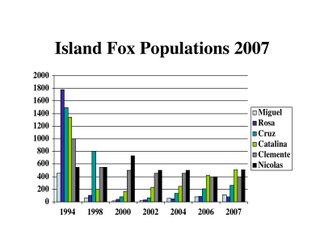
San Miguel Island foxes have returned to stability, but they are a naturally small population. Renewed drought could cause declines as it did from 2015–2018. Research continues to search for the vector species that is being consumed by island foxes and leads to fatalities from an intestinal parasite. Channel Islands National Park continues to watch this population closely. (In the graph below the Green line shows even years, the population estimate in 2019 was 453.)

Stable

The two other smaller islands San Nicolas and San Clemente remain stable. In fact, San Clemente experienced a localized rain event that occurred at the perfect time in spring 2020. Plant life and deermice thrived and the island fox population boomed (see Blue line in graph below). Human impacts–car strike, entrapment in man-made structures, toxic waste, and improperly deployed rodenticide remain the greatest threat to these island foxes.


Santa Cruz Island foxes remain close to carrying capacity for their habitat and naturally adjusted downward in a lower rain year. Adult foxes had a 93.1% probablity of surviving in 2020. Study of tick-borne disease continues. Biosecurity is a concern for this second most visited island. The Nature Conservancy is analyzing boater activity around the island and determining the most critical areas to deploy biosecurity cameras to watch for nonnative species making their way onto the island. This may be important technology looking forward.


Santa Rosa Island foxes
are believed to have increased in 2020 and have yet to reach a carrying capacity plateau. (Pink line in graph above.) The estimated population now exceeds all other islands and the density is estimated at 11.3 foxes per km squared. The high number of foxes on this island may increase survival challenges for island foxes as drought impacts heighten. Another thought is that prior range-size data may no longer accurately represent this island. The last time data on range size was studied on Santa Rosa was 2009–10, when fox density was much lower. Friends of the Island Fox would like to support a GPS/telemetry collar investigation of island fox range size on Santa Rosa Island to update the understanding of range size in a dense population. This data is vital to accurate population estimates and understanding of how disease might move through this population.

*Note graphs show population estimates from even years. Population graphs with data from all years show greater fluctuation. 2019 was a record high population year for Santa Cruz and Santa Catalina Islands, these two populations adjusted downward in 2020. 

Researchers also gave updates on island fox diet and microbiome investigations. FIF will report on this in the coming weeks.


Friday, August 02, 2019

2019 Island Fox Status Update

In 2018 most island fox populations were stable, but not without risk factors. 


As expected, high temperatures and below average rainfall in 2018 contributed to lower pup numbers and reduced adult survivorship across all islands. As first documented on Catalina Island, island fox reproduction is linked to annual rainfall. Fortunately, normal rainfall levels in 2019 should benefit all island fox populations.

In 2019 Channel Island foxes face four major threats:
  • climate change: increasing regional temperatures and decreasing annual rainfall, which reduce food resources, increase wildfire threat, and promote parasite numbers
  • biosecurity: the introduction of non-native plants, animals, and diseases
  • parasites: rising tick numbers and tick-borne diseases; increased intestinal parasites on some islands
  • reduction of management funding
The following update is drawn from FIF notes taken at the 2019 Island Fox Conservation Working Group meeting. Population numbers reported here are the official estimates from each island manager, as calculated from the fall 2018 count and reported May 21, 2019. Download the detailed 2019 Island Fox Status Update


Greatest Concern 
San Miguel Island foxes robustly recovered from 15 individuals in 2000 to over 500 by 2010 (lime-green line on graph below). As a smaller island, it will always have a smaller fox population. In 2015, however, following several years of drought, the population began declining. As of fall 2018, the population has dropped to an estimated 171 individuals (a decline of over 70%). This decline may involve several interconnected threats: climate change, biosecurity and parasites. Details regarding San Miguel will be posted in coming days.


Improved
San Nicolas Island foxes declined by 59% to 260 individuals during consecutive years of drought from 2012–2015
(pink line on graph above). The US Navy initiated native plant restoration projects in conjunction with Channel Islands Restoration. As these plants, like prickly pear cactus, mature they are providing food and habitat for island foxes and prey species. The fox population has increased to a more stable number–estimated 400 individuals. 


Stable
Santa Rosa Island foxes may have reached capacity for the island (pink line on "larger islands" graph above). Native vegetation is recovering and increasing resource options for foxes during periods of drought. No island foxes have been lost to golden eagles on this island or San Miguel since 2010. Parasites, including tick-borne disease, are a growing concern on Santa Rosa. FIF has refurbished 7 radio collars, and funded dietary research and health testing measures in 2019.


Santa Cruz Island foxes have reached capacity for their habitat. As a result the population decreased naturally during 2018 (green line on "larger islands" graph above). Parasites, especially tick-borne Lyme disease, are an increasing concern. Because the Cruz population has been stable since 2014, there is pressure to reduce funds for monitoring. This poses a potential threat because this population receives elevated contact from the outside world via island visitors. FIF has refurbished 20 radio collars for monitoring in 2019.


Santa Catalina Island foxes have also reached capacity for their habitat. In reaction to decreased rainfall, this population also declined naturally in 2018
(red line on "larger islands" graph above). Parasites, especially tick-borne Lyme disease, and biosecurity are an increasing concern for this population. Lyme disease and canine herpes virus were both introduced via human visitors and their pets. Monitoring of disease exposure is vital to this populations continued health. FIF has funded 5 new radio collars and health testing measures in 2019.

San Clemente Island foxes live on the most southern Channel Island
(blue line on "smaller islands" graph above). In 2018, they were the first population to see deaths directly attributed to high temperatures. Reduced rainfall stressed the population and eight individual island foxes are known to have perished in the heatwave between June and July of 2018. Climate change is impacting this island fox most directly. 

Download the detailed 2019 Island Fox Status Update

Friday, July 20, 2018

2018 Channel Island Fox Update

2017 was a successful year for island fox pups!

In May, the Island Fox Conservation Working Group gathered to report on the status of island foxes across the Channel Islands. The population numbers reported here reflect the annual counting effort from late summer/fall 2017. Land managers are currently in the field counting island foxes and providing health evaluations.

For most islands, the spring rain in 2017 resulted in greater pup survival and higher population numbers. The larger islands, Santa Rosa, Santa Cruz, and Santa Catalina, all documented population highs. The larger islands have greater plant diversity and therefore a greater variety of food resources for island foxes.

Along with these higher population densities (more foxes per kilometer) come increased concern for problems brought to the islands from the outside world: introduced disease and introduced parasites carrying disease.

blood taken during health exams is checked for disease
While the four island fox subspecies that were close to extinction in 2000 have all recovered, higher density means disease can spread more rapidly through a population. On Catalina, serology testing in 2015-2017 revealed canine Adenovirus (CAV-1) marching across Catalina within months. This virus causes "kennel cough" and canine hepatitis. Fortunately, there have been no identified island fox fatalities from the disease, but it demonstrates the fragility of these isolated populations.


2017 - Year of the Tick

Across the islands ectoparasites, parasites that live on the outside of the fox's body, have been increasing in drought years. Some islands have had more problems with fleas and lice, while others have seen increases in ticks. This past year, two tick-borne diseases were identified for the first time on Channel Islands; Lyme disease (Borrelia burgdorferi) was found on both Catalina and Santa Cruz Islands and a related disease, relapsing fever (Borrelia miyamotoi) was identified on Santa Rosa Island. Both diseases are known to impact dogs and humans. Understanding the extent of these tick-borne diseases is a priority. Ticks are being collected from island foxes and pathology will need to be run on tick specimens to determine if they carry these or other viruses. What is the extent of these diseases in the tick population? How has island wildlife been impacted? Pathology runs $15 - $50 per tick depending on the necessary tests. 

Friends of the Island Fox is committed to helping land managers with this new cost. Understanding the disease threat in the tick population is vital for island fox survival and human health. Parasite testing and serology have become a new focus in 2018.

Island Fox Update 2018 pdf provides a detailed island-by-island status report for island foxes. In summary:

The smaller islands face more immediate challenges and population volatility.
  • San Miguel Island ~ 260 foxes (low of 15 in the year 2000) - The population has recovered from extinction threat and is trying to stabilize. Concerns: Drought impact on food resources and an increase in life-threatening parasites. (see Island Fox Update 2018 above) Research is needed to understand how a new parasite is accessing the fox's diet.
  • San Clemente Island ~ 770 foxes - This Navy island has a robust population, but drought has impacted food resources and the fox population has adjusted downward. Concerns: Fatalities caused by cars have increased dramatically in the past year, (for more see Island Fox Update 2018 above)
  •  San Nicolas Island ~ 416 foxes (low of ~250 in the year 2015) - The dramatic decline on this Navy island, which began with the drought in 2013, seems to be stabilizing. More pups survived in 2017 and there were fewer emaciated individuals. Efforts to re-establish native vegetation may be providing more direct and indirect food for island foxes (for more see Island Fox Update 2018 above). Concerns: Parasites may have added to poor health in some individuals. A return to drought conditions could further challenge this island.
The larger islands have greater biodiversity of plant and prey species to support island foxes and enable island foxes to adapt to challenges, like changing climate. This is an important conservation lesson: habitats with reduced natural biodiversity are less likely to offer survival options when challenged by negative pressures. Foxes across the larger islands did very well in 2017 (see graph at top of story).

  • Santa Rosa Island ~ 1,850 foxes (low of 15 in the year 2000) - The population has recovered from extinction threat and continues to thrive. Concerns: Tick-borne disease and an unusual fatal parasite, Leptospira, have been introduced to this island (see Island Fox Update 2018 above). Research is needed to quantify the threat to island foxes and people. 
  • Santa Cruz Island ~ 3,150 foxes (low of 80 in the year 2000) - In 2017, Cruz was home to the largest known population of island foxes ever recorded. Concerns: Tick-borne Lyme disease was introduced to this island. The introduction of other diseases is a major concern (see Island Fox Update 2018 above). 
  • Santa Catalina Island ~ 2,047 foxes (low of 103 in the year 2000) - In 2017, Catalina reached it's highest recorded island fox population. Fox saver bins and road signs are reducing island fox deaths from car strikes. Concerns: Tick-borne Lyme disease was introduced to this island and the threat from human impacts (introduced disease, cars, and aggression from pets and feral animals) is greatest on this island (see Island Fox Update 2018 above). Successful reunion of an island fox pup and its mother.  
2017 was a successful year for island foxes, but all land managers agree: Lower rainfall in 2018 may reduce resources leaving island foxes with less support for this year's pups. Even the larger islands may have reached or be reaching carrying capacity - the greatest number of individuals that can be sustained in a habitat. Population numbers are not expected to increase in 2018.

Friends of the Island Fox continues to support important conservation efforts for island foxes: radio-monitoring collars, vaccinations against canine distemper and rabies, ID microchips, blood testing for disease (serology), and items that reduce human impacts "Fox-saver" bins and road signs.

Tick-borne disease is a new and potentially long-term threat to island fox survival. The sooner the threat can be understood, the better the outcome will be for island foxes and people.

Wednesday, June 13, 2012

Channel Island Foxes Reaching Recovery!

courtesy of Anita Machlis
Twelve years ago, four subspecies of Channel Island foxes almost went extinct. Today in 2012, all populations are stable or increasing. The three populations of island foxes on San Miguel, Santa Cruz and Santa Catalina Islands have reached or are approaching the historic numbers documented before introduced disease and predation by golden eagles caused catastrophic declines.

Yesterday, June 12, 2012, the biologists, field researchers, scientists, veterinarians, government agencies and conservation organizations that make up the Integrated Island Fox Recovery Team met to report on each island fox population, compare findings and discuss actions to be taken in the coming year.

It was a day of good news:

  • no island foxes killed by golden eagles since January of 2011
  • reduced numbers of island foxes hit by cars
  • increased numbers of pups born in 2011
  • no raccoons accidentally transported to Santa Catalina Island so far in 2012
  • introduced mule deer and elk have been removed from Santa Rosa Island

And changing concerns:

  • to protect island foxes from the canine distemper virus, vaccinations must be given annually
  • increasing island fox populations mean more interactions between wild island foxes and humans and/or their pets
  • decreasing funds for monitoring efforts
  • need for greater understanding of naturally occurring diseases and parasites
  • need for greater understanding of natural island fox diet and impacts from interactions with humans
It was exciting to see the growing community of scientists interested in researching island foxes and the Channel Island ecosystems. There were representatives from:
  • University of California, Davis and Los Angeles
  • Smithsonian
  • Cal Poly, San Luis Obispo
  • Colorado State University
  • University of Wyoming

In twelve years, the San Miguel Island fox has gone from a low of 15 individuals to a thriving 581. This is an amazing population increase of 3,830%, as reported in “On Time, On Target; How the Endangered Species Act Is Saving America’s Wildlife” compiled by the Center for Biological Diversity.

At the heart of this successful recovery is the Integrated Island Fox Recovery Team and the joint effort of people from Channel Islands National Park, Catalina Island Conservancy, The Nature Conservancy, Institute for Wildlife Studies, the U.S. Navy, CA Dept. of Fish & Game and the U.S. Fish & Wildlife Service, all working together, sharing information and experience. When you add concerned private citizens like you who help support continued monitoring of island foxes by funding radio collars and annual vaccinations, you have one of the most successful efforts to save an endangered species in history.


Check back in the next few weeks for details from annual meeting.

Tuesday, October 07, 2008

Island Fox Information

Friends of the Island Fox announces the launch of our
Educational Resources Library

O
ur goal is to bring the expertise of researchers, land managers and biologists in the field, to the general public. We want you to have access to the most current information available about the island fox and the Channel Island ecosystem.

By clicking on the "Library" button in the navigation bar at the top of the page, you will go directly to our library of resources both written and visual.

Our new list of publications includes:
  • an Island Fox Fact Sheet (written by Catherine Schwemm PhD, co-author of an upcoming book on the island fox)
  • Island Fox Update 2008 (the most current information island-by-island)
  • Summaries of recent research findings on island fox behavior, relationships with eagles, island fox health, management, and the island fox and the Channel Island ecosystem
Dive into the new Library and discover the important news from the scientists:

  • The San Miguel Island fox is making the most successful recovery recorded in a canine species
  • Eagles leave evidence in their nests that proves what they are eating
  • The Santa Catalina Island fox is facing serious health threats
Click on "Library" in the navigation bar at the top of the site.

Friends of the Island Fox is devoted to providing educational resources about the island fox and the Channel Islands ecosystem to the public. Your donations help support this effort and island fox conservation.

To donate click on the Pay Pal button in the upper right panel.

Monday, August 06, 2007

Highlights from the Island Fox Conference 2007

Integrated Island Fox Recovery Team Meeting
June 19-21, 2007

This was the ninth year people concerned with saving the island fox on the Channel Islands have come together to share information and strategies. Some are scientists and biologists working in the field, others represent conservation organizations or government agencies, but everyone has the same goal - assuring the recovery of the four endangered island fox populations and maintaining the health of the two populations on the southern islands.

Reports were provided by each of the land managers or their representatives:
  1. San Miguel and Santa Rosa Islands - Tim Coonan, National Park Service
  2. Santa Cruz Island - Rachel Wolstenholme, The Nature Conservancy
  3. Santa Catalina Island - Julie King, Catalina Island Conservancy
  4. San Clemente Island - Bill Andelt, Department of Fish, Wildlife and Conservation Biology Colorado State University
  5. San Nicolas Island - Grace Smith, U.S. Navy
  6. Alan Varsik, Director of Animal Programs and Conservation at the Santa Barbara Zoo and keeper of the studbook for the captive San Clemente Island fox population in mainland Zoos.
Summary:
Reproduction in the wild has been very successful and endangered island fox populations continue to recover. However, golden eagle attacks reoccurred this spring threatening foxes on Santa Cruz Island. Concerns regarding disease are being raised on Santa Rosa and Santa Catalina. Wild fire appeared as a new threat, while public education became vital in helping to reduce an old threat - vehicular trauma. This past year demonstrated how fragile island fox populations are and how important it is to monitor them for the earliest signs of threats that could be catastrophic.

A Glance at the Numbers
There still is a long way to go to reach normal population numbers, but island foxes are increasing in number on all islands.


HIGHLIGHTS
:

Southern Islands:

San Nicolas Island (~506 foxes in the wild)
Island fox population studies were completed on San Nicolas Island. All foxes handled had blood drawn and were given identification microchips. Some individuals were vaccinated against distemper and rabies viruses. The San Nicolas Island fox subspecies has shown a slight increase in population and has the highest density for any of the islands - 18 individuals per square kilometer in the coastal dune area. The population appears stable and there is no indication of widespread disease.

On a positive note: In previous years as many as 20-25 island foxes lost their lives to vehicular trauma. Education programs and fox-warning signs have dramatically decreased car-related fatalities. In 2007, only 2 known and 1 possible island fox death were the result of car strikes.

San Clemente Island (~450 foxes in the wild; 11 - in captivity in mainland zoos)
The territories of 71 radio-collared foxes were studied. Foxes that stayed away from roads had a greater survival rate than those that traveled along the roads. While education programs and signs have helped reduce fox deaths related to car strikes, studies are being done to see if more foxes are hit in specific areas where drivers have less visibility.

On a positive note: Fox fatalities due to cars have numbered only 6 for the first half of 2007. This is a dramatic drop from the 55 fatalities in 2005 and 35 in 2006. During this research, island foxes were observed eating prickly pear cactus fruit. A food item not previously known to be part of their diet.

In mainland Zoos, there are currently ten male island foxes and one female. Unfortunately, all offspring born in the zoos have been male. An island fox was born at the Santa Barbara Zoo April 2007. For more: see new pup and hear an update on our Fox Talk podcast.

Santa Catalina Island (~509 foxes in the wild, 1 in captivity)
The Santa Catalina population continues to recover from the near-catastrophic decline of 1999-2000 and island fox density has increased to 3.31 per square kilometer (compare that to San Nicolas Island above). New challenges to fox recovery are cancerous tumors of the ear and wild fire. The Catalina Island Conservancy is working with the Institute for Wildlife Studies (IWS) and the University of California at Davis to culture the ear mites that appear linked to cancerous ear tumors. All island foxes caught are being closely examined. It is unknown whether the ear mites are being transferred to foxes from feral cats, are specific to Catalina, are the cause of the cancer, or if inflammation caused by irritation from the mites is uniquely causing cancer in this fox subspecies. Further study is needed to understand the connection between the ear mites and the growing percentage of foxes with cancerous tumors. Currently, 44% of the population is showing signs of this disease. It is a very high percentage and analogous to the facial cancer that is threatening the Tasmanian devil.

One island fox was injured, but no island foxes are known to have perished in the wild fire that affected 10% of the island (4,750 acres). For more on the Catalina Fire. Friends of the Island Fox donated funds for radio collars for 5 foxes in the fire area including the injured female fox that was released back into the wild on July 11, 2007.

On a positive note: Over 87% of the island foxes on Santa Catalina have now been vaccinated for canine distemper. Public education and a “pet policy” for the island’s interior have helped to decrease the number of island foxes being killed by domestic dogs. Ten roadside fox-warning signs and a speed-feedback machine in a high fox-density area have helped reduce fox fatalities due to car strikes to just 5 for the first half of 2007. The City of Avalon has formed an Animal Task Force to actively address the feral cat population. New GPS tracking collars are being tried on 10 foxes in the burn area and 10 outside of the burn area to track day-to-day movement.

Northern Islands:

Santa Cruz Island (~260 foxes in the wild, 33 in captivity)
Fall 2006, 56 Santa Cruz island foxes were released back into the wild. Released foxes were recaptured 1-2 weeks later to check on their health and none needed to be returned to captivity. 73 foxes were radio collared. While the initial island fox numbers were up on Santa Cruz Island, spring 2007 turned out to be a very dangerous time, especially for island foxes born in captivity. After nearly a year without a death due to golden eagle predation, it is believed a single golden eagle killed 21 foxes on Santa Cruz Island in a few weeks. Most of the caught foxes were young adults that had been born in captivity. As of the Fox Conference, biologists on Santa Cruz Island were still searching for the golden eagle, with hopes of catching it and relocating it back to the mainland.

On a positive note: All 5,036 feral pigs on Santa Cruz Island appear to have been removed; there has been no sign of a pig since January 2007. Without the food source provided by the pigs there will be less motivation for the golden eagle to stay on the island. Captive breeding of island foxes will continue on Santa Cruz and more releases are hoped to occur later in the year.

Santa Rosa Island (total ~40 foxes in the wild; 37 in captivity)
Island foxes continue to be released into the wild. There have been no deaths due to golden eagles since spring 2006, but several foxes have died from unusual illnesses and injuries from other foxes. The National Park Service plans to maintain 12 individuals at a breeding facility for several more years, but will be releasing the others.

On a positive note: Foxes in the wild on Santa Rosa have been reproducing at high rates.

San Miguel Island (80 foxes in the wild; 2 in captivity)
From the most endangered population, with only 15 surviving individuals, the island foxes on San Miguel are making a strong recovery. In November 2006, 16 foxes were released back into the wild. Watch one of the fox releases on San Miguel Island. Foxes as young as one year old are becoming parents, resulting in 32 pups being born in the wild in 2006. There have been no fox deaths caused by golden eagles in 16 months.

On a positive note: Because the San Miguel Island foxes are doing so well in the wild, ALL releasable individuals will be returned to the wild. (Two elderly females will be cared for at the breeding facility.) The last captive San Miguel Island fox is scheduled to be released July 31, 2007. This marks a milestone in helping this population recover from near extinction. Stay tuned for our next Fox Talk and report on the release from Tim Coonan.

New Insights:

- In 2006, the greatest survival threat to the island fox was vehicular trauma. 35% of known island fox deaths last year were car related. The efforts to reduce incidents with cars are vitally important.

- Monitoring island foxes in the wild is imperative to maintaining healthy populations and the ability of biologists to respond quickly to fox survival threats, whether those threats are introduced predators or disease. Radio telemetry collars are being placed on as many island foxes as possible. Other monitoring methods were also discussed:
  1. Automated telemetry systems that would sweep the island picking up signal from all foxes on a daily basis and reporting to a single terminal. Man hours would be reduced but hardware cost is unknown.
  2. Noninvasive fecal genotyping was presented by Melissa Gray, a UCLA graduate student. Even in the small San Miguel population, DNA markers can be found that allow individuals to be identified from DNA in their scat. Collecting the scat, recording locations and correlating the DNA can provide information on an individual fox’s movements in a way that is noninvasive to the individual animal.
To read the complete Summary of the “NINTH ANNUAL MEETING ISLAND FOX WORKING GROUP” with access to some of the participants presentations go to http://californiaislands.org/_wsn/page3.html

For more on how YOU CAN HELP THE ISLAND FOX.

Friends of the Island Fox, Inc. strongly supports all of the conservation efforts by the various biologists and organizations working on behalf of the island fox. Our goal is to make the community at large aware of the island fox’s situation and to help all of these positive efforts to Save the Island Fox.

Thursday, May 24, 2007

Friends of the Island Fox Supports Integrated Fox Conference

Saving the endangered island fox requires the efforts of caring and knowledgeable individuals from around the country. The Integrated Fox Conference brings all of these people together once a year.

The third week in June, biologists and scientists will meet with conservation professionals and land managers for each of the Channel Islands to report on the current status of all six subspecies of island fox and to make conservation decisions for the upcoming year.

To support the efforts of the Integrated Fox Conference, this year Friends of the Island Fox is providing a grant to the U. S. National Park Service to help offset the transportation costs of the four veterinarians that provide care to the foxes on the islands and who do veterinary laboratory work during the year. These devoted people help maintain the health of island foxes and move quickly when disease threatens this endangered population.
  • Karl Hill, DVM - Santa Barbara Zoo
  • Karen Blumenshine, DVM - Wildlife Services Associates
  • Winston Vickers, DVM - Institute for Wildlife Studies
  • Linda Munson, DVM-PMI - University of California, Davis
The Integrated Fox Conference is sure to bring to light unexpected successes and new conservation challenges regarding the island fox. FIF will post a summary of the Conference, including an update on the status of island foxes on Catalina Island after the fire.

FIF thanks all of you who have donated toward island fox conservation during the first half of 2007. Your contributions have made this grant possible.

See last year’s
  • “Highlights from the Integrated Fox Conference, June 20-22, 2006” Highlights 2006
  • Mid year population UPDATE