Showing posts sorted by relevance for query pigs. Sort by date Show all posts

Monday, July 24, 2006

Highlights from the Integrated Island Fox Recovery Team Meeting

June 20-22, 2006

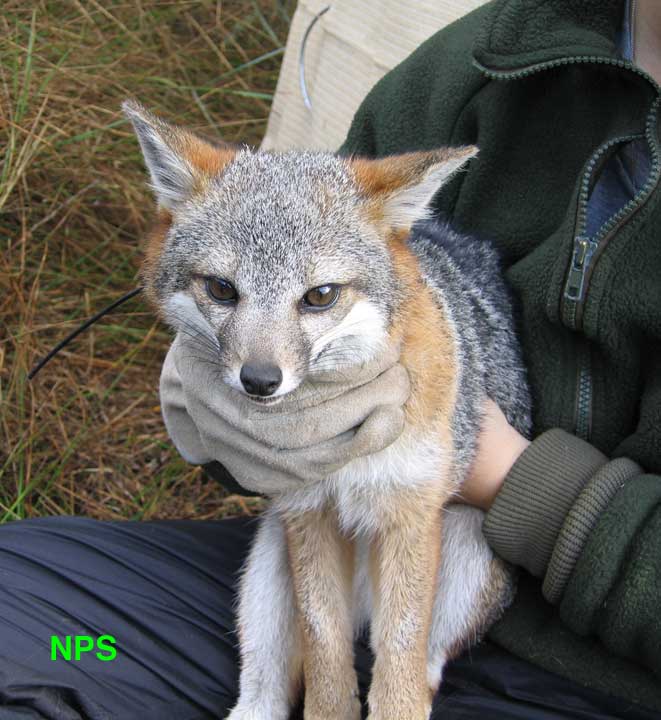
The island fox may be a small animal but it has many friends.
With island foxes living on six of the Channel Islands, a wide range of people and organizations are involved in assuring their recovery from endangered status on the northern islands and maintaining their populations on the southern islands.

Reports on the current status were provided by each of the land managers:
  1. San Miguel and Santa Rosa Islands - Tim Coonan, National Park Service
  2. Santa Cruz Island - Lotus Vermeer, The Nature Conservancy
  3. Santa Catalina Island - Carlos de la Rosa, Catalina Island Conservancy
  4. San Clemente Island - Kelly Brock, U.S. Navy
  5. San Nicolas Island - Grace Smith, U.S. Navy

This has been a good year for the island fox. Populations appear stable or increasing, and with the exception of Santa Catalina Island, there is no evidence of widespread disease.

HIGHLIGHTS:

Northern Islands:
  • San Miguel Island (46 foxes in the wild; 32 in captivity)
  • Santa Rosa Island (~42 foxes in the wild; 42 in captivity)
  • Santa Cruz Island (~324 foxes in the wild, 81 in captivity)
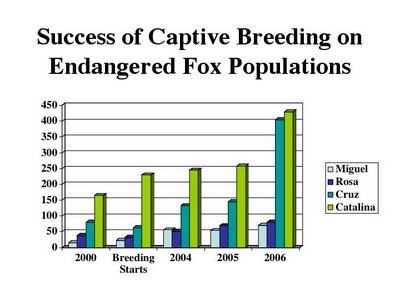
Foxes on the Northern islands are reproducing well in the wild. Most released females had pups this spring, helping to dramatically increase fox numbers on Santa Cruz Island.

Foxes in the captive breeding programs are reproducing less. Hormone and stress level research over the past year was unable to identify any specific reasons for this decline in fertility. The island fox appears to be different from other foxes regarding reproduction. More research is needed to understand how best to manage sustained successful reproduction in captivity.

The last known breeding pair of golden eagles were removed from Santa Cruz Island on 6/21 and 6/22/06. This wily raptor pair has eluded capture for several years, but the two golden eagles were finally caught with net guns released from a low-flying helicopter. The two eagles have been fitted with radio transmitters and will be released in Northern California. Their chick has been taken to San Diego for fostering. A few immature golden eagles may still reside on the northern islands, but this is a huge step forward in making the islands safe (link) for foxes released back into the wild.

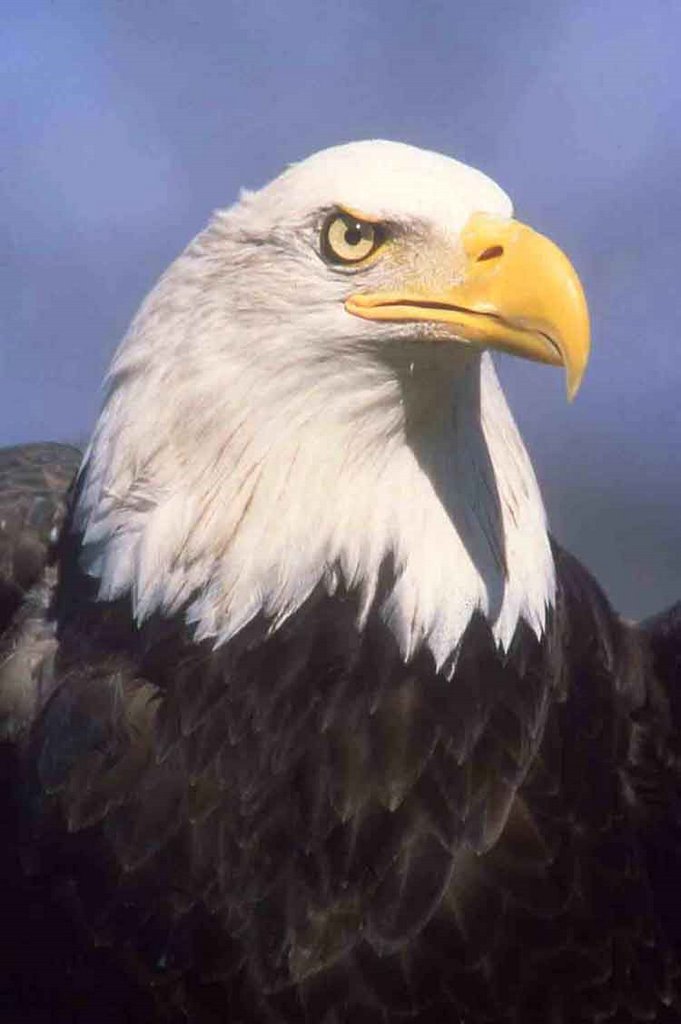
This is the fifth and final year for bald eagle releases on the northern islands. To date ~60 juvenile bald eagles have been released. Two bald eagle chicks were hatched by released birds and are being successfully raised by their first-time parents on Santa Cruz Island. This is a positive step toward the reestablishment of bald eagles on the northern islands. You can observe one of the island eagle families as they occasionaly return to the nest at www.iws.org/nestcam.htm

In order to restore the natural habitat on Santa Cruz Island, feral pigs continue to be removed. To date nearly 5,000 feral pigs have been removed and it is believed only 10 pigs are still loose on the island. This is an important step forward in restoring the entire ecosystem on Santa Cruz Island.

  • Santa Catalina Island (415 foxes in the wild, 5 in captivity)
The island fox population continues to recover from the virus, believed to be canine distemper, that swept through the population in 1999-2000. Over 80% of the foxes on the island have now been vaccinated for the disease.

Ear mites, possibly transmitted from feral domestic cats, are currently causing tumors in the ear canals of 30% of the Catalina island foxes. These tumors appear to gradually become cancerous and 20% of the general population has this form of cancer. The causes and ramifications of this trend are yet unknown, but concern for the situation is growing. The majority of the foxes in captivity on Santa Catalina Island are individuals receiving health care.

Domestic dogs running loose have also been responsible for the death of several foxes. The Catalina Conservancy is trying to educate the public on Catalina Island and a new Pet Policy requiring domestic pets be contained has been implemented for the interior of the island.

Southern Islands:
New studies are proposed to more precisely determine the fox population on San Clemente Island. This will help the Navy monitor fox numbers and needs. The population on San Nicolas Island is regularly monitored and believed to be stable at ~400 foxes. On both islands steps are being taken to reduce fox fatalities from car strikes.


New Insights:
  • Even when it is offered, island foxes do not seem to drink much fresh water. Perhaps they are utilizing fog condensed on plants.
  • Research showed that for foxes kept in captive breeding facilities having 8 or more structures in their pen (boxes, hammocks, etc.) gave them multiple options and reduced stress.
  • Some of the radio-tagged bald eagles released on the islands have returned to the mainland; one traveling as far as Montana.
  • Bald eagles are scavengers. Ammunition used by a hunting facility on Santa Rosa Island has caused lead poisoning in some of the released bald eagles.
  • The primary food sources for golden eagles on the northern islands are mammal species that have been introduced by humans (feral piglets, deer and elk fawns). Removing these introduced species would remove the primary reason golden eagles are attracted to the islands.
Friends of the Island Fox, Inc. strongly supports all of the conservation efforts by the various biologists and organizations working on behalf of the island fox. Our goal is to make the community at large aware of the island fox’s situation and to help all of these positive efforts to Save the Island Fox.

Tuesday, March 19, 2013

Channel Island Foxes and Golden Eagles in 2013


NPS photo of a golden eagle in Denali N.P.
Between February and March of 2013, a threat to island foxes on the northern Channel Islands returned - a golden eagle.

Golden eagles migrate north from Mexico and the lower 48 U.S. states up into Canada and Alaska annually. Sometimes this means they fly over the Channel Islands. Historically, golden eagles have not lived on the Channel Islands for two primary reasons:
  1. Golden eagles are mammal specialists. Their chosen diet consists primarily of mammals about the size of a football. The Channel Islands, prior to European settlement, did not have adequate food resources for this large predator to successfully live and breed.
  2. Bald eagles historically thrived on the Channel Islands because they prey on fish, sea birds and carrion. Similar in size, bald eagles are highly territorial and dissuaded the golden eagles,  from spending extended amounts of time in the island ecosystem.

Why Did Golden Eagles Become a Threat to Island Foxes?

Beginning in 1843*, the islands were transformed into ranches. The surrounding ocean was the perfect fence.  Domestic animals (pigs, sheep, goats, rabbits (on Santa Barbara Island) and even cattle) were introduced and then allowed to go wild or feral. Mule deer and elk were also introduced on Santa Rosa Island for paid hunting trips. The young of these species, plus entrails left behind from hunting, attracted golden eagles to the northern islands.

By the mid 1950s bald eagles on became extinct on the Channel Islands because of DDT in the marine ecosystem. Without the bald eagle to drive it away, the golden eagle took up residence on the northern islands. Between 1994 and 2000, golden eagles nearly ate all of the island foxes on San Miguel, Santa Rosa and Santa Cruz Island. Island fox decline.

Positive Conservation Steps

island foxes during captive breeding, NPS
While the island foxes were protected in captive breeding facilities on the islands (2000-2008) conservation efforts helped restore balance on the islands:
  • ~40 golden eagles were captured and relocated to northern California
  • Bald eagles were reintroduced to Santa Cruz and Santa Catalina Islands. In 2006 they began reproducing naturally. The recovering bald eagle population is helping to stop golden eagles from recolonizing  the islands.
  • Feral pigs, sheep and goats were removed and by 2012 introduced deer and elk were removed from Santa Rosa Island

Golden Eagles in 2013

On February 26, 2013 a group of bird watchers spotted a golden eagle at the Saticoy Spreading Ponds in Ventura. During this same time period, two island foxes on San Miguel Island were preyed upon by a golden eagle and a golden eagle was also seen on Santa Rosa Island.

Each year the threat posed by golden eagles flies over the endangered island foxes. Radio tracking collars are a primary means of alerting biologists that a golden eagle has killed an island fox. If predation continues, biologists can respond by trying to locate and capture the lingering golden eagle. Microchips under the skin of each island fox help biologists know the age and life history of individual foxes that are the victims of predation. Friends of the Island Fox raises funds to provide radio tracking collars and microchips for endangered Channel island foxes.

As the Channel Island fox populations recover on the northern islands, golden eagles pose less of a long-term threat. A normal population of 500 or more island foxes can withstand the loss of a few individuals to natural predation by golden eagles passing by. As the natural balance of the islands is restored with dense native vegetation, the territorial bald eagle in residence and robust island fox populations, the occasional golden eagle migrating by will become less of a threat.

*"Channel Islands National Park Timeline", Channel Islands National Park

Monday, August 06, 2007

Highlights from the Island Fox Conference 2007

Integrated Island Fox Recovery Team Meeting
June 19-21, 2007

This was the ninth year people concerned with saving the island fox on the Channel Islands have come together to share information and strategies. Some are scientists and biologists working in the field, others represent conservation organizations or government agencies, but everyone has the same goal - assuring the recovery of the four endangered island fox populations and maintaining the health of the two populations on the southern islands.

Reports were provided by each of the land managers or their representatives:
  1. San Miguel and Santa Rosa Islands - Tim Coonan, National Park Service
  2. Santa Cruz Island - Rachel Wolstenholme, The Nature Conservancy
  3. Santa Catalina Island - Julie King, Catalina Island Conservancy
  4. San Clemente Island - Bill Andelt, Department of Fish, Wildlife and Conservation Biology Colorado State University
  5. San Nicolas Island - Grace Smith, U.S. Navy
  6. Alan Varsik, Director of Animal Programs and Conservation at the Santa Barbara Zoo and keeper of the studbook for the captive San Clemente Island fox population in mainland Zoos.
Summary:
Reproduction in the wild has been very successful and endangered island fox populations continue to recover. However, golden eagle attacks reoccurred this spring threatening foxes on Santa Cruz Island. Concerns regarding disease are being raised on Santa Rosa and Santa Catalina. Wild fire appeared as a new threat, while public education became vital in helping to reduce an old threat - vehicular trauma. This past year demonstrated how fragile island fox populations are and how important it is to monitor them for the earliest signs of threats that could be catastrophic.

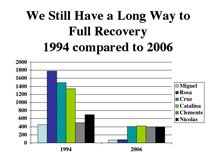
A Glance at the Numbers
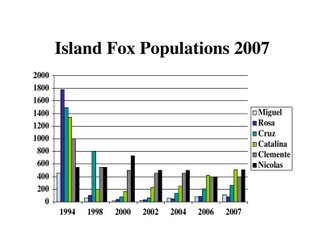
There still is a long way to go to reach normal population numbers, but island foxes are increasing in number on all islands.


HIGHLIGHTS
:

Southern Islands:

San Nicolas Island (~506 foxes in the wild)
Island fox population studies were completed on San Nicolas Island. All foxes handled had blood drawn and were given identification microchips. Some individuals were vaccinated against distemper and rabies viruses. The San Nicolas Island fox subspecies has shown a slight increase in population and has the highest density for any of the islands - 18 individuals per square kilometer in the coastal dune area. The population appears stable and there is no indication of widespread disease.

On a positive note: In previous years as many as 20-25 island foxes lost their lives to vehicular trauma. Education programs and fox-warning signs have dramatically decreased car-related fatalities. In 2007, only 2 known and 1 possible island fox death were the result of car strikes.

San Clemente Island (~450 foxes in the wild; 11 - in captivity in mainland zoos)
The territories of 71 radio-collared foxes were studied. Foxes that stayed away from roads had a greater survival rate than those that traveled along the roads. While education programs and signs have helped reduce fox deaths related to car strikes, studies are being done to see if more foxes are hit in specific areas where drivers have less visibility.

On a positive note: Fox fatalities due to cars have numbered only 6 for the first half of 2007. This is a dramatic drop from the 55 fatalities in 2005 and 35 in 2006. During this research, island foxes were observed eating prickly pear cactus fruit. A food item not previously known to be part of their diet.

In mainland Zoos, there are currently ten male island foxes and one female. Unfortunately, all offspring born in the zoos have been male. An island fox was born at the Santa Barbara Zoo April 2007. For more: see new pup and hear an update on our Fox Talk podcast.

Santa Catalina Island (~509 foxes in the wild, 1 in captivity)
The Santa Catalina population continues to recover from the near-catastrophic decline of 1999-2000 and island fox density has increased to 3.31 per square kilometer (compare that to San Nicolas Island above). New challenges to fox recovery are cancerous tumors of the ear and wild fire. The Catalina Island Conservancy is working with the Institute for Wildlife Studies (IWS) and the University of California at Davis to culture the ear mites that appear linked to cancerous ear tumors. All island foxes caught are being closely examined. It is unknown whether the ear mites are being transferred to foxes from feral cats, are specific to Catalina, are the cause of the cancer, or if inflammation caused by irritation from the mites is uniquely causing cancer in this fox subspecies. Further study is needed to understand the connection between the ear mites and the growing percentage of foxes with cancerous tumors. Currently, 44% of the population is showing signs of this disease. It is a very high percentage and analogous to the facial cancer that is threatening the Tasmanian devil.

One island fox was injured, but no island foxes are known to have perished in the wild fire that affected 10% of the island (4,750 acres). For more on the Catalina Fire. Friends of the Island Fox donated funds for radio collars for 5 foxes in the fire area including the injured female fox that was released back into the wild on July 11, 2007.

On a positive note: Over 87% of the island foxes on Santa Catalina have now been vaccinated for canine distemper. Public education and a “pet policy” for the island’s interior have helped to decrease the number of island foxes being killed by domestic dogs. Ten roadside fox-warning signs and a speed-feedback machine in a high fox-density area have helped reduce fox fatalities due to car strikes to just 5 for the first half of 2007. The City of Avalon has formed an Animal Task Force to actively address the feral cat population. New GPS tracking collars are being tried on 10 foxes in the burn area and 10 outside of the burn area to track day-to-day movement.

Northern Islands:

Santa Cruz Island (~260 foxes in the wild, 33 in captivity)
Fall 2006, 56 Santa Cruz island foxes were released back into the wild. Released foxes were recaptured 1-2 weeks later to check on their health and none needed to be returned to captivity. 73 foxes were radio collared. While the initial island fox numbers were up on Santa Cruz Island, spring 2007 turned out to be a very dangerous time, especially for island foxes born in captivity. After nearly a year without a death due to golden eagle predation, it is believed a single golden eagle killed 21 foxes on Santa Cruz Island in a few weeks. Most of the caught foxes were young adults that had been born in captivity. As of the Fox Conference, biologists on Santa Cruz Island were still searching for the golden eagle, with hopes of catching it and relocating it back to the mainland.

On a positive note: All 5,036 feral pigs on Santa Cruz Island appear to have been removed; there has been no sign of a pig since January 2007. Without the food source provided by the pigs there will be less motivation for the golden eagle to stay on the island. Captive breeding of island foxes will continue on Santa Cruz and more releases are hoped to occur later in the year.

Santa Rosa Island (total ~40 foxes in the wild; 37 in captivity)
Island foxes continue to be released into the wild. There have been no deaths due to golden eagles since spring 2006, but several foxes have died from unusual illnesses and injuries from other foxes. The National Park Service plans to maintain 12 individuals at a breeding facility for several more years, but will be releasing the others.

On a positive note: Foxes in the wild on Santa Rosa have been reproducing at high rates.

San Miguel Island (80 foxes in the wild; 2 in captivity)
From the most endangered population, with only 15 surviving individuals, the island foxes on San Miguel are making a strong recovery. In November 2006, 16 foxes were released back into the wild. Watch one of the fox releases on San Miguel Island. Foxes as young as one year old are becoming parents, resulting in 32 pups being born in the wild in 2006. There have been no fox deaths caused by golden eagles in 16 months.

On a positive note: Because the San Miguel Island foxes are doing so well in the wild, ALL releasable individuals will be returned to the wild. (Two elderly females will be cared for at the breeding facility.) The last captive San Miguel Island fox is scheduled to be released July 31, 2007. This marks a milestone in helping this population recover from near extinction. Stay tuned for our next Fox Talk and report on the release from Tim Coonan.

New Insights:

- In 2006, the greatest survival threat to the island fox was vehicular trauma. 35% of known island fox deaths last year were car related. The efforts to reduce incidents with cars are vitally important.

- Monitoring island foxes in the wild is imperative to maintaining healthy populations and the ability of biologists to respond quickly to fox survival threats, whether those threats are introduced predators or disease. Radio telemetry collars are being placed on as many island foxes as possible. Other monitoring methods were also discussed:
  1. Automated telemetry systems that would sweep the island picking up signal from all foxes on a daily basis and reporting to a single terminal. Man hours would be reduced but hardware cost is unknown.
  2. Noninvasive fecal genotyping was presented by Melissa Gray, a UCLA graduate student. Even in the small San Miguel population, DNA markers can be found that allow individuals to be identified from DNA in their scat. Collecting the scat, recording locations and correlating the DNA can provide information on an individual fox’s movements in a way that is noninvasive to the individual animal.
To read the complete Summary of the “NINTH ANNUAL MEETING ISLAND FOX WORKING GROUP” with access to some of the participants presentations go to http://californiaislands.org/_wsn/page3.html

For more on how YOU CAN HELP THE ISLAND FOX.

Friends of the Island Fox, Inc. strongly supports all of the conservation efforts by the various biologists and organizations working on behalf of the island fox. Our goal is to make the community at large aware of the island fox’s situation and to help all of these positive efforts to Save the Island Fox.

Friday, February 12, 2016

USFWS Announces Recovery of Channel Island Fox

photo courtesy of Kim Michaels
Today is a banner day for island foxes and for those who have worked so long for their recovery and long-term conservation, including Friends of the Island FoxThe U.S. Fish and Wildlife Service(USFWS) proposed today that the three subspecies of island foxes on the northern Channel Islands be delisted; that is, that they be taken off the Federal list of "threatened" and "endangered" species, because they are recovered. The USFWS  has determined that those subspecies meet the criteria for complete delisting, as set forth in their island fox recovery plan. The  USFWS also proposed that island foxes on Santa Catalina Island be downlisted, meaning that their status would change from "endangered" to "threatened."

photo courtesy of Channel Islands National Park
Four island fox subspecies were listed as "endangered" in 2004 because of impacts from an unexpected predator (golden eagles) on the northern Channel Islands and canine distemper virus on Santa Catalina Island. More than a decade of recovery actions conducted by a host of organizations and individuals, in a cooperative conservation effort that now serves as model for species conservation, has resulted in one of the quickest recoveries, ever, of an endangered species.  Most species stay on the list for about 25 years and the island fox will exit after a mere 12 years on the list. The quick recovery is a testament to the effectiveness of the recovery actions, which included captive breeding and reintroduction of island foxes, capture and relocation of golden eagles, vaccination of foxes against distemper, and larger ecosystem recovery actions of bald eagle restoration and nonnative ungulate removal (pigs, deer and elk).

photo courtesy Catalina Island Conservancy
What happens next? Today’s action by the  USFWS is a proposed rule; after a period of public comment, the  USFWS will publish a final rule which actually takes the three northern island fox subspecies (in Channel Islands National Park) off the list, and upgrades the status of the Santa Catalina Island fox from "endangered" to "threatened." That final rule will likely be published later in 2016, perhaps as soon as several months from now. We’ll keep you posted on the progress of this momentous action! 

We at Friends of the Island Fox, with your help and support, have been working toward this goal of island fox recovery since our inception in 2005. After official recovery, we will still work for the long-term conservation of this special species. Its small population size and restricted range make it vulnerable to catastrophic mortality causes such as canine disease, and it faces unknown impacts from global climate change; island foxes will always need to be monitored closely to detect and mitigate future mortality causes. With your help, we’ll continue to be on the job!

Tim Coonan, Island Fox Program Director 

photo courtesy of Melissa Baffa
 

Saturday, May 24, 2014

Students Helping Endangered Island Fox

Summer is a great time to visit the Channel Islands and the endangered island fox.

Island Fox Ambassadors from Carpinteria Family School
It is also a great time to contribute to island fox conservation. The students of Jan Silk's class at the Carpinteria Family School are Island Fox Ambassadors. Not only have they raised funds for island fox health checks, they participated in an additional service-learning project while visiting Santa Cruz Island in Channel Islands National Park.

During the years that Santa Cruz Island was a ranch, not only were large domestic livestock introduced to the island, so were invasive non-native plants. While the goats, pigs and sheep have been removed from Santa Cruz, the fennel and non-native grasses persist. Non-native plants typically do not provide food for wildlife and can push out the native plants. 

The students helped remove invasive fennel.


Trash left behind by visitors and campers can also be hazardous to native animals like the endangered island fox. The students gathered up any trash items they found and packed them off the island.

The students of Carpinteria Family School have shared their hearts with the endangered island fox and discovered not only California's Channel Islands but the role they can play as individuals and as a group in making a positive difference.

natural rocks on the beach on Santa Cruz Island

Friends of the Island Fox works with teachers, schools, youth groups and community organizations to build connections between people and the wildlife of the Channel Islands. 


For more on school programs and community presentations.

FIF school presentations are fully booked through June. We will begin scheduling for the next school year in Sept. To receive an e-mail regarding the schedule in 2014/15, e-mail islandfoxnews@gmail.com

Wednesday, April 29, 2026

"Date with a Fox" - Holly Gamblin and Arctic Fox Research

Join Friends of the Island Fox for 

"Date with a Fox" on Zoom

originally Tuesday, May 12, 2026

with PhD candidate Holly Gamblin


In this "Date with a Fox," Holly Gamblin shares her research titled "Changing biomes: Implications of a rapidly shifting landscape on Arctic fox dynamics." 


Holly Gamblin is a PhD Candidate at the University of Manitoba in the Biological Sciences Department, and her thesis examines the impacts of climate change on Arctic foxes. Holly's previous position as the Island Fox Project Manager on San Clemente Island inspired her to pursue this research, as the Channel Island fox conservation story demonstrates the importance of evaluating the impacts of a novel species at the community level.

Holly overseeing island fox health checks on San Clemente Island
 

On the Channel Islands, feral pigs facilitated the presence of golden eagles in unprecedented densities. Feral pig eradication led to a rapid reduction of prey resources for golden eagles and contributed to  hyperpredation of three island fox subspecies. Island foxes on Santa Cruz, Santa Rosa, and San Miguel Islands faced near extirpation in less than ten years.

Island fox on Santa Rosa Island

 
This "out of the frying pan and into the fire" invasive management scenario illustrates the importance of taking a holistic approach to invasion ecology that incorporates a broader understanding of food-web dynamics and the cascading effects that may occur at a biological community level. With the recent expansion of red foxes from the boreal forest onto the tundra, the Arctic fox serves as an excellent study species for examining a species-level response to the arrival of an ecologically similar competitor. 


Holly's research takes a species-level approach to investigate patterns of space use, niche partitioning, and competition, as the arrival of a novel species, whether through range expansion or an invasion, can have cascading effects that extend to the community level. Holly will share how her role on the Channel Islands inspired her to pursue research in the Arctic, discussing how the expansion of red foxes onto the tundra and a reduction in sea ice availability may impact Arctic fox persistence. 

For more on Arctic foxes compared to island foxes 

Holly Gamblin "Date with a Fox" about San Clemente Island Foxes 

Wednesday, November 29, 2006

Looking for An Ideal Holiday Gift?


Island Fox Update - As the year comes to a close, the island fox is showing very positive signs of recovery on the northern islands.

You can play an important role in helping the endangered island fox. Give the gift that makes a difference:

Give the GIFT of FREEDOM: $250 purchases a radio collar for a captive fox being released back into the wild or for a pup born in 2006

Give the GIFT of EDUCATION: $50 provides printed materials for a school visit or community outreach event

Give the GIFT of INVOLVEMENT: Any contribution to Friends of the Island Fox, Inc. supports island fox conservation and education. Any amount you can give is important.

Donate directly through the PayPal button on the right or through the mail. (Download brochure)


San Miguel Island Update

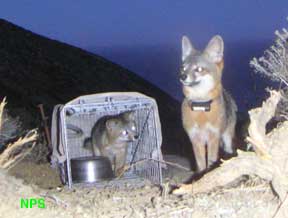
Currently on San Miguel Island there are 20 foxes in captivity and 77 in the wild, for a subspecies total of 97. National Park Service lead biologist Tim Coonan says, “The last time we had close to 100 San Miguel foxes was in 1996, so that's a pretty significant milestone. The wild foxes include 25 pups born in the wild this year. Our camera monitoring indicates that 12 of the 13 pairs we monitored had litters.” Traps with food are put out to attract foxes to locations with cameras, so pups born in the wild can be counted.

Island foxes returned to the wild are breeding very successfully. But before an island fox can be released it needs a radio collar so its safety can be monitored. This month 16 more foxes were released into the wild on San Miguel Island. It is hoped that captive breeding on this island will be unnecessary by the end of 2007 and that all of the San Miguel foxes will once again be roaming free. With the donation of funds for a radio collar, you can help make this happen.

More about San Miguel Island

Santa Rosa Island Update

Radio collars are vital to the 13 captive foxes released back into the wild on Santa Rosa Island this fall. Monitoring the foxes allows biologists to rapidly respond when a fox is preyed upon by a golden eagle. Since the capture of two adult golden eagles this summer, only two juvenile golden eagles have been seen on the northern islands. No fox fatalities attributed to golden eagles have occurred since March 8, 2006.

Currently there are 28 island foxes in captivity on Santa Rosa and 52 in the wild, including 14 pups born this year to 5 litters. Captive breeding will continue on Santa Rosa for a couple years.

More about Santa Rosa Island & Island Journal


Santa Cruz Island Update

In June of 2006 there were 81 foxes in captivity on Santa Cruz Island. But as nonnative species have been removed and the natural island habitat has been reclaimed, 58 of the captive island foxes have been released. Tim Coonan reports, “The estimated wild population is approximately 250 foxes, though it may be significantly higher than that, perhaps as high as 400 foxes.”

Educating the public about the complex natural balance on the Channel Islands - the importance of removing feral pigs, reintroducing bald eagles and relocating golden eagles - is vital to creating an informed public and the survival of the island fox. When you support Friends of the Island Fox’s education efforts, you help create a community that actively supports island fox conservation.

More about Santa Cruz Island & Island Journal.

In 2006, Friends of the Island Fox provided funds for 10 radio collars, visited schools from primary grades through college and educated 1000s of people like you about the island fox at six different community events.

Can an endangered animal be saved? YES

This season Give the GIFT of A FUTURE.
Through the efforts of like-minded people, we will SAVE the ISLAND FOX.

Please use the PayPal button at the upper right to donate or contact us through the mail. (Download brochure)

Monday, April 17, 2006

Restoring Natural Balance - The Bald Eagle


First bald eagle hatched on northern Channel Islands in 51 years !

In March biologists spotted a bald eagle nest with an egg, on Santa Cruz Island.

On Wednesday, April 12, 2006, the egg hatched and the first bald eagle chick since 1949 chirpped to its parents on one of California’s northern Channel Islands. This is very exciting news not only for the bald eagle, but also for the island fox.

Bald eagles and island foxes lived together amicably on the Channel Islands for thousands of years. The bald eagle preyed primarily on fish, sea birds, and carrion, while the omnivorous fox hunted the islands’ small rodents, insects, and birds, and also foraged for a variety of native fruit. The two predators each had their own niche and played an important role in maintaining balance in the island ecosystem.

The delicate balance, however, was destroyed when the chemical insecticide DDT (dichlorodiphenyltrichloroethane) entered the marine food chain. Small sea life absorbed the DDT, they were eaten by fish, who in turn were eaten by the bald eagles. High levels of DDT in the bald eagles caused them to lay eggs with thin shells that cracked when the parents tried to hatch them.

The last successful bald eagle chick on the northern Channel Islands hatched on Anacapa in 1949.

Without the territorial bald eagle, the islands were open habitat for the golden eagle. Golden eagles migrated to the islands to hunt the large number of feral pigs on Santa Cruz Island. Preying mainly on mammals, the golden eagle next began hunting the island fox. In the late 1990’s predation by golden eagles nearly pushed the island fox to extinction on San Miguel, Santa Rosa, and Santa Cruz Islands.

In the last few years, over 40 golden eagles have been removed from the northern islands and relocated to the mainland. Since 2001, 46 young bald eagles have been returned to Santa Cruz Island. As the bald eagles have matured they have begun reclaiming the islands as their own.

With the hatching of this first youngster in April 2006, there is hope bald eagles will once again be able to make the northern Channel Islands their home. A successful return of the bald eagle would be a important step toward restoring the natural balance and making the islands safe again for the island fox.

(While bald eagles have also been reintroduced on Santa Catalina Island, DDT levels still remain high enough off Catalina that these eagles are unable to lay sufficiently-shelled eggs. On Catalina, bald eagle eggs are collected by biologists, incubated, and the chicks are then returned to the nest to be raised by their parents. Large quantities of DDT in barrels were dumped into the ocean off Palos Verdes Peninsula by Montrose Chemical Company in the 1950s and 60s. These unstable barrels continue to slowly release their toxic content into the ocean and there is no sign that bald eagles on Santa Catalina will be able to reproduce on their own for sometime into the future.)

Monday, October 10, 2005

CURRENT CONSERVATION EFFORTS

Saving the island fox and conserving its island habitat requires many different conservation efforts. The following are just a few of the actions currently taking place:

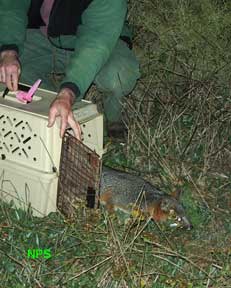
  • Island foxes on San Miguel, Santa Rosa and Santa Cruz islands have been taken into captive breeding facilities to ensure their survival and to increase their numbers to a level that facilitates their safe release back into the wild. On San Miguel and Santa Rosa, increased population numbers and the absence of golden eagles has allowed initial releases of foxes back into the wild.
  • All released island foxes on the northern islands have been radio collared. The radio collars enable biologists to monitor the foxes’ activity and determine their survival.
  • A program of humanely capturing golden eagles is ongoing. Approximately 40 golden eagles have been successfully captured and released in northeastern California. To date, none of the relocated eagles has returned. Currently, San Miguel and Santa Rosa islands appear to be clear of golden eagles, however some golden eagles remain on Santa Cruz island.
  • Bald eagles are being reintroduced to the northern Channel Islands. Up to 12 juveniles will be released annually on Santa Cruz from 2002 to 2006. It is hoped these bald eagles will establish territories when they reach maturity and deter golden eagles from colonizing the Channel Islands.
  • Feral pigs are being removed from Santa Cruz Island as part of a joint project conducted by the National Park Service and the Nature Conservancy.
  • Non-native plants and animals are being removed from the northern islands in an attempt to return the island habitat to its original natural ecosystem condition.