
We love this island fox pumpkin carved by
2020 FIF Research Grant recipient Katie Elder.
See Katie's report on GPS tracking collar study
Happy Halloween !

2020 FIF Research Grant recipient Katie Elder.
See Katie's report on GPS tracking collar study
Happy Halloween !

Radio-tracking collars are the primary way that island fox survival is monitored across the Channel Islands.

12 new radio collars and 21 refurbished radio collars funded by your donations are going on island foxes RIGHT NOW on Catalina Island.

Across Catalina Island wildlife biologists are giving island foxes health checks. Weighing them, checking their ears,

teeth,

and overall condition.

Meet wildlife biologist Emily Hamblin and hear how she gives health checks to island foxes. "Date with a Fox" program (video recording)

Island foxes faced near extinction on four islands twenty-two years ago. One of the causes was introduced canine distemper virus. Island foxes can be vaccinated for this disease, but new diseases arriving on the islands remains one of the greatest threats to this island species. The word for this is "biosecurity."
Everyone that visits the islands plays a role in biosecurity. See what you can do
Happy 50 Years of protecting Catalina Island's wildlife and wild places to the Catalina Island Conservancy (CIC).

This photo says it all. Twenty-three years ago Catalina Island foxes faced extinction from introduced canine distemper virus. Today Catalina's island foxes thrive.
Friends of the Island Fox works with CIC to help vaccinate island foxes, provide radio collars for monitoring survival and investigate threats from other virus introductions.
Protecting island foxes takes a community.

Even with her face covered, F257 from Santa Rosa Island is a stunning island fox. Her coat is lustrous, her weight is good, she looks healthy. The mask/muzzle helps keep her calm during her health check.

She received her first health check when she was a pup in July of 2019. In the winter of 2019, she was fitted with her first radio tracking collar.
F257 continues to live in the Old Ranch area on Santa Rosa Island. This is the same area where she was born and first seen.

Low rainfall frequently correlates with fewer resources and female foxes tend to have fewer pups or no pups. Santa Rosa Island may also have reached maximum population size. F257 may not be able to find a mate or adequate territory to support having pups. Being single, may also be a choice. She looks great.

After two and a half years, F257's radio collar needed a new battery. Her collar was replaced and the old collar will be refurbished so it can be used again. In the video below, you'll see F257 be released after her health check.
Did you notice F257 looked back at the biologist multiple times. Maybe she recognizes the biologist, too.
With her radio-tracking collar F257 is helping to monitor island fox survival on Santa Rosa Island.
Your donations to Friends of the Island Fox fund radio-tracking collars and important research across the Channel Islands.


When the zoo established their Wildlife Conservation Fund, Friends of the Island Fox was a 2014 grant recipient. Over the years, the FCZ Wildlife Conservation Fund has funded not only radio collars, but vaccinations, equipment for safe capture of island foxes, important evaluation of island fox blood samples for evidence of disease and other critical health measures.

Friends of the Island Fox just received our FCZWCF grant of $3,200 for 2022. This funding will go toward health monitoring and/or vaccinations for island foxes.
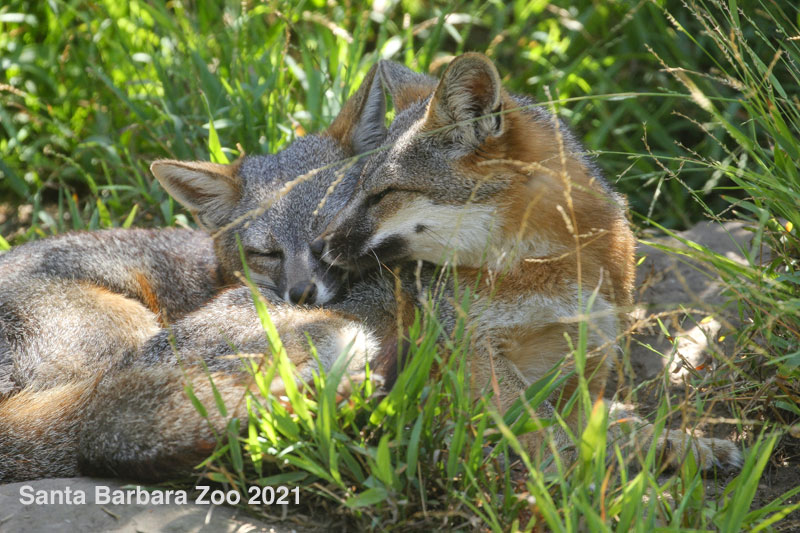
The Santa Barbara Zoo was the first to come to the aid of endangered island foxes and they participate in the Island Fox Conservation Working Group. Keepers and veterinary staff helped develop the care and feeding protocols for island foxes in captive breeding facilities from 2001–2006. The zoo has provided a home for a few island foxes and was the first to successfully breed island foxes in captivity. Today, all of the island foxes living in mainland zoos are rescued wild individuals that do not have the skills to survive in the wild.
Lewis and Clark (above) are brothers who were abandoned by their parents in the midst of drought on San Clemente Island. Today these two island foxes play an important role for their wild relatives. Because they live in a controlled environment with ready access to veterinary care, they are health advocates for other island foxes. They provided samples to the island fox microbiome research study.

Island foxes are very susceptible to introduced diseases. Many vaccinations for dogs are not safe for island foxes. In the controlled environment of the Santa Barbara Zoo, Lewis and Clark were vaccinated against Covid-19. They had no ill side-effects. Zoo veterinarians monitor whether the vaccine continues to protect the two foxes. If necessary we know island foxes can be safely vaccinated for Covid-19.
 |
| Beau at the Living Desert |
Living Desert in Palm Springs - Home to Beau (above) a male abandoned as a pup during drought on San Clemente Island
 |
| Female gray fox and island fox sisters at CALM |
California Living Museum in Bakersfield - Home to two sisters (above) abandoned as pups during drought on San Clemente Island
San Diego Safari Park - Home to Sage a female with a chronic health condition from Catalina Island
FIF is thankful for the continued support of island fox conservation from our Zoo Friends.

Analyzing stable isotopes in slivers of island fox whisker, Juliann Schamel (Research grant recipient 2018 and 2019) has been uncovering the range of diet eaten by island foxes, drought impacts on their diet, and a new understanding of how some island foxes use marine resources.

Your scientific research could also benefit island fox survival and the management of rare and endangered species.
Friends of the Island Fox is accepting applications for the 2022 Island Fox Research Grant through August 29, 2022.
More about current island fox research and recent grant recipients.
Your donations help support vital island fox research.
Island fox populations remain stable, but continuing drought raises concerns.

This is the update from across the Channel Islands as compiled from notes by Friends of the Island Fox at the Island Fox Working Group Meeting held May 11, 2022 at the Santa Barbara Zoo (hybrid meeting).
Reported population numbers are official estimates from each land manager as calculated during the 2021 counting period. (How are island foxes counted)

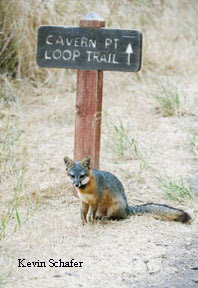
Overview: While adult island foxes appeared healthy across the islands in 2021, record low rainfall correlated with an extremely low number of births. As California and the Channel Islands face a second year of drought in 2022, island foxes will experience greater survival challenges. Concern is heightened for the San Miguel and San Nicolas Island foxes because they are naturally smaller populations and the native plant communities on these islands have been slow to recover from historic overgrazing.
The leading threats to island foxes in 2022 are:
Greatest Concern: The connection between island fox reproduction and rainfall was first documented on Catalina Island. A lack of rainfall reduces resources and depresses island fox reproduction. This is a natural way for canine populations to adjust downward so that individuals can find adequate food and territory.

Notice how the yellow bar (Santa Cruz, above) and the red bar (Catalina) decline from 2017 to 2018, a year of extreme drought. The following year (2019), above normal rainfall returned and all island fox populations benefited. While 2020 provided a minimum average rainfall of 12 inches, it was followed by historic low rainfall in 2021. Most island fox populations adjusted downward.
The 2021 estimates for Santa Rosa and Santa Cruz Islands may be slightly inflated. It is possible that in the face of food instability, a greater number of adult island foxes may have gone into capture cages for a meal. At the same time, the number of pups documented on these two islands was only 2 and 3 individuals, respectively. There was virtually no observed reproduction in 2021. Expected age range models can get out of balance when no pups are born into the population and the surviving island foxes continue to age.

Further impacts from drought and increased temperatures:
Island foxes enter a second year of drought with minimal reserves.

The smaller islands remain stable, but did adjust downward after two years of reduced rainfall. Both San Miguel (lime green) and San Nicolas Island (pink) appear to be balancing out at lower population levels than in the past. This may be due to reduced food availability and a diet shifting away from nonnative ice plant which died off in earlier drought years.

San Nicolas Island - (pink line) Lower density also benefited island foxes on this island–11 pups received health checks. While still a low number, this was the highest pup count seen across the islands in 2021. Adenovirus (dog flu) was unexpectedly found in a high number of foxes on this island, but fortunately no fatalities were found. The source of the virus's introduction remains a mystery. Friends of the Island Fox worked with U.S. Navy biologists to educate Navy personnel about island fox behavior and life cycle. The number of island foxes hit by cars was reduced from the same period of time the previous year.
San Clemente Island - (blue line) Island foxes appeared healthy, but only 3 pups were recorded in 2021. Concerted education efforts by Institute for Wildlife Studies biologists and the U.S. Navy dramatically decreased car strike fatalities in 2021 - though the low number of young foxes may have also helped decrease the number of animals on the roads.

Larger Islands:
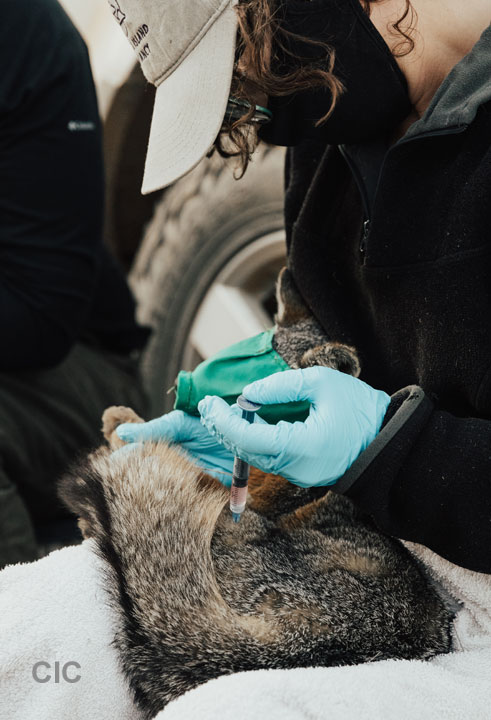 |
| island fox being vaccinated |
Santa Catalina Island - (red line) The recovery of this population is well established and the population naturally fluctuates around 1500 individual island foxes. Biosecurity is a daily challenge. Vaccination efforts have increased to every fox in-hand except sentinel foxes. In 2021 Adenovirus increased to 80% of the fox population; fortunately no fatalities are known. Testing for introduced disease is vitally important and there are hopes to increase this effort.
Santa Cruz Island - (green line) The recovery of this population is also well established. The population naturally fluctuates around 2,300 individuals with a fairly high density of 9.86 foxes per square kilometer. [for reference Disneyland's Magic Kingdom in Anaheim, CA is 1 sq. km] Biosecurity is also a heightened concern on this island. As well as monitoring with radio collars, new wildlife cameras are being established at island entry points to watch for introduced species that could be carrying disease. Adult survival rates declined to a 69% chance of surviving the year and there is concern that continuing drought will challenge adult survival in 2022.
Santa Rosa Island - (pink line) With the plateauing of the island fox population on Santa Rosa Island, it is believed this island has fully recovered and reached carrying capacity. The next few years should see adjustment toward a naturally sustainable population level. Currently the island has a density calculated at 12.4 foxes per square kilometer; a very high density. Continuing drought could impact the ability of older island foxes to maintain territory and access to resources. Two GPS research projects supported by Friends of the Island Fox will be watching the movement, diet, territory size, and interaction of island foxes very closely this summer on Santa Rosa Island.
*Note line graphs show population estimates from even years, with the exception of the most current year 2021. Population graphs with all years show greater fluctuation. See bar graph "Island Fox Populations of the Last 5 Years" at top of page.

This effort spots viruses introduced to the island. If a fox comes in contact with a virus, its immune system will develop antibodies to try and fight off the disease.
This is similar to how COVID-19 is tracked in humans.
We know this effort is important because FIF funding in 2021 helped biologists on Catalina Island discover that antibodies for Adenovirus (dog flu) were present in 80% of Catalina Island foxes. This is a steep increase from 2020.

A blood sample might not seem as exciting as a radio collar, but both are important to island fox survival. This effort was funded by donors like you and a one-time grant from the Fresno Chaffee Zoo Wildlife Conservation Fund.
Your donations help protect island foxes from disease.

Biosecurity is a major concern across the Channel Islands. Disease, especially viruses, can be introduced through unvaccinated pets, people, and wildlife species that are not native to the islands.
The island foxes on Catalina Island face the greatest potential biosecurity threat because their home is visited by millions of people

Friends of the Island Fox just purchased over $5,100 worth of vaccines to vaccinate 350 Catalina Island foxes this summer. Island foxes captured for health checks will receive two vaccinations:

It costs $20 to vaccinate and protect an island fox.
Make A Difference
Your donations help island foxes

Biosecurity measures you can take when traveling to the islands

Fifty to sixty island foxes on each island wear radio telemetry collars. Most of these are sentinel foxes. FIF funds radio collars to monitor island foxes.

See the GPS data comparing island fox movement and island spotted skunks on the same hillside.
"Date With a Fox" May 1, 2022 Brian Cypher, Ph.D., Director and Research Ecologist CSU Stanislaus' Endangered Species Recovery Program talks about how GPS data provided important information on endangered San Joaquin kit foxes and how this same technology can benefit island foxes.
Friends of the Island Fox is supporting two research projects starting this summer to investigate island fox territory and habitat use on Santa Rosa Island.
Katie Elder will replicate a GPS investigation of island fox territory size that was initially done when the population was under 400 individuals. Will territory size be different with the current estimated 2600 island foxes? Have these foxes reached the island's carrying capacity?
Juliann Schamel will also track island fox movement and territory size with GPS collars. She'll integrate her findings on diet with how individual island foxes are moving in the environment. Do all island foxes have access to beach resources or are there distinct areas and resources used by individual island foxes?

Your donations make this important research possible.