Friday, February 17, 2023

Fresno Chaffee Zoo Helps Island Foxes


What are those island foxes whispering?

They are spreading the word that the Fresno Chaffee Zoo Wildlife Conservation Fund has provided island foxes with a special end of the year 2022 grant.

$2,400 will help fund Canine Distemper Virus and 

Rabies vaccinations


Canine distemper virus is typically fatal to island foxes. To protect them, a minimum number of 100 island foxes are vaccinated each year on each island.

Because the vaccine that is safe for island foxes only provides protection for 10–11 months, island foxes need to be vaccinated every year.

Vaccination takes place during annual health checks.

Catalina Island has an increased threat of CDV for island foxes. Approximately, 350 island foxes are vaccinated each year on Catalina. FIF funds Catalina shots 2022

This year FIF has the goal to provide vaccine for: 

  • 350 Catalina Island foxes
  • 100 foxes on Santa Cruz
  • 100 foxes on Santa Rosa
  • 100 foxes on San Miguel

With support from the Fresno Chaffee Zoo, Riverbanks Zoo, and private donors like you, we'll vaccinate 650 island foxes in 2023.

We only need to raise another $2,000 to protect 650 island foxes


Friday, January 27, 2023

Virtual Program: How Microbes Influence Island Fox Health and Understanding Island Spotted Skunks

 Join Friends of the Island Fox for a virtual

"Date with a Fox"

Tuesday, January 31 at 6:30–7:30 pm (Pacific Time)

on Zoom

Hear directly from researchers investigating island fox health and biologists working in the field on the Channel Islands.


Jasmine Lu became acquainted with Channel Island foxes while working on her senior thesis at Princeton under the guidance of Alexandra DeCandia, Ph.D. Their work investigated how mite infection can destabilize the microbial community structure in the ear canals of Santa Catalina Island foxes. Their findings have recently been published in the journal Molecular Ecology. Lu will explain their discoveries; she says "It's exciting to be able to contribute to the growing body of knowledge on this fox population!"


Lara Brenner is a FIF Board Member, island biologist for the Nature Conservancy, and member of the Island Spotted Skunk Conservation Working Group. Island spotted skunks co-exist with island foxes on Santa Cruz and Santa Rosa Islands, but little is known about these tiny predators. As island foxes have recovered, how have island spotted skunks been affected? What are we learning about the relationship between these two endemic predators and what more needs to be investigated? Brenner will provide an update on island spotted skunks.

It should be a fascinating evening. We hope you will join us for this free virtual event. Reservations are required.

Watch The Recorded Program


More on FIF and island spotted skunks

Videos of past "Date with a Fox" programs are available here.

Friday, January 06, 2023

Fox Foto Friday - Rain, Races, & Island Foxes


The rains are bringing renewed resources to the Channel Islands! Time to bask in the sun and be hopeful for a positive 2023.

This photo was taken by FIF volunteer Megan Sarrail in December on Santa Cruz Island. 

Avalon 50K Update - Island foxes are sad to report that Cassidy Smith has sustained an injury making her unable to run in the Avalon 50K on Saturday, January 7. The sponsorships she has received will be carried over to a new race and still go to work helping island foxes. 

While the rainy weather isn't the best for all-terrain races, its a good time to spot island fox tracks.


Tuesday, December 13, 2022

FIF Research Grant Will Investigate Island Spotted Skunk Genome


Meet Julia Owen, a researcher at the University of California, Davis Mammalian Ecology and Conservation Unit. 

FIF's 2022 Research Grant will help process samples in Owen's effort to decode the genome of island spotted skunks and determine their genetic history. When did this island endemic diverge from a mainland ancestor and which mainland spotted skunk is their closest ancestor?


Little is known of the island spotted skunk that shares habitat with island foxes on two islands–Santa Rosa and Santa Cruz. Because island spotted skunks are nocturnal and reclusive, basic knowledge like diet, social behavior, and even when these tiny predators reproduce remains unclear. Yet, island foxes and island spotted skunks have an impact on each other. More on foxes and skunks sharing habitat
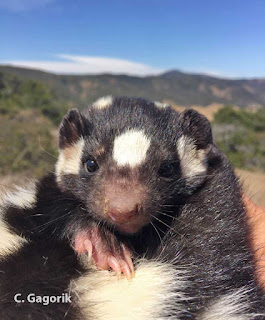
 

Currently island spotted skunks (Spilogale gracilis amphiala) are considered a subspecies of western spotted skunks. Physically they all appear similar to human eyes and, until recently, the relationship between spotted skunks across North America has been regarded as primarily a division of western and eastern species. New genetic research, however, is revealing that there are substantial genetic differences and even reproductive variation between the two groups–western spotted skunks have delayed implantation of embryos and eastern spotted skunks do not. "Delayed implantation" means that spotted skunks in difficult desert, mountain, or isolated environments can breed at a time that is easier to find a mate, but the embryo within the female will stop development for a period of time and then resume development so that birth will occur at a more optimal time for success.

"Through the use of genetic and genomic tools, " Owen explains, "it is now becoming clear that island foxes and island spotted skunks have been coinhabitants of Santa Cruz and Santa Rosa Islands for thousands of years. Investigating the evolutionary history of island spotted skunks will also provide information on the evolutionary ecology of island foxes on the northern Channel Islands."

This work could also help us understand if island spotted skunks should be considered a unique island species, like island foxes. Julia Owen adds, "shedding light on the distinctness of each population of island spotted skunks may help inform and increase conservation efforts on each island."

Friends of the Island Fox participates in the Island Spotted Skunk Conservation Working Group. For more about island spotted skunks check out their website: www.islandspottedskunk.com

See Ellie Bolas talk on preliminary research on island fox and island spotted skunk interactions

Tuesday, December 06, 2022

Running for Island Foxes!

Cassidy Smith has found a new way to help raise funds and awareness of island foxes!


On January 7th, 2023

Cassidy is running in the Avalon 50K 

(= to 31 miles!)

And she'll be doing it to benefit island foxes!


The course will take her and more than 700 other participants along Catalina Island's mountain ridges and down canyons, from Avalon to Little Harbor and back. Along the way island foxes will be cheering Cassidy on!


You can join-in the effort and sponsor Cassidy through FIF's Special Event Sponsorship page hosted on Givebutter 

Her goal is $1000 and FIF hopes to match Cassidy's fundraising! 

$2000 will vaccinate 100 island foxes on Catalina Island.

Help Cassidy raise funds for island foxes 

each step of this ultra-marathon!


Friday, October 21, 2022

Radio Collars Going On Island Foxes!

Radio-tracking collars are the primary way that island fox survival is monitored across the Channel Islands.


12 new radio collars and 21 refurbished radio collars funded by your donations are going on island foxes RIGHT NOW on Catalina Island.


Across Catalina Island wildlife biologists are giving island foxes health checks. Weighing them, checking their ears, 

teeth, 

and overall condition.


Meet wildlife biologist Emily Hamblin and hear how she gives health checks to island foxes. "Date with a Fox" program (video recording)

Island foxes also receive vaccinations and have a sample of their blood drawn looking for signs of exposure to other diseases.

Island foxes faced near extinction on four islands twenty-two years ago. One of the causes was introduced canine distemper virus. Island foxes can be vaccinated for this disease, but new diseases arriving on the islands remains one of the greatest threats to this island species. The word for this is "biosecurity." 

Everyone that visits the islands plays a role in biosecurity. See what you can do  

Friday, October 14, 2022

Fox Foto Friday - Island Foxes Say: "Happy 50th"

Happy 50 Years of protecting Catalina Island's wildlife and wild places to the Catalina Island Conservancy (CIC).


This photo says it all. Twenty-three years ago Catalina Island foxes faced extinction from introduced canine distemper virus. Today Catalina's island foxes thrive.

Friends of the Island Fox works with CIC to help vaccinate island foxes, provide radio collars for monitoring survival and investigate threats from other virus introductions.

Protecting island foxes takes a community.  


Friday, September 16, 2022

Do You Remember This Fox? It's F257


Even with her face covered, F257 from Santa Rosa Island is a stunning island fox. Her coat is lustrous, her weight is good, she looks healthy. The mask/muzzle helps keep her calm during her health check.


You might remember F257 from 2021, 2020, and 2019

She received her first health check when she was a pup in July of 2019. In the winter of 2019, she was fitted with her first radio tracking collar.

F257 continues to live in the Old Ranch area on Santa Rosa Island. This is the same area where she was born and first seen.


In August, National Park biologists were happy to see F257 during island-wide counting of island foxes. Biologist Juliann Schamel says "[F257] has been captured every summer on the [Old Ranch] grid, and has never shown signs of having reproduced, although she is in good condition/health. She's still quite young and most foxes on Rosa did not reproduce in 2020 or 2021, so this isn't surprising." 

Low rainfall frequently correlates with fewer resources and female foxes tend to have fewer pups or no pups. Santa Rosa Island may also have reached maximum population size. F257 may not be able to find a mate or adequate territory to support having pups. Being single, may also be a choice. She looks great.


You can see from her data sheet that F257s health check and the replacement of her radio-collar took only 12 minutes.

After two and a half years, F257's radio collar needed a new battery. Her collar was replaced and the old collar will be refurbished so it can be used again. In the video below, you'll see F257 be released after her health check.


Did you notice F257 looked back at the biologist multiple times. Maybe she recognizes the biologist, too. 

With her radio-tracking collar F257 is helping to monitor island fox survival on Santa Rosa Island. 

Your donations to Friends of the Island Fox fund radio-tracking collars and important research across the Channel Islands.

Friday, September 09, 2022

Zoos Helping Island Foxes


Sometimes you have to look behind the scenes to see the important role that zoos play in wildlife conservation. The island fox has several important zoo friends.

Fresno's Chaffee Zoo

Fresno's Chaffee Zoo has been a vital partner in island fox recovery and health for 16 years. It started with a few zoo keepers committed to helping island foxes and a donation for a radio-tracking collar. 

When the zoo established their Wildlife Conservation Fund, Friends of the Island Fox was a 2014 grant recipient. Over the years, the FCZ Wildlife Conservation Fund has funded not only radio collars, but vaccinations, equipment for safe capture of island foxes, important evaluation of island fox blood samples for evidence of disease and other critical health measures.

In January of 2022, the FCZ Wildlife Conservation Fund provided a special one-time grant that funded the refurbishment of 15 radio collars for Santa Cruz Island foxes. These collars were all placed on island foxes over the last month. The grant also helped fund vital testing for disease among island foxes.

Friends of the Island Fox just received our FCZWCF grant of $3,200 for 2022. This funding will go toward health monitoring and/or vaccinations for island foxes.


Santa Barbara Zoo

The Santa Barbara Zoo was the first to come to the aid of endangered island foxes and they participate in the Island Fox Conservation Working Group. Keepers and veterinary staff helped develop the care and feeding protocols for island foxes in captive breeding facilities from 2001–2006. The zoo has provided a home for a few island foxes and was the first to successfully breed island foxes in captivity. Today, all of the island foxes living in mainland zoos are rescued wild individuals that do not have the skills to survive in the wild. 

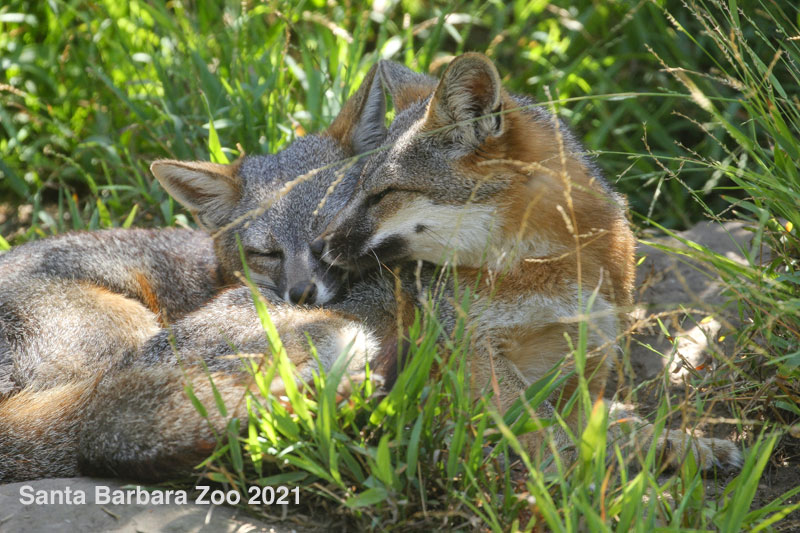
Lewis and Clark (above) are brothers who were abandoned by their parents in the midst of drought on San Clemente Island. Today these two island foxes play an important role for their wild relatives. Because they live in a controlled environment with ready access to veterinary care, they are health advocates for other island foxes. They provided samples to the island fox microbiome research study. 


Early in the pandemic it was discovered that Covid-19 could be passed to canines. As the pandemic grew there was concern for island foxes in the wild. Could biologists handle island foxes for health checks as they had in the past? Might island visitors pass Covid-19 to island foxes?

Island foxes are very susceptible to introduced diseases. Many vaccinations for dogs are not safe for island foxes. In the controlled environment of the Santa Barbara Zoo, Lewis and Clark were vaccinated against Covid-19. They had no ill side-effects. Zoo veterinarians monitor whether the vaccine continues to protect the two foxes. If necessary we know island foxes can be safely vaccinated for Covid-19.

Beau at the Living Desert

Island Foxes at other Zoos

Living Desert in Palm Springs - Home to Beau (above) a male abandoned as a pup during drought on San Clemente Island

Female gray fox and island fox sisters at CALM
 

California Living Museum in Bakersfield - Home to two sisters (above) abandoned as pups during drought on San Clemente Island

San Diego Safari Park - Home to Sage a female with a chronic health condition from Catalina Island

FIF is thankful for the continued support of island fox conservation from our Zoo Friends.