Showing posts with label wildfire on islands. Show all posts

Tuesday, May 19, 2026

Fire Burning on Santa Rosa Island Impacts Island Foxes

image source: CalFire Santa Rosa Island 2026-05-19 at 3.41.57
 

As of 4:30 pm Tuesday, May 19, the wildfire on Santa Rosa Island continues to burn. CalFire estimates 16,938 acres have burned so far. The fire is being fought by federal fire fighters and, today, winds have decreased allowing aircraft to assist with firefighting. (CalFire is not fighting this fire, but their website is posting updates)

While the ignition of the wildfire is officially under investigation, the blaze was most likely human-caused. Early Friday morning, flames spread quickly through dry grassland vegetation. 

photo source: USCG Air Station Ventura Coast
 

When similar wildfire events have occurred on other Channel Islands, adult island foxes have been able to flee the fire's edge and survive. (Burnie Boots - 2007) We are hopeful that the same will be true in this case.

Unfortunately, pups born in April are currently in dens and not able to flee. In other spring-time wildfire events, pups did not survive. It is highly likely that fox pups in the fire zone will be lost.

Santa Rosa Island foxes are currently at carrying capacity for the island. The 2025 population was estimated at over 2,000 individuals. While this will most likely cause a temporary decline in the island population, island foxes and island spotted skunks have shown resilience to wildfire. Following smaller wildfire events both species have been quick to return to burned territories and able to find food resources. 

Santa Rosa is the only island were island foxes are currently monitored and studied with GPS collars. These GPS-collared individuals may provide insight into exactly how island foxes react in the face of wildfire. This data may help us understand what is important for them to survive fire events.

Island fox on Santa Rosa Island

Our thoughts are with our National Park friends as they work to protect rare plants, like the Santa Rosa Island Torrey pine and other endemic island species, and to preserve infrastructure that enables biologists and researchers to study the island ecosystem.   


Monday, September 18, 2017

Wildfire Can Threaten Island Foxes


Responding to wildfire on the Channel Islands raises a quandary, because there are positive and negative aspects to letting wildfire burn:
  • Fire is a natural element on the Channel Islands. Many native plants depend on fire to open up areas for new growth, to renew the soil, or even jump-start seeds. As omnivores, island foxes depend on diverse and healthy native plants.
  • Fire can provide unexpected abundance for predatory or scavenging animals, including island foxes. Smaller animals may get caught in the fire, while birds and larger animals might escape.
  • Years of drought, however, have created areas with exceptionally dry vegetation and greater than usual build-up of wildfire fuel.
  • Land animals, like the island fox, and some lesser-flying birds, like the island scrub-jay, can not escape a fire burning out of control that might consume an entire island.
  • Santa Cruz Island is home to endemic plants and animals that only live on that one island and nowhere else in the world. If the entire island burned, some of these species might be driven to extinction.
  • The National Park is tasked with protecting historic human cultural artifacts and structures that could be destroyed.
  • People visiting the island can not easily evacuate on their own; they are dependent on sea or air transportation provided by others. The National Park must always consider visitor and staff safety.
Island scrub-jays only live on Santa Cruz Island
When lightning struck Santa Cruz Island during the night of Sept. 10th or early morning of Sept. 11th, all of these factors (and more) had to quickly be taken into account by officials at Channel Islands National Park.
2007 Catalina Island Fire
'Burnie Boots' - Catalina 2007
In 2007, fire raged up canyons and across hillsides on Santa Catalina Island. While only one female island fox was known to be injured in the fire, biologists later discovered that numerous island fox pups were lost to the flames because the fire occurred in spring and many pups were still too young to leave the dens where they were born. Catalina Island Conservancy biologists believe the injured female island fox risked her own life, walking across burning coals, to try and return to her pups in the den.

Wildfire is unpredictable, and in this incidence, the negative threats outweighed the potential positives. U.S. Forestry Service smoke jumpers were called in and they parachuted down to the island to put out the fire.

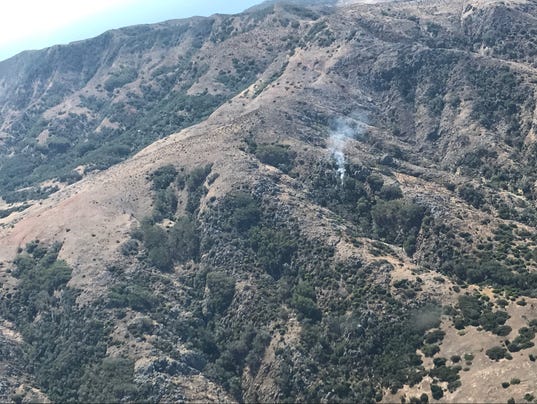
Fire on Santa Cruz Island 2017 - U.S. Forestry Dept. via Ventura Co. Star
The wildfire was first spotted by a concerned citizen on a boat. Threats to island foxes and the Channel Islands can come in many different forms. Some like disease from domestic dogs or introduced wildlife are similar to lightning, they may initially strike in one place, but the consequences can quickly spread across an entire island. Island foxes need all of us to be as vigilant as the boater who reported the wildfire - one person can make a difference.