Showing posts with label fire threatens island foxes. Show all posts

Thursday, May 21, 2026

Update on Santa Rosa Fire and Island Foxes


As of Thursday, May 21, 2026:

The fire on Santa Rosa Island has now burned 17,554 acres, but is reported to be 44% contained. Specific news on wildlife and rare plants remains limited. This is what we know:

Official report from government agencies 5/21/26 on the fire (https://inciweb.wildfire.gov/incident-information/cacnp-santa-rosa-island-fire)

Highlights: Increased humidity has assisted firefighting. Today firefighters along the western fire edge are concentrating on the Cloud Forest area and working south. The fire has passed through Water Canyon, but damage to the campground was minimal. 

According the official report: "Resource Advisors continue working alongside firefighters to ensure that sensitive species and the island's cultural assets are accommodated as effectively as possible throughout firefighting operations." 

The Santa Barbara Independent reports that members of the Chumash Fire Department have joined the firefighting effort and will work with Resource Advisors on protecting Chumash cultural resources.

Containment lines are being established along Telephone Road in the area of Cherry Canyon.  

Regarding island foxes:

Like the rest of us, NPS biologists are watching the firefighting effort from the mainland. They hope to check on the status of collared foxes as soon as possible. From a small plane they will fly over the island searching for the signals of radio-collared island foxes and accessing survivorship. 

Once it is safe for biologists to return to the island, they'll be able to determine what their population wide response and capacity will be.  

Fire of this size on Santa Rosa is unprecedented since the island became part of the National Park and the full impact may not be known until island-wide island fox monitoring takes place later this summer.

When FIF has more info on specific needs for Santa Rosa Island foxes, we will post it here on islandfox.org and through our social media. 


Grove of Santa Rosa Torrey Pines (at right, along ridge) before the fire.

Regarding the Torrey Pines:

The fire is believed to have burned quickly through the stand of rare Santa Rosa Island Torrey pines. In 2015, approximately 10,000 pines were counted in the single grove. Fire has not accessed these trees since the National Park was established. Firefighters report that the fire burned less intensely as it came down the slope. Preliminary firefighter reports are that pines are still standing and the grove remains. The full extent of the damage, however, will not be known until ecologists and tree experts can access the island.

Fire brings mixed impacts  


Monday, September 18, 2017

Wildfire Can Threaten Island Foxes


Responding to wildfire on the Channel Islands raises a quandary, because there are positive and negative aspects to letting wildfire burn:
  • Fire is a natural element on the Channel Islands. Many native plants depend on fire to open up areas for new growth, to renew the soil, or even jump-start seeds. As omnivores, island foxes depend on diverse and healthy native plants.
  • Fire can provide unexpected abundance for predatory or scavenging animals, including island foxes. Smaller animals may get caught in the fire, while birds and larger animals might escape.
  • Years of drought, however, have created areas with exceptionally dry vegetation and greater than usual build-up of wildfire fuel.
  • Land animals, like the island fox, and some lesser-flying birds, like the island scrub-jay, can not escape a fire burning out of control that might consume an entire island.
  • Santa Cruz Island is home to endemic plants and animals that only live on that one island and nowhere else in the world. If the entire island burned, some of these species might be driven to extinction.
  • The National Park is tasked with protecting historic human cultural artifacts and structures that could be destroyed.
  • People visiting the island can not easily evacuate on their own; they are dependent on sea or air transportation provided by others. The National Park must always consider visitor and staff safety.
Island scrub-jays only live on Santa Cruz Island
When lightning struck Santa Cruz Island during the night of Sept. 10th or early morning of Sept. 11th, all of these factors (and more) had to quickly be taken into account by officials at Channel Islands National Park.
2007 Catalina Island Fire
'Burnie Boots' - Catalina 2007
In 2007, fire raged up canyons and across hillsides on Santa Catalina Island. While only one female island fox was known to be injured in the fire, biologists later discovered that numerous island fox pups were lost to the flames because the fire occurred in spring and many pups were still too young to leave the dens where they were born. Catalina Island Conservancy biologists believe the injured female island fox risked her own life, walking across burning coals, to try and return to her pups in the den.

Wildfire is unpredictable, and in this incidence, the negative threats outweighed the potential positives. U.S. Forestry Service smoke jumpers were called in and they parachuted down to the island to put out the fire.

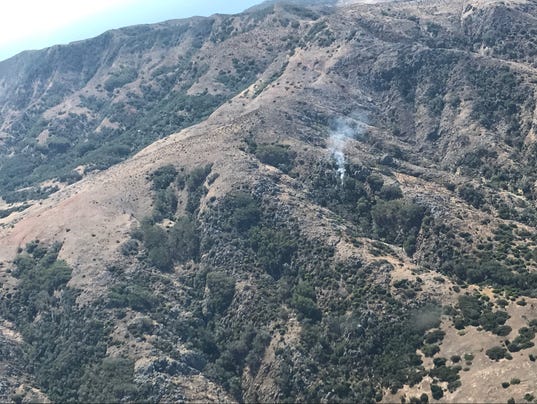
Fire on Santa Cruz Island 2017 - U.S. Forestry Dept. via Ventura Co. Star
The wildfire was first spotted by a concerned citizen on a boat. Threats to island foxes and the Channel Islands can come in many different forms. Some like disease from domestic dogs or introduced wildlife are similar to lightning, they may initially strike in one place, but the consequences can quickly spread across an entire island. Island foxes need all of us to be as vigilant as the boater who reported the wildfire - one person can make a difference.