What is small, but mighty? Only 3-6 lbs., but willing to stand its ground and protect its territory? An island fox.
Catalina Island Conservancy wildlife biologist Calvin Duncan approached a wild fox’s territory, he took this video of an island fox on Santa Catalina Island.
Protecting territory is important for a pair of island foxes. They need a hunting area that will provide enough food to support themselves and their pups. How does an island fox let you know you are in its territory? Watch and see.
Images like this of an island fox in the wild are very rare. Island foxes on Santa Catalina Island declined dramatically between 1998 and 2000 because of a disease, canine distemper, that was passed to them from a domestic dog. Today the estimated population has increased to approximately 572 individuals, slightly more than one third of their original number. Catalina island fox decline
The fact that island foxes are running wild again on Catalina, Santa Rosa, Santa Cruz, and San Miguel Islands is due to the undaunted efforts of biologists, scientists, government agencies, private conservation organizations and concerned individuals like YOU.
When you support island fox conservation efforts YOU HELP to make sure that moments like this will continue into the future.
A special thanks to the Catalina Island Conservancy fox biologists Calvin Duncan and Julie King for sharing their experiences in the field with us. For more on their work with the Catalina island fox: Counting island foxes; Island Fox Health Check.
See video of an island fox release on San Miguel Island. Link
Island fox and fruit
What do island fox pups look like?
What do island foxes eat?
Why are they endangered?
More about island foxes

Monday, April 21, 2008
Monday, April 14, 2008
Earth Day and the Island Fox
This Saturday and Sunday,
Friends of the Island Fox will be at the
Los Angeles Zoo Earth Day Expo 2008
Friends of the Island Fox will be at the
Los Angeles Zoo Earth Day Expo 2008
April 19 and 20, 2008
10:00AM - 4PM
10:00AM - 4PM
The event will highlight California Wildlife and part of that focus will be the endangered island fox.
The Los Angeles Zoo is home to a male San Clemente Island fox. FIF and representatives from the Channel Islands National Park will be up near the island fox enclosure providing activities throughout the day.
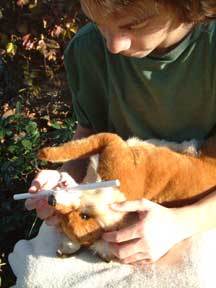
- 11:30 AM & 2:30 PM Fox Health Check: Participate in all the steps that biologists do in the field to check the health of wild island foxes.
- Noon & 3 PM Radio Tracking Demonstration: How do biologists find small island foxes on large islands? Come and help us a track a radio collared animal in the zoo.
- 1 PM Exhibit Talk at the Island Fox Enclosure
Come out to the L.A. Zoo, help celebrate Earth Day and find out how you can help preserve California’s unique wildlife diversity like the endangered island fox.

Happy Birthday to Finnigan, The Island Fox
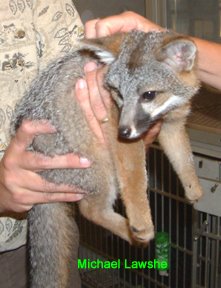
One of our favorite island foxes just turned 1 year old.
Finnigan, or Finn for short, was born last year at the Santa Barbara Zoo. Because his mother is an older fox, she did not nurse him and the Zoo staff had to hand raise him. See Finn's baby picture.
Fortunately this little island fox had the perfect personality to become an educational representative for all of his wild cousins. Finn makes guest appearances at special events at the Santa Barbara Zoo.
The Santa Barbara Zoo actively participates in island fox conservation and is the home of Finnigan, his parents, and two other island foxes. For more information on visiting the Santa Barbara Zoo and seeing the island foxes that live there.
Friends of the Island Fox sends our best wishes to a hard working island fox.
Happy, Healthy, First Birthday, Finnigan !
Saturday, February 23, 2008
The Island Fox has Friends
If you have seen the Island Fox San Miguel Island 2006 Release video, you have heard the original music of David Lynch.
David’s guitar solos add heart and bounce to the video. One of the themes used in the video has currently climbed to #8 of 2,480 on the Neil Young website for original music. You can help David climb even higher in the ranking by placing your vote for the song "Mahatma"at: neilyoung.com
Complete versions of David Lynch’s music can be found on his CD “Dozen” available through his website.
David Lynch
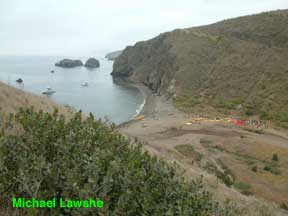
The video was also edited by island fox friend Michael Lawshe. Michael is nominated for a Golden Reel Award this Saturday, February 23 for his work as Sound Supervisor on Smallville. Check out his blog at Soundzgood.info
CLICK the picture to watch the video.
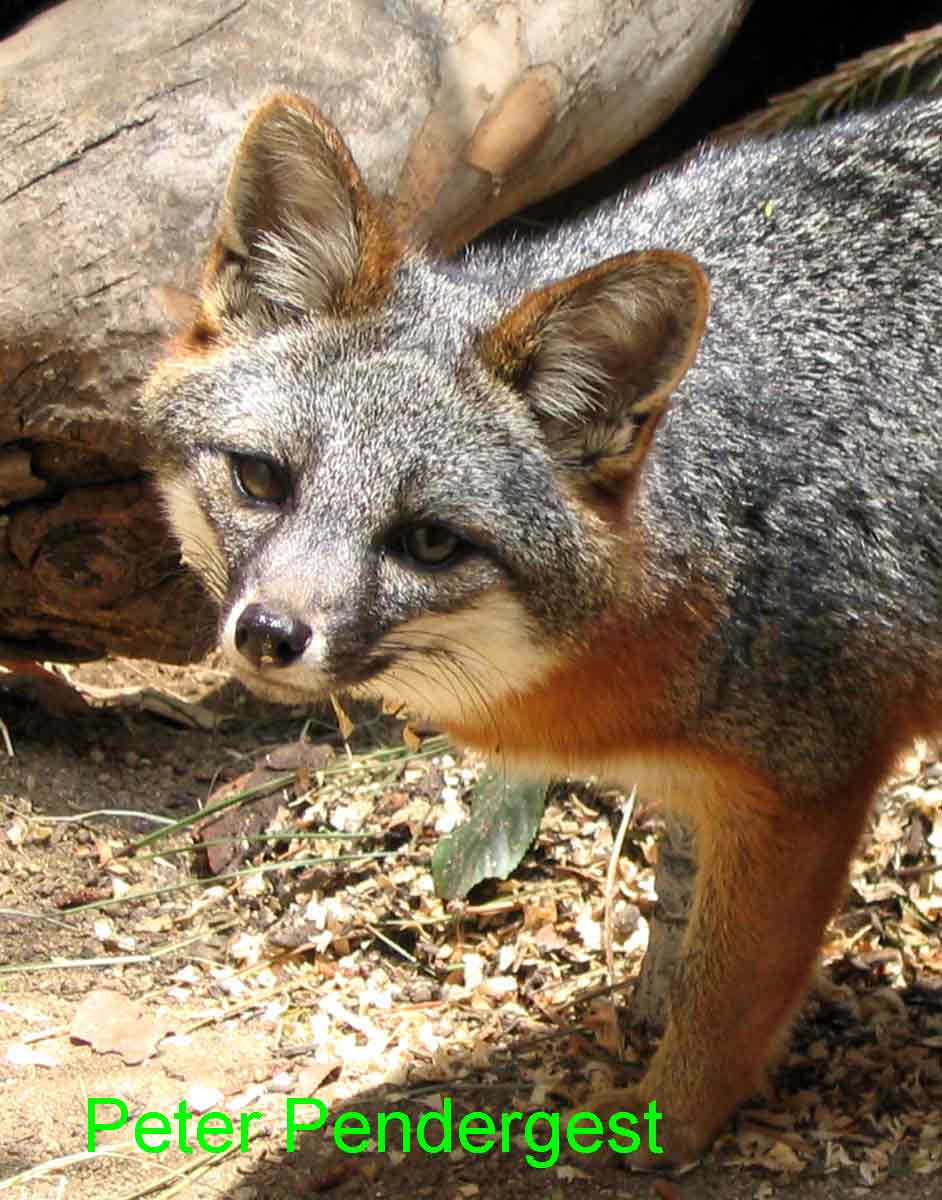
The photo at the top, was taken by Peter Pendergest.
Without help from friends like David, Michael and Peter we wouldn’t have a video of the island foxes to show the public or photos to post on our website. Friends of the Island Fox thanks them for their support of island fox conservation and appreciates their efforts to get involved in helping to save the island fox.
Thursday, February 07, 2008
Island Romance - Island Fox Mating Season
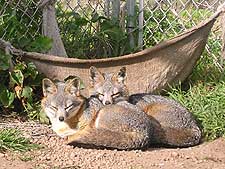
Island Romance - Island Fox Mating Season
Are you contemplating romance and Valentine’s Day? So are the island foxes. The cold blustery days from December to February are the perfect season for California’s Channel Island foxes to pair up and settle down in a cozy den.
During autumn, island fox families tend to split up. The youngsters, now over six months old, head off on their own and the parents take a vacation from family life and each other. With the arrival of winter, the monogamous mates come back together. (About the island fox)
Island foxes make their dens in a sheltered location, sometimes underground, in a tree stump or in amongst dense undergrowth. The male and female establish a territory around their den site and settle down to finding food for a family.
A few island foxes born last spring, will also be out looking for a mate. Even though they are less than a year old, some will become parents this spring. Because population numbers are still far below normal on San Miguel, Santa Rosa, Santa Cruz and Santa Catalina Islands, island foxes are breeding younger and having more offspring than they usually would. The abundance of island deer mice and other food items makes it possible for a pair of island foxes to raise five pups instead of the typical two or three.
Valentine’s Day 2008 will be very special on San Miguel and Santa Cruz Islands. For the first time since emergency captive breeding began in 2000, ALL of the island foxes on these two islands are once again free-roaming and choosing their own mates.
(2007 fox release on San Miguel Island) (2007 fox release on Santa Cruz Island).
Captive breeding programs saved the island foxes from extinction on both of these islands, but human matchmakers are never as good as the foxes themselves. We can all hope that this year there will be an increased number of island fox pups born on San Miguel and Santa Cruz Islands.
Eleven of the island foxes released in Channel Islands National Park are wearing radio-tracking collars funded through donations to Friends of the Island Fox. (radio collars)
Pups born in the spring and foxes slated for release from the captive breeding facility on Santa Rosa Island will soon be needing there own radio tracking collars. Your donation to Friends of the Island Fox helps to provide radio tracking collars vital to monitoring the recovery of endangered island foxes. You can donate through the PayPal and Cause for Good buttons in the upper right .
This Valentine’s Day give a truly romantic gift.
Help support a solution.
Working together we can SAVE the island fox.
Help support a solution.
Working together we can SAVE the island fox.
Friday, February 01, 2008
Seventh Annual California Islands Symposium

The islands along California’s coast present a unique collection of habitats with various wildlife and human problems and successes. Island foxes live on six of these islands: Six Islands, Six Different Foxes.
Where can you find the most current information from the experts working in the field?
The 7th California Islands Symposium
5-7 February 2008
5-7 February 2008
This gathering will bring together experts in archeology, anthropology, cultural resources, human history, population biology, ecological processes and systems, systematics, geology, paleontology, oceanography, and climatology.
The Symposium is a forum for the presentation of natural and cultural resource information collected on all of the California Islands - the Channel Islands, the Farallones, and the Baja Mexican islands - and their surrounding marine environments.
This important event will take place at the Embassy Suites Hotel in Oxnard, California. Presenters will include:
- Tim Coonan from the National Park Service (podcast with Tim Coonan)
- Julie King from the Catalina Island Conservancy (podcast with Julie King)
- Cathy Schwemm, biologist and FIF Secretary
On-site registration
Three days: $200
One-day: $75
Student: $125
There will be a poster session and book signing event Tuesday evening, Feb. 5, from 5:30 PM - 8:00 PM
Poster session fee for educators: $10
Book Signing Authors:
- Torben C. Rick - The Archaeology and Historical Ecology of Late Holocene San Miguel Island
- Jan Timbrook - Chumash Ethnobotany: Plant Knowledge among the Chumash People of Southern California
- Araceli Samaniego Herrera, Anny Peralta Garcia, and Alfonso Aguirre Munoz, editors - Vertebrados de las islas del Pacífico de Baja California. Guía de campo (Mammals of the Pacific Islands of Baja California.)
- Betsy Lester Roberti - San Miguel Island: A Childhood Memoir
For more details and a complete listing of presentations: http://www.californiaislands.org/
Thursday, December 06, 2007
Island Fox Update - Channel Islands National Park
Island Fox Update
with Tim Coonan
Wednesday, December 12th at 7.00 P.M.
with Tim Coonan
Wednesday, December 12th at 7.00 P.M.
As part of the Shore to Sea Lecture Series, Tim Coonan, biologist for Channel Islands National Park, will speak on the most current information regarding the island foxes on San Miguel, Santa Rosa and Santa Cruz Islands.
This is a great opportunity to hear the most up-to-date information on the island foxes on the northern islands.
The free lecture will be presented at:
Channel Islands National Park headquarters
1901 Spinnaker Drive in Ventura
1901 Spinnaker Drive in Ventura
Hear an interview with Tim Coonan.
Good News 2007 island foxes on Santa Cruz Island
Good News 2007 island foxes on San Miguel Island
Counting foxes on Santa Catalina Island
Tuesday, November 20, 2007
Island Fox Health Checks on Catalina Island
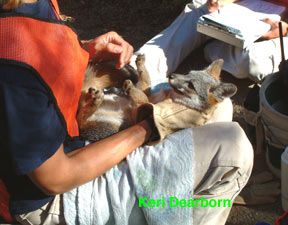 The Santa Catalina Island fox became endangered when an outbreak of disease, believed to be canine distemper, killed over 85% of the population in just a few years. To help prevent such catastrophic events in the future, biologists across the Channel Islands use the late summer and early fall to count island foxes and give them health checks.
In September, Friends of the Island Fox went out in the field with Julie King, fox biologist for the Catalina Island Conservancy as she did health checks on wild island foxes.
Click to Listen to Island Fox Talk Podcast in the field with Julie King as she examines a young female island fox.
An island fox health check involves:
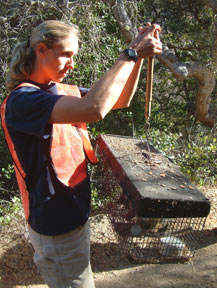
- taking the weight - The island fox is weighed while still in the trap.
- evaluation of over all physical status - The biologist feels the fox’s body for any lumps, bumps or wounds. (photo above)
- visual check of teeth, coat - Teeth are checked for wear and breakage (this female fox was under 2 years old but had a broken tip on an upper canine tooth); the coat is examined for overall heath and the presence of parasites, fleas and ticks.
- ear exam - An otoscope is used to look in the fox’s ears. The biologist is looking for ear mites, inflammation and disease.


- vaccinations - Island foxes receive vaccinations to help reduce the chance of disease.
- drawing a blood sample - The blood sample provides
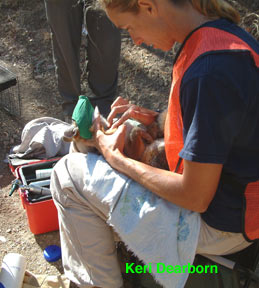 additional information on health and possible disease exposure. A mask is put over the foxes eyes to reduce the animal's stress while being handled by humans.
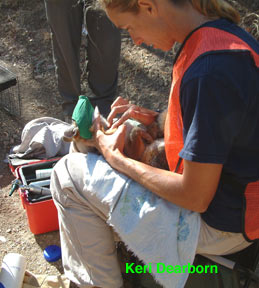
How was the island fox caught for the health check?
The island foxes on Santa Catalina are increasing in number, but a new threat is causing them problems, ear mites. Cancerous tumors are forming in the ears of island foxes on Catalina. The relationship between the ear mites and the cancer is currently being studied. Friends of the Island Fox would like to help the Catalina Island Conservancy in their quest to solve this mystery that is posing a new danger to island foxes. You can help by making a donation through the "Pay Pal" or "Donate Now" buttons at the top right of the page.
 Through generous donations Friends of the Island Fox has funded 17 radio collars in the past 2 years so island foxes can be monitored in the wild. Your donation to Friends of the Island Fox helps fund conservation efforts across all of the Channel Islands to help save the island fox.
Saturday, November 10, 2007
Counting Island Foxes
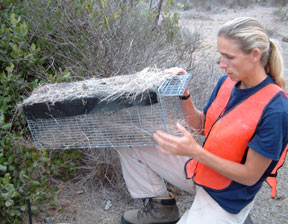 If you are a fox biologist on the Channel Islands, late summer through early autumn is a busy season. During this short window of time, island fox populations are counted and individual animals receive health check-ups. To get their hands on these pint-sized, but sharp-toothed predators, special box-type traps are put out in specific areas.
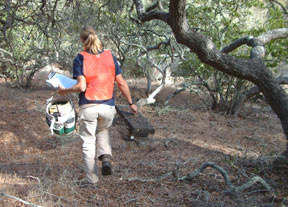
In September, Friends of the Island Fox rode along with Julie King, fox biologist for the Catalina Island Conservancy. The day on Santa Catalina Island started very early, because all of the traps on a string must be checked before the day starts to get warm.
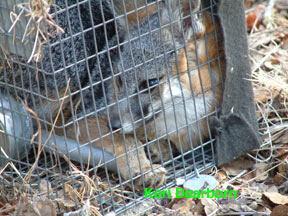 Most foxes are captured in the evening or during the night. Even so, the traps are set in shaded spots so that a fox won’t become overheated. Each trap has a covering over the top and grass or hay inside to make it more comfortable
The fox is first identified by its “pit tag.” A scanner responds to the microchip tag and displays the animals identification number.
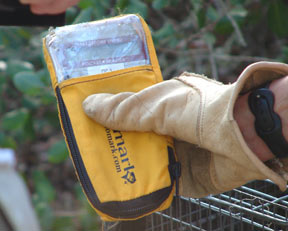
Endangered island foxes on Santa Catalina, San Miguel, Santa Rosa and Santa Cruz islands are given microchip identification tags like those you would use on your pet dog. The fox in the trap is scanned with the microchip reader to identify it. In this way, the biologist knows when the fox was last caught and whether or not it needs vaccinations, a health check or radio collar maintenance.
If the fox does not have a microchip or pit tag, it will receive one.
If it has already been caught this season and has had its health check, the biologist will release the fox and reset the trap. If not, then the island fox will spend 15-20 minutes with the biologist getting a full health workup.
Join us November 20th for an audio podcast as biologist Julie King does a health check on an island fox.
Tuesday, October 09, 2007
Island Foxes Released on Santa Cruz Island
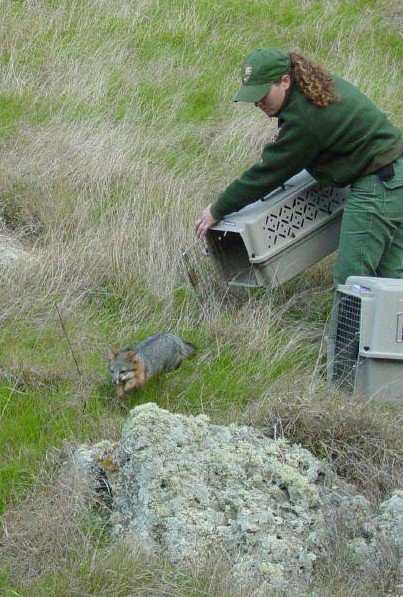 October 8, 2007 was another landmark day in the ongoing recovery of our endangered island foxes on the California Channel Islands. Yesterday, 10 island fox pups, born as part of the captive breeding program on Santa Cruz Island, were released into the wild.
Due to the success of several conservation efforts the fortunes of these newly released foxes look hopeful. Since 2002, captive breeding on Santa Cruz has produced over 85 fox pups and the overall Santa Cruz Island fox population has increased to approximately 300. Golden eagles that nearly ate the foxes into extinction, have been almost completely removed from the island and bald eagles, that were reintroduced to the northern islands beginning in 2000, are now breeding successfully and repopulating their historic home. Currently, 40 bald eagles reside on the northern islands.
“Historically, fox populations on the island ranged between 1,500 and 3,000,” said Dr. Lotus Vermeer, The Nature Conservancy’s Santa Cruz Island Project Director. “After several successful breeding seasons and with golden eagle predation curtailed we’re optimistic that the foxes will continue this upward trend.”
 The fox population on Santa Cruz Island has more than tripled since the island fox was listed as an endangered species just three years ago. If everything continues to go well, all of the remaining island foxes in the breeding facility on Santa Cruz will be released back into the wild before the end of 2007.
On this auspicious day, Russell E. Galipeau, Jr., Superintendent of Channel Islands National Park offered “Many thanks to our partners: Pacific West Regional Office, The Nature Conservancy, Fish and Game, Fish and Wildlife Service, Institute of Wildlife Studies, UC system, Friends of the Island Fox and special thanks for the professionalism and dedication of the entire [Channel Islands National Park] CHIS staff. Everyone has played a role in stealing the island fox from the grasp of extinction and all of you should feel proud. Island fox recovery is still going to be a long journey with many challenges, but ... [we] are making, and will continue to make far-reaching achievements in ecological restoration and what is most important to remember is that in a world of troubling times someone, somewhere must provide a ray of hope.”
You can help support that “ray of hope” and the island foxes being released into the wild.
Your donation of $250 puts a radio collar on an island fox so it can be monitored in the wild.
$100 helps pay for biological research into island fox diseases.
$50 funds materials to raise awareness about the island fox at a school visit or a community event.
With your help, Friends of the Island Fox is helping to make a difference. Working Together We Can Save the Island Fox and create a community that treasures our Channel Islands.
Subscribe to:
Posts (Atom)