Radio-tracking collars are the primary way that island fox survival is monitored across the Channel Islands.
12 new radio collars and 21 refurbished radio collars funded by your donations are going on island foxes RIGHT NOW on Catalina Island.
Across Catalina Island wildlife biologists are giving island foxes health checks. Weighing them, checking their ears,
teeth,
and overall condition.
Meet wildlife biologist Emily Hamblin and hear how she gives health checks to island foxes. "Date with a Fox" program (video recording)
Island foxes also receive vaccinations and have a sample of their blood drawn looking for signs of exposure to other diseases.
Island foxes faced near extinction on four islands twenty-two years ago. One of the causes was introduced canine distemper virus. Island foxes can be vaccinated for this disease, but new diseases arriving on the islands remains one of the greatest threats to this island species. The word for this is "biosecurity."
Everyone that visits the islands plays a role in biosecurity. See what you can do
This is F257–a female island fox on Santa Rosa Island. She first started wearing a radio-tracking collar (funded by FIF) last December when she was captured as a youngster.
In 2020, F257 is 18 months old and a mature female. It surprised everyone when she was caught in the exact same place she was found last year. This means she didn't disperse, or travel away, from her parents' territory.
It is typically expected that island fox pups will move away to find their own territory as they mature. Female offspring sometimes stay close to their parent's territory and that seems to be what F257 is doing.
She is looking healthy and happy in her territory adjacent to the coastline.
Friends of the Island Fox sends a "Hello" and "Thank You" to the biologists working across the Channel Islands. They are finishing up health checks and annual island fox counting. FIF is hearing good news from the field. Individual island foxes look healthy and populations appear stable.
Radio collars, like the one F257 is wearing, provide an important conservation monitoring system that provides an early alert system regarding threats to island foxes.
Your donations help to fund radio-tracking collars for island foxes.
Across the Channel Islands, winter rains have renewed the native island plants and increased food resources for island foxes.
2019 should be a good year for island fox pups!
Most island foxes are born in April. For the first several months of their lives, they depend on their mother for milk. Both parents will then bring food to the youngsters back at the den. Pups, generally, emerge in June and over the summer their parents teach them how to hunt and find native fruit. Healthy island fox parents have a head start in raising healthy pups. You can help keep island foxes healthy and safe.
This year the need for radio-tracking collars is greater than ever.
On each island 50–60 island foxes wear radio-tracking collars. Each year 30% to 50% of the collars need to be replaced or refurbished.
In 2019, Friends of the Island Fox is trying to fund:
These radio collars will be assigned to island foxes this summer and fall during annual counting and health checks. A radio-tracking collar monitors an island fox's movements and signals to biologists when an island fox has died. Radio-tracking collars provide the first alert that disease, parasites, or unexpected predators have killed an island fox. The sooner biologists can respond to a new threat, the more island foxes can be protected.
Friends of the Island Fox is also helping to fund important investigations into new health threats facing island foxes:
What can you do with a radio-tracking collar that looks like this? Recycle it! Across the Channel Islands, a select number of island foxes wear radio-tracking collars. See more about sentinel foxes. But radio collars have a limited lifespan. Their batteries last up to 36 months, then they need to be replaced. Refitting batteries, however, isn't like put new batteries in a flashlight. The waterproof and fox-proof casing has to be removed and refurbished in a workshop. Friends of the Island Fox is happy to announce that our February fundraiser more than met our goal to fund the recycling of radio collars for Channel Islands National Park.
Thanks to your donations
FIF is refurbishing all 20 of the radio collars
that CINP planned to recycle in 2018
"The collars will get new antennas, new casings, new batteries, new bands, and/or any other new parts that may be necessary," says Laura Shaskey, Wildlife Biologist at Channel Islands National Park. "They will be completely rebuilt, however intact components will be re-used. As you can see the previously used collars are in very poor shape, chewed up, and are often missing antenna."
courtesy of K. Schafer
Another important benefit of recycling radio collars is the reusing of established bandwidths of radio frequency. In our high-tech wireless world, more and more radio frequencies are being gobbled up for human devices. Fewer radio frequencies are available for wildlife tracking equipment. Recycling collars and reusing pre-established radio-collar frequencies is a smart use of physical and audio resources.
As Shaskey points out, "Refurbishing collars is an efficient cost-effective method to replace collars, so they are as good as new for monitoring another fox for the next three years."
Because recycling a radio collar costs less, FIF was also able to purchase 5 new radio collars for use in Channel Islands National Park.
25 radio tracking collars that will be placed on island foxes
this season because of your donations!
"Thanks again for all your support with collar purchases this year! It is a great help!" - Laura Shaskey
At the Island Fox Conservation Working Group meeting on June 16th, we
learned of a serious threat looming over Channel Island foxes. The Canine
Distemper virus (CDV) is highly contagious and deadly to these small
canines. It nearly caused the Catalina Island fox's extinction in 1999.
Since
that emergency, Channel Island foxes have been vaccinated for CDV with a
specific vaccine designed for ferrets. Unfortunately, the vaccine has
not been produced for two years. Island land managers have only been able to
use vaccine they had on hand, leaving the majority of island foxes
unprotected for the last two years.
A new CDV vaccine has
recently become available, however it is unclear whether it will be
effective for island foxes. There is great urgency to test the new
vaccine before fall countingandhealth check season. This is the only
time when a large number of island foxes are handled by biologists on
all islands.
Safe capture cages allow island foxes to be captured for health checks
island fox radio-tracking collars
As part of an emergency effort to verify the effectiveness
of the new CDV vaccination, five island foxes will be tested on each
island. Each of these individuals, which have never been vaccinated for
distemper before, will be caught, blood tested, vaccinated with the new
vaccine, radio-collared, and released.
These radio-collared individuals
will be caught again a month later and their blood will be tested to
verify that they have built-up antibodies against the disease. ID microchips and records on each animalenable biologists to know which island foxes can participate in this test.
This
is an extra unexpected cost for each island. Friends of the Island Fox
committed to quickly fund:
FIVE radio-tracking collars for Santa Rosa
Island ($1,500)
FIF Santa Cruz Island Trip 2015
Thanks to the participants on our Santa Cruz Island Tripand generous private donors, we have provided these important
funds. The vaccine is currently being tested across the islands. If the
new CDV vaccine provides protection to Channel Island foxes, we may be
raising money for vaccinations to protect as many individuals as possible this fall.
Your support helped us to pledge this important financial commitment. Thank You to all of our conservation supporters.
It's that time of year when island foxes take a holiday, a holiday from family life.
courtesy of National Park Service
Channel Island foxes typically form monogamous pairs. A male and a female with adjoining or overlapping territories, mate for life. Their committed relationship helps them to successfully defend territory with important food resources and enables them to successfully raise offspring.
Pups are born helpless and require dutiful parental care to survive. While the female may not allow the male into the den to see the pups for a period of time, the male plays an important role in supplying the female and the pups with food.
After the pups have been raised to an age where they can fend for themselves, 6-8 months, they set out to find their own territories. Female pups tend to establish territories close to their parents, while male pups disperse to the opposite side of the island. Male dispersal may be a natural selection adaptation to avoid breeding with close relatives.
When the pups head out, the parents tend to take a holiday from each other as well. From November to early January, island foxes live a more solitary life. Perhaps this separation enables island foxes to find adequate food during the late fall and early winter. Perhaps it creates a greater opportunity for those who have lost a mate, to find a new one. Or perhaps, after a spring and summer filled with parenting, island foxes just need a break and a little solitude.
When the male and female reunite in late December - early January, they will be ready to start a new family in the spring. As well as monitoring for unexpected fatalities, radio tracking collars help biologists to understand island fox movement and territory size.
island fox with radio tracking collar; courtesy CIC
Island fox populations are returning to normal levels across the six California Channel Islands where this rare species lives. With hundreds of island foxes on each island, the number of radio-collared animals is limited to a representative group. Typically 40-60 individual animals wear radio-tracking collars on each island.
Which island foxes receive radio tracking collars?
Island foxes that wear radio-tracking collars are typically younger–ages 1-4 years old. Island foxes can live 8-10 years in the wild, with rare individuals living to age 12 years. Younger animals are more likely to move across the islands as they try to find a mate and establish their territory. (Female that traveled across Catalina's isthmus)
While some radio-collared island foxes are individuals with specific survival challenges (Burnie Boots and three-legged island fox), most collared island foxes act as disease and predator sentinels. If something happens to these foxes their demise is quickly brought to the biologists' attention because of the radio collar. When an island fox stops moving, even breathing, for over six-eight hours the collar signals a specific mortality signal. Using the signal, biologists can locate the island fox's body, discover the cause of death and take action. (Listen to radio signals on our Audio/Video page)
“Being able to identify the threats greatly improves our
ability to understand and protect this unique species,” says Julie King,
director of conservation and wildlife management for the Catalina
Island Conservancy. Once the carcass is collected it is sent to the California Animal Health and Food Safety Laboratory to ascertain the exact cause of death.
Both male and female island foxes can be sentinels. These
individuals are not vaccinated against the two most threatening
diseases to island foxes–rabies and canine distemper. (FIF vaccination funding)
courtesy of Jason Bean
Reading information from the radio-collars varies across the islands. On flat-terrain islands radio receiver towers pick up the signals of island foxes in their area and relay the information to a computer terminal. Mountainous terrain is more challenging; on some islands radio-collar signals are picked up from the air by small aircraft, weekly or biweekly. On other islands, biologists with hand-held antennae and a receiver locate island foxes from vehicles or on foot.
In 2014 FIF has the goal to fund our 100th radio collar. With your help we will reach that goal.
Island foxes are making a strong recovery across the Channel Islands, but the need to monitor their populations continues.
This past year, in 2013, three radio-collared island foxes were killed by golden eagle predation. Two foxes were killed by a golden eagle on San Miguel Island and one on Santa Cruz Island. Biologists do not know if the island foxes were killed by the same golden eagle or by two different golden eagles. The distance between the islands can be easily managed by a single large eagle. However, in the past, golden eagles have often preyed on island foxes in a specific area when they have been successful.
As the populations of island foxes have increased, the cost of radio-collaring all adults has become prohibitive. Radio-tracking collars now cost $300 each. A representative number of island foxes are radio-collared on each island–approximately 5% to 11% of individual island foxes on each of the northern islands.
golden eagle at Denali Nat'l Park, courtesy of NPS
For each radio-collared island fox killed by a golden eagle, there is the possibility of several non-collared foxes being impacted as well. Island foxes are well camouflaged for their habitat. When an island fox without a radio collar is killed by a golden eagle it is difficult to know the incident happened, little alone to find the fox's remains.
Because
radio-tracking collars give off a specific signal when a fox is no longer living, radio collars are vital tools for locating individual island foxes
and responding quickly to determine why that animal has died. Island Fox CSI On Santa Catalina Island this past year biologists were on the look out for stowaway raccoons carrying disease. But in 2013 they encountered a new invader–a northern opossum that hitchhiked on a private boat and made its way onto the island. Introduced animals pose a serious disease threat to island foxes. Canine distemper
Radio-tracking collars are the island foxes' best defense against unexpected threats. To-date Friends of the Island Fox supporters have funded 96 radio collars.
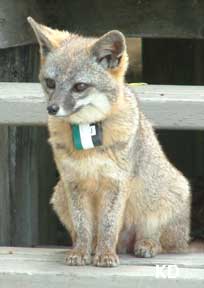
Tracking collars, like the one slightly visible on the picture at the left, are worn by island foxes across the four islands where they are considered endangered: San Miguel, Santa Rosa, Santa Cruz and Santa Catalina Islands. (Look for the brown of the collar just below the fox's white cheek patch and the antennae rising up behind its ear and going over its back.) Why are radio collars important? This rare species of fox is found only on California's Channel Islands. Where do island foxes live? In the year 2000, four of the subspecies faced extinction. But through the joint efforts of conservation organizations, government agencies, involved local citizens of all ages and dedicated biologists in the field, all of the endangered Channel Island fox populations are recovering. What does recovery look like?
Thank you to everyone: our friends, neighbors, concerned students and global partners. You all are playing an active role in helping to save the Channel Island fox.
There is still more work to do: You can play an important roll in providing lifelong identification for an island fox.
male island fox after recovery from leg amputation
FIF strives to connect the scientists in the field with the local community that cares about Channel Island foxes. We are thrilled to offer this:
Report from the Field
By Calvin Duncan, Island Fox Biologist,
Catalina Island Conservancy
No matter how many times it happens, it is
always amazing to see the resilience of animals and their ability to bounce
back from serious injury. While conducting the annual Island-wide fox trapping survey and vaccination efforts last fall, Conservancy biologists captured a
five-year-old male fox suffering from a compound fracture (broken bones exposed
through skin) on his rear right leg.
The injury occurred several weeks prior to
his capture and we suspect that another dominant male fox in the area was
likely to blame. “Island foxes are extremely territorial” reports Julie King,
the Conservancy’s senior wildlife biologist. “Injuries sustained by fighting
males can often be permanently debilitating or even fatal.”
In most cases the proper approach is to let
nature, as cruel as it may often be, take its course, but the Conservancy is
still actively working to recover the Catalina Island fox population from its
near extinction in 1999. For that reason, we actively treat injuries detected
in the field and work to improve the health and survival of each fox captured
during the annual survey. Approximately 80% of the fox population on Catalina
Island is also vaccinated against both canine distemper virus (CDV) and rabies
as a means of protecting the population against another potential disease
introduction.
In this particular case, the injured fox
was immediately transported to the Animal Clinic in Catalina for assessment and
potential treatment. In addition to the obvious leg injury the fox was also
extremely thin due to its inability to effectively forage for several weeks.
Conservancy biologists consulted with Avalon veterinarian Dr. Richard Denney
and agreed upon an approach that would require the amputation of the injured
leg.
According to Julie King there have been
several wild foxes on Catalina and the other Channel Islands that have
sustained injuries where the amputation of a leg was necessary and the foxes
were released and survived.
“At the conclusion of the captive breeding
program in 2004, an adult female was released with only three legs” says Julie
King, “while monitoring her post-release, she was found to have traveled
several miles before settling into a territory and successfully raising pups.”
Biologist Calvin Duncan with recovering fox
Though the bone fracture on the male island
fox occurred within the tarsal bones or “ankle joint,” the leg was amputated
mid- femur and the remaining nub was tucked under the skin. According to Dr.
Denney this was necessary in order to eliminate the chance that the fox would
attempt to walk on the remaining limb leading to abrasions and potential
infection.
After the surgery the fox was transported to the Conservancy’s
Middle Ranch Wildlife Field Clinic where he was cared for by Conservancy
biologists during his twenty-day recovery.
On October 4, 2011 he was fitted
with a radio collar and successfully released at his original capture location.
We continue to monitor this fox as he makes his adjustment back into the wild
and to date he is doing well.
This is another example of how radio collars are used to help monitor individual island foxes.
Video of an island fox barking taken by Calvin Duncan
Across the Channel Islands young island foxes are striking out on their own. They have spent the summer playing with their siblings and growing up. Their parents have taught them to hunt and find native fruit. Island fox food. Now, it is time for them to search out their own territory.
Tani, the young island fox that we have been following on Twitter, has left her parents and faced some challenges. Tani. A few days ago she tangled with another adult island fox female and was injured. Island foxes depend on the resources in their territory and they will protect their territory from other island foxes. Tani was lucky to only be injured on her ear, but the infection she suffered left her weak and vulnerable. Fortunately, on the Channel Islands biologists in the field are able to provide somemedical care to wild island foxes. (Channel Islands National Park, Santa Catalina Island and the U.S. Navy islands)
When Tani received medical treatment she also was fitted with a radio collar to track her movements. The radio collar will provide information on how far she travels from her parents home range and enable biologists to understand where a young fox establishes its own territory.
Across the islands young island foxes face challenges surviving without their parents. In the past two months several young island foxes have been hit by cars on Santa Catalina Island. Territory along roads can be attractive, but inexperienced youngsters don't know how to avoid cars. Support Watch for Foxes Signs.
This autumn Friends of the Island Fox funded our 72nd radio collar to track island foxes on the Channel Islands. Radio collars provide information on island fox movements and also alert biologists when an island fox has died. If the animal stops moving for a 6-8 hours, the collar gives off a special mortality signal. With the aid of the radio collar, biologists can locate the island fox's body and determine if the animals death marks a potential threat to other island foxes. Response to introduced disease and unexpected predation by golden eagles can happen rapidly when biologists have specific information from animals in the field. Radio collars on island foxes have helped the endangered populations on San Miguel, Santa Rosa, Santa Cruz and Santa Catalina Islands to make unprecedented recoveries.
photo courtesy of Kevin Pease
Tani is wearing her new radio collar and hopefully it will help biologists track her recovery and her activities as she becomes an adult island fox and establishes her own territory.
Across the Channel Islands endangered island foxes are successfully making a come back from the brink of extinction. You and your friends and neighbors are helping to make a positive difference. Friends of the Island Fox extends our thanks to the following special friends that have made extra efforts on behalf of endangered island foxes.
This summer Native Foods Cafe raised funds for the island fox during a day of business. Their event raised $500 for island fox conservation.
In May, Island Fox Program Director Pat Meyer and Keri Dearborn, Education Director, were interviewed on Cynthia Fox's Sunday morning show "Spotlight on the Community" on KLOS Radio. Listen to the Interview. Cynthia Fox continued her support by sponsoring a fox radio-tracking collar.
This summer private donors supported another radio-tracking collar to bring our total number of collars funded to 72!
Because of your support and concern this local endangered species is recovering. Your involvement on behalf of the island fox is allowing images like the one below to be natural once again. Watch as an island fox ventures into a bald eagle nest at night looking for tidbits of food that the bald eagle chick has dropped. This is a brave little island fox, notice the bald eagle chick (bigger than the island fox) sleeping in the lower right corner.
Island foxes across the Channel Islands thank all of you who care and are taking action to support health checks and vaccinations, radio collars and education to make a positive difference on their behalf.
wild island fox wearing radio collar funded by Fresno Chaffee Zoo
Zoos of the 21st century are active partners in conservation. Friends of the Island Fox salutes our Zoo friends.
The Fresno Chaffee Zoo has awarded a conservation grant to Friends of the Island Fox for 5 years in a row. They have sponsored 20 radio collars to monitor island foxes in the wild! These radio collars are vital to maintaining a healthy wild population and demonstrate the role modern zoos play in supporting conservation efforts to preserve and restore healthy wild ecosystems. Thank you to the keepers and staff of Fresno Chaffee Zoo for being true island fox friends. Visit the Fresno Chaffee Zoo. The Santa Barbara Zoo is home to four island foxes, three San Clemente island foxes born in captivity and a Santa Rosa island fox with a chronic health condition. The keepers and staff of the Santa Barbara Zoo wrote the book on keeping captive island foxes healthy and on successfully breeding them. When island foxes became endangered in the wild (the crisis years - northern islands, Catalina Island), the knowledge gathered at the Santa Barbara Zoo helped to establish successful captive breeding programs on four islands. Zoo veterinarians have also provided vital healthcare to wild island foxes. The Santa Barbara Zoo is home to Finnigan, the education island fox, helping to bring the story of this endangered species to thousands of local people every year. Thank you to the keepers and staff of the Santa Barbara Zoo for being true island fox friends. Visit the Santa Barbara Zoo.
Size of golden eagle presented at AZAD Conference
The docents of the Los Angeles Zoo and Botanical Gardens have made educating the local community about the endangered island fox a priority mission. This September they carried their education outreach back to Memphis, Tennessee to the national conference of the Association of Zoo and Aquarium Docents. The success of island fox recovery depends on active partnership between scientists, conservation organizations, government agencies and an educated local community. The Friends of the Island Fox grew out of the docent program at the Los Angeles Zoo and these dedicated volunteers continue to be some of our greatest supporters. (Annual Earth Day event) Thank you to the docents of the Los Angeles Zoo and Botanical Gardens for being true island fox friends. Visit the Los Angeles Zoo.Become a docent.
Pat Meyer and Canalino Elementary 4th grade students
What can you do with popcorn and hot chocolate? Help save the endangered island fox!
Fourth grade students at Canalino Elementary School in Carpinteria, California have become Island Fox Ambassadors. They made posters to increase awareness about the endangered island fox and they raised funds by selling popcorn and hot chocolate at a school movie night.
The fourth grade students learned about the island fox through their teachers and a presentation by Friends of the Island Fox educators. (For information on Island Fox classroom programs call 805 228-4123 or e-mail admin@islandfox.org).
Working together the Canalino students raised a large enough donation to support a radio tracking collar for an island fox. Radio tracking collars are vital to monitoring island fox welfare across the Channel Islands. More on GPS collars.
The “Canalino collar” marks radio collar #65 supported by generous donations to Friends of the Island Fox. Part of the island fox’s rapid recovery from the brink of extinction is due to the partnership between scientists, conservationists and the public.
Friends of the Island Fox proudly adds the fourth grade students of Canalino Elementary School to our list of Island Fox Ambassadors.
The island fox is a California treasure and it needs devoted conservation ambassadors like these students to safeguard its survival into the future.
You can make a positive difference too, by supporting island fox conservation through the donation button at the top of the page.
Follow the adventures of Tani, an island fox on Twitter@ ifoxtweet, see box to the right, or Find us on Facebook. May 24th will mark a landmark day for this island fox pup. You won’t want to miss it!
We often talk about how radio-tracking collars on endangered island foxes provide an important early warning sign of disease or unnatural predators on the Channel Islands. Importance of radio collars
In December, radio tracking collars and special GPS tracking collars provided important information on island fox locations and activity during the Catalina Grand Prix motorcycle event.
Catalina Island Conservancy biologists were able to determine the location of island foxes near the race event, track fox activity during the event and determine that no foxes were directly injured by motorcyclists. At the end of January, the island foxes with GPS collars will be captured again so that detailed information can be downloaded from their GPS collars. These high-tech collars record location data every 75 minutes. By putting these special collars on a group of island foxes before the motorcycle race, movement behavior was documented prior to the race, during the race event and for several weeks following the event.
When the full data is collected and analyzed the biologists will be able to determine if the race changed the animals’ behavior and how long it took for the foxes to return to their normal movement patterns.
This is a great example of how technology can help us make better choices in our interactions with wildlife, especially endangered species like island foxes.
August 2010 brings exciting news and support for the island fox.
Island Fox Friends from Fresno Chaffee Zoo visit Santa Cruz Island
For the third year in a row the Fresno Chaffee Zoo’s Conservation Committee has awarded a conservation grant toFriends of the Island Fox.
The $1,000.00 grant will fund four radio collars to be worn by endangered island foxes on the northern islands.
Radio collars provide biologists with information on where island foxes are living and whether or not they are alive. (See Catalina Island Fire) If an island fox stops moving for 6 hours, the radio collar changes its regular transmission pattern to a “mortality beep.” This allows biologists to recover the body quickly and determine the cause of death (Necropsy).
Island foxes with radio collars provide the first alert that a golden eagle has returned to the Channel Islands, that disease has been introduced, or that some other unnatural situation could be impacting island foxes. See Fire Fox and The Island Fox and the Fishing Hook. This past spring, several island foxes were killed when a golden eagle returned to the island. (Santa Rosa)
With the grant funds provided by the Fresno Chaffee Zoo, Friends of the Island Fox has now funded 56 island fox radio collars: 42 for the northern islands in Channel Islands National Park and 14 for the southern island of Santa Catalina.
While island foxes on Santa Rosa Island faced additional challenges this year, populations are successfully recovering on San Miguel, Santa Cruz and Santa Catalina Islands. A major part of that recovery is community involvement. Each island fox wearing a radio collar has a story and many of those stories begin with proactive people.
56 Radio Collars - Each one represents a personal donation, a community group like the Eaton Canyon Nature Center Associates, or the energy and conviction of a Fox Ambassador School.
You too can help save the endangered island fox by supporting conservation efforts and Friends of the Island Fox.
Last week biologists and land managers from across the Channel Islands came together to report on the current status of California's endangered island fox.
The news in 2010 is very positive. Conservation efforts are paying off in increased population numbers for all four of the endangered subspecies–San Miguel, Santa Rosa, Santa Cruz and Santa Catalina Islands. But even as there was discussion on the criteria needed to support a possible delisting from endangered status, the importance of monitoring these vulnerable populations was brought home.
In the early months of this year, 11 island foxes on Santa Rosa were killed by an unnatural predator, a golden eagle. A juvenile golden eagle was spotted on several occasions, but to date it has not been caught. The deaths of the endangered animals came to light because of individual island foxes that were radio collared and monitored.
Across the islands radio collars enable biologists to quickly locate a fox that has died. When the animal doesn't move at all for six hours the radio collar changes it signal to a "mortality" pattern. This timely knowledge enables the biologists to immediately find the carcass and begin to determine the cause of death. The sooner the cause of death is understood, the quicker steps can be taken to protect other island foxes.
Radio tracking collars play a vital role in monitoring island foxes and have helped these tiny animals to make an unprecedented recovery for an endangered mammal species. This is why Friends of the Island Fox has worked to raise funds to place radio collars on individual island foxes. (See Radio Collars)
As we distill down our notes from the Annual Conference and verify our information with the island fox biologists, we will be posting an update for each of the 6 subspecies of island foxes.
While there are still challenges ahead for endangered island foxes, population numbers are up and community awareness is growing. Friends of the Island Fox thanks all of you who have played a role in raising funds, educating the public, and working on island fox conservation. You have played an important role in bringing the island fox back from the brink of extinction.
Friends of the Island Fox is proud to announce the funding of our 50th radio collar!
Despite the difficult economic times, people like you have stepped forward to play an active role in saving the endangered island fox.
Radio collars play an important role in allowing biologists to track fox behavior, monitor fox health and determine threats to fox survival. Radio collar on fire fox
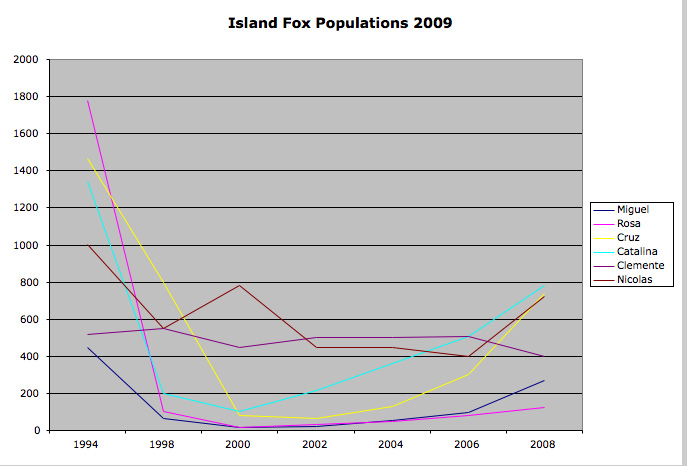
Today, with your help and support, island fox populations are recovering. Current populations
Because island foxes live only on the Channel Islands, like all island species they are small populations that can be quickly impacted by the introduction of disease, ecosystem imbalance and potentially, climate change.
Across San Miguel, Santa Rosa, Santa Cruz and Santa Catalina Islands, island fox numbers are rising. Populations that hovered just above extinction, with just 15 individual animals, are climbing toward recovery.
This Holiday Season you can give the gift of helping support island fox recovery.
$250 funds a radio-collar for an island fox To date Friends of the Island Fox has funded 47 radio-tracking collars for monitoring wild island foxes. Radio collars provide important information on island fox welfare, including the first information on threats from disease or golden eagle predation. Radio Collars.
When you sponsor a radio collar you receive information about an individual island fox, its history and current life in the wild. You are actively playing a role in island fox conservation. $100 supports Friends of the Island Fox education programs in schools This year alone, FIF provided FREE educational programs to 2,000 students from 3rd grade to college. The next generation is the vital connection to sustaining wild populations of island foxes. FIF in schools. Interaction with students and community.
$50 funds rabies and distemper vaccinations for 5 island foxes Diseases transmitted from domestic pets or introduced animals pose a serious threat to island foxes. Each year island foxes are given Health Checks. In order to maintain viable populations in the face of another disease outbreak, 80 - 100 island foxes need to be vaccinated on all 6 islands.
You can play an active role in island fox recovery by donating to Friends of the Island Fox. Give a gift that makes a difference and helps to save the endangered island fox.
In 2005, Kevin Pease encouraged his school to become the first Island Fox Ambassador School and they raised funds for one of Friends of the Island Fox's first radio collars.
During the summer of 2006, Kevin and his family went to Santa Cruz Island and he sent us his Island Journal complete with an island fox photo.
Kevin returned to Santa Cruz Island again this summer and sent us the following update:
Santa Cruz Island Journal - Summer 2009
Not even after 5 minutes of having been on Santa Cruz Island did I see an island fox, casually strolling through the campgrounds. This reoccured every day for the seven days I was out there. Some days there would be multiple foxes together, looking for food or picking a fight with the skunks. I would have to say though the last night there was the best. Venturing out at around 10 PM for a night hike, I came across two adults and about three pups. The pups were curious, running up and sitting in front of my feet staring up at me, it was a wonderful experience. What was remarkable and joyous about this trip was the difference in population. On the first trip to the islands I saw few foxes but now, they are all over the place. The hard efforts to help these foxes is really showing! - Kevin
A major factor in the rapid recovery of the endangered island fox has been the active participation of school children and community members in island fox conservation efforts.
You can help support island fox conservation by contributing to Friends of the Island Fox.
During Fall health checks, funds are needed to vaccinate wild island foxes against rabies and distemper. Funds are also needed to radio collar island foxes to monitor the health of the population.