Happy 50 Years of protecting Catalina Island's wildlife and wild places to the Catalina Island Conservancy (CIC).
This photo says it all. Twenty-three years ago Catalina Island foxes faced extinction from introduced canine distemper virus. Today Catalina's island foxes thrive.
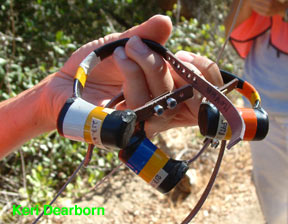
Nineteen refurbished radio-tracking collars and two new ones provided by Friends of the Island Fox are being deployed onto Catalina Island foxes, right now.
Why the bands of color?
Catalina Island Conservancy biologist Emily Hamblen explains that the color-coding is individual to each collared fox. Especially on Catalina Island, this adds an additional way to collect information on individual animals. "When visitors report that they have seen a fox with a specific color combination," Hamblen says, "...it helps us keep track of foxes between telemetry shifts."
This fall on Catalina Island, four new faces are working with Hamblen: (Above, from left to
right) Makenzie Henk (Conservancy wildlife biologist), wildlife interns
Ava Johnson and Jenna Hatfield, and Ricky Robbins (wildlife technician). Hamblen says: "This year, the fox interns helped us prepare the collars by adding the colored tape, checking to ensure the frequencies were correct, and punching holes in the leather of the collars so that we can place them on foxes more quickly in the field."
The Catalina team is into its third week of counting island foxes and placing radio collars. "We have placed 11 collars so far," Hamblen reports, "and plan on placing the rest over the next 4 weeks!"
She added, "I was reflecting on how important the contributions of FIF have been to the success of this year's fox program."
In 2021, your donations provided the following for island foxes on Catalina:
Thanks to Friends of the Island Fox a
speed-detecting traffic sign on Catalina Island is back in operation
slowing down drivers.
I'm happy to report that with funding from FIF we have repaired our radar speed detector and deployed it on the landscape! says Lara Brenner, Wildlife Biologist for the Catalina Island Conservancy. In the next few days I will take some time to hide in nearby brush
and monitor the speed machine's efficacy at convincing people to slow
down. Thank you so much for your continued support of our fox program. We
hope to continue working with you to decrease the impact of vehicles on
the Catalina island fox population.
The traffic sign is again alerting drivers to SLOW DOWN and watch for island foxes.
Thank you to ALL of our DONORS who helped fund this important fox-safety effort on Catalina. Working with the Catalina Island Conservancy, we can make sure Catalina Island foxes continue to have a solid recovery and healthy future.
male island fox after recovery from leg amputation
FIF strives to connect the scientists in the field with the local community that cares about Channel Island foxes. We are thrilled to offer this:
Report from the Field
By Calvin Duncan, Island Fox Biologist,
Catalina Island Conservancy
No matter how many times it happens, it is
always amazing to see the resilience of animals and their ability to bounce
back from serious injury. While conducting the annual Island-wide fox trapping survey and vaccination efforts last fall, Conservancy biologists captured a
five-year-old male fox suffering from a compound fracture (broken bones exposed
through skin) on his rear right leg.
The injury occurred several weeks prior to
his capture and we suspect that another dominant male fox in the area was
likely to blame. “Island foxes are extremely territorial” reports Julie King,
the Conservancy’s senior wildlife biologist. “Injuries sustained by fighting
males can often be permanently debilitating or even fatal.”
In most cases the proper approach is to let
nature, as cruel as it may often be, take its course, but the Conservancy is
still actively working to recover the Catalina Island fox population from its
near extinction in 1999. For that reason, we actively treat injuries detected
in the field and work to improve the health and survival of each fox captured
during the annual survey. Approximately 80% of the fox population on Catalina
Island is also vaccinated against both canine distemper virus (CDV) and rabies
as a means of protecting the population against another potential disease
introduction.
In this particular case, the injured fox
was immediately transported to the Animal Clinic in Catalina for assessment and
potential treatment. In addition to the obvious leg injury the fox was also
extremely thin due to its inability to effectively forage for several weeks.
Conservancy biologists consulted with Avalon veterinarian Dr. Richard Denney
and agreed upon an approach that would require the amputation of the injured
leg.
According to Julie King there have been
several wild foxes on Catalina and the other Channel Islands that have
sustained injuries where the amputation of a leg was necessary and the foxes
were released and survived.
“At the conclusion of the captive breeding
program in 2004, an adult female was released with only three legs” says Julie
King, “while monitoring her post-release, she was found to have traveled
several miles before settling into a territory and successfully raising pups.”
Biologist Calvin Duncan with recovering fox
Though the bone fracture on the male island
fox occurred within the tarsal bones or “ankle joint,” the leg was amputated
mid- femur and the remaining nub was tucked under the skin. According to Dr.
Denney this was necessary in order to eliminate the chance that the fox would
attempt to walk on the remaining limb leading to abrasions and potential
infection.
After the surgery the fox was transported to the Conservancy’s
Middle Ranch Wildlife Field Clinic where he was cared for by Conservancy
biologists during his twenty-day recovery.
On October 4, 2011 he was fitted
with a radio collar and successfully released at his original capture location.
We continue to monitor this fox as he makes his adjustment back into the wild
and to date he is doing well.
This is another example of how radio collars are used to help monitor individual island foxes.
Video of an island fox barking taken by Calvin Duncan
The Catalina Island Conservancy reports that a raccoon was spotted in the Two Harbors Campground on Catalina Island. Despite a rapid response setting up capture cages, the raccoon has not been apprehended. This raccoon poses a serious threat to island foxes and other endemic island species.
Raccoons are not native to the California Channel Islands and they are now believed to have been the source of the distemper virus that killed over 88% of the Catalina Island foxes between 1998 and 2000. More on the threat posed by raccoons.
If you should see the raccoon on Catalina Island please contact the Catalina Island Conservancy. For the safety of the island fox and other island species it is imperative that this raccoon is apprehended as soon as possible.
When is a cute raccoon a serious threat? When it is mistakenly transported to the Channel Islands.
The masked face of a raccoon makes us sigh and their antics can make us laugh, but raccoons pose a serious threat to native wildlife on the Channel Islands. Raccoons are not native to our California islands. Species like the island fox, spotted skunk and island birds have all evolved without raccoons and without the diseases and parasites that raccoons can carry.
Recent research has pointed to a raccoon as the origin of the distemper virus that nearly wiped out the island fox population on Santa Catalina Island between 1998-2000. Raccoons carry many diseases, like rabies, parvo and distemper, that are fatal to canines. The introduction of a single disease-infected raccoon could have drastic consequences for endangered island foxes and other unique island species. Support vaccinations.
How does a raccoon get all the way from Los Angeles or Santa Barbara to the Channel Islands?
In the past few years, raccoon populations have grown in harbor areas. This means that occasionally they wander onto private boats. Unsuspecting boat owners may have a stowaway raccoon that they unknowingly transport to the islands. While this scenario may seem unbelievable, it has happened on Catalina Island several times in the last two years. Because Catalina is fairly populated and Avalon is the primary port of entry, the Catalina Island Conservancy has been alerted to the arrival of these raccoons. Usually the animal is caught within a short window of time, but one raccoon traveled to the interior of the island in just three days.
A raccoon accidentally introduced to Channel Islands National Park might go undetected for sometime, potentially coming in contact with numerous island animals.
Friends of the Island Fox urges all boat owners traveling to any of the Channel Islands to make sure there are no stowaway animals on your boat before leaving the harbor. Pass this information on to friends and family that may be boaters along the southern California coast.
Autumn is the time for counting island foxes across the Channel Islands and providing them with health checks. Early word from our friends at the Catalina Island Conservancy is that island fox numbers are up and they may see their population reach a 1000 this year!
Considering that the Catalina Island fox was nearly wiped out by the introduction of the distemper virus in the late 1990s, the rebounding of the wild population is a huge success story. Friends of the Island Fox has participated in this recovery by funding radio tracking collars for island foxes on Catalina.
The CIC has posted a wonderful slide show of the whole capturing and health check process. Click HERE to visit the slide show.
Read more about Island Fox Health Checks and listen to biologist Julie King as she does a health check in the field.
Friends of the Fox offers an interactive Fox Health Check Presentation to teach children and adults about the island fox and the work biologists actually do in the field.
To contact us regarding programs about the island fox: 805 228-4123 or admin@islandfox.org
What is small, but mighty? Only 3-6 lbs., but willing to stand its ground and protect its territory? An island fox.
Catalina Island Conservancy wildlife biologist Calvin Duncan approached a wild fox’s territory, he took this video of an island fox on Santa Catalina Island.
Protecting territory is important for a pair of island foxes. They need a hunting area that will provide enough food to support themselves and their pups. How does an island fox let you know you are in its territory? Watch and see.
Images like this of an island fox in the wild are very rare. Island foxes on Santa Catalina Island declined dramatically between 1998 and 2000 because of a disease, canine distemper, that was passed to them from a domestic dog. Today the estimated population has increased to approximately 572 individuals, slightly more than one third of their original number. Catalina island fox decline
The fact that island foxes are running wild again on Catalina, Santa Rosa, Santa Cruz, and San Miguel Islands is due to the undaunted efforts of biologists, scientists, government agencies, private conservation organizations and concerned individuals like YOU.
When you support island fox conservation efforts YOU HELP to make sure that moments like this will continue into the future.
The Santa Catalina Island fox became endangered when an outbreak of disease, believed to be canine distemper, killed over 85% of the population in just a few years. To help prevent such catastrophic events in the future, biologists across the Channel Islands use the late summer and early fall to count island foxes and give them health checks.
In September, Friends of the Island Fox went out in the field with Julie King, fox biologist for the Catalina Island Conservancy as she did health checks on wild island foxes. Click to Listen to Island Fox Talk Podcast in the field with Julie King as she examines a young female island fox.
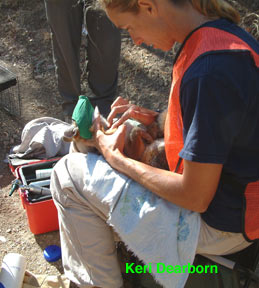
An island fox health check involves:
taking the weight - The island fox is weighed while still in the trap.
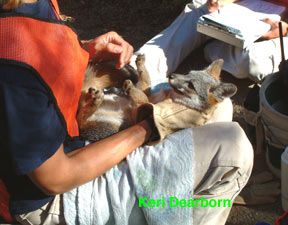
evaluation of over all physical status - The biologist feels the fox’s body for any lumps, bumps or wounds. (photo above)
visual check of teeth, coat - Teeth are checked for wear and breakage (this female fox was under 2 years old but had a broken tip on an upper canine tooth); the coat is examined for overall heath and the presence of parasites, fleas and ticks.
ear exam - An otoscope is used to look in the fox’s ears. The biologist is looking for ear mites, inflammation and disease.
vaccinations - Island foxes receive vaccinations to help reduce the chance of disease.
drawing a blood sample - The blood sample provides additional information on health and possible disease exposure. A mask is put over the foxes eyes to reduce the animal's stress while being handled by humans.
The island foxes on Santa Catalina are increasing in number, but a new threat is causing them problems, ear mites. Cancerous tumors are forming in the ears of island foxes on Catalina. The relationship between the ear mites and the cancer is currently being studied. Friends of the Island Fox would like to help the Catalina Island Conservancy in their quest to solve this mystery that is posing a new danger to island foxes. You can help by making a donation through the "Pay Pal" or "Donate Now" buttons at the top right of the page. Through generous donations Friends of the Island Fox has funded 17 radio collars in the past 2 years so island foxes can be monitored in the wild. Your donation to Friends of the Island Fox helps fund conservation efforts across all of the Channel Islands to help save the island fox.
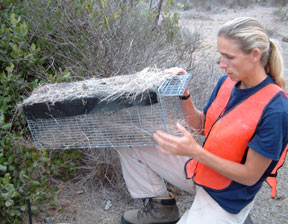
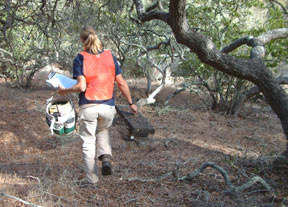
If you are a fox biologist on the Channel Islands, late summer through early autumn is a busy season. During this short window of time, island fox populations are counted and individual animals receive health check-ups. To get their hands on these pint-sized, but sharp-toothed predators, special box-type traps are put out in specific areas.
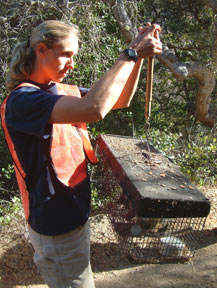
In September, Friends of the Island Fox rode along with Julie King, fox biologist for the Catalina Island Conservancy. The day on Santa Catalina Island started very early, because all of the traps on a string must be checked before the day starts to get warm.
Most foxes are captured in the evening or during the night. Even so, the traps are set in shaded spots so that a fox won’t become overheated. Each trap has a covering over the top and grass or hay inside to make it more comfortable
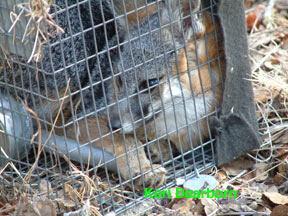
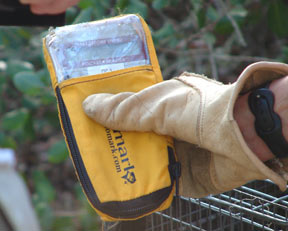
The fox is first identified by its “pit tag.” A scanner responds to the microchip tag and displays the animals identification number. Endangered island foxes on Santa Catalina, San Miguel, Santa Rosa and Santa Cruz islands are given microchip identification tags like those you would use on your pet dog. The fox in the trap is scanned with the microchip reader to identify it. In this way, the biologist knows when the fox was last caught and whether or not it needs vaccinations, a health check or radio collar maintenance. If the fox does not have a microchip or pit tag, it will receive one.
If it has already been caught this season and has had its health check, the biologist will release the fox and reset the trap. If not, then the island fox will spend 15-20 minutes with the biologist getting a full health workup.
Join us November 20th for an audio podcast as biologist Julie King does a health check on an island fox.
Early reports on island foxes surviving the Catalina Island fire are very hopeful.
Ann Muscat of the Catalina Island Conservancy
“Habitat damage is extensive and will require further analysis. There is no obvious loss of larger wildlife (eagle chicks in nest, deer, bison, foxes). Our staff was able to fly over the Island and monitor for 48 radio-collared foxes and all signals were picked up. This is very good news. Foxes are in the pupping season, however, and staff are now surveying the burn area for females in their dens to see if pups are surviving. A number of iron wood and oak groves were lost, but until we can overlay our vegetation maps onto the fire area, we will not know the full extent of the loss of rare and endangered plant species.”
Julie King, Senior Wildlife Biologist, Catalina Island Conservancy adds the following fox details about four foxes that were sighted in the burn area. Three were non-injured, but one female fox with “severe burns to all four paws, severe dehydration and malnutrition” was captured. The “fox is being treated in the Middle Ranch Veterinary Clinic under the direction of Institute for Wildlife Studies veterinarian Dr. Winston Vickers. An additional fox was captured in the process, a large healthy male, was given a workup, fitted with a radio collar and released at the location of capture.”
As of Saturday, May 26, 2007:
We'll be setting traps all weekend to get a better assessment of potential injuries in the burn area. I'll be sure to keep you updated if we get any additional injuries. On a happy note, the fox we are treating is responding very well to treatment. When caught, she was only 1.2kg and she's now up to 1.7kg. She's eating well and so far there is no sign of infection in her paws. It has only been 5 days, but her feet do appear to be slowly healing. She has a long road ahead of her, but she's doing much better than we had initially expected. Dr. Vickers will be out on June 4th to do an assessment. - Julie King
As the information from the Catalina fire area becomes available we will post it here. Friends of the Island Fox is rallying our resources to see what we can do to help the Catalina island foxes. These island fox survivors of the fire need our support more than ever.
Just a quick Update on the island foxes on Santa Catalina Island.
Friends of the Island Fox has been in communication with the Catalina Island Conservancy (CIC).The few individual island foxes that are in captive care for health problems and Tachi, CIC's education fox, are all fine. (For more about Tachi)
As of Thursday May 17, the fire is completely out. Now biologists are beginning the task of trying to locate radio collared island foxes to determine if there were any fatalities due to the fire.
CIC will make their full report at the Fox Conference in mid June. A complete summary of all island fox conservation successes and issues will be posted here following the Conference. (most recent look at island foxes on Santa Catalina Island)
Thank you for your concern about the island foxes in the face of this recent fire threat.
As of 6 PM Friday May 11 the wildfire on Catalina Island appears to be 35% contained. The current situation is an unfortunate example of the delicate nature of island habitats.
Officials from the Catalina Island Conservancy report:
Bald Eagles The bald eagle chicks that recently hatched on the island are safe. The nests are on the eastern end of the island and not near the fire area. (more on the new bald eagle chicks)
Island Foxes Currently the effect of the fire on wild island foxes is unknown. Radio collars on individual foxes will be vital in locating individual animals and determining if any have been overwhelmed by the wildfire.
This is another situation that highlights the importance of radio collars on the endangered island foxes on San Miguel, Santa Rosa, Santa Cruz and Santa Catalina Islands. Island foxes are currently having their pups on the islands. This new generation will soon need radio collars.
You can help make sure all endangered island foxes have radio collars.
As details regarding the Santa Catalina island foxes and the Catalina Island Conservancy become available Friends of the Island Fox will provide updates through our Island Fox News e-mails. To be added to the e-mail list contact us at islandfoxnews@gmail.com
For photos and an article in the Los Angeles Times CLICK HERE