Showing posts with label zoos helping endangered species. Show all posts

Tuesday, February 11, 2025

Conservation Working Dogs and Zoos Helping Wildlife

photo courtesy of TNC and WD4C
 

Meet “Moose” a hard-working canine with the nonprofit organization Working Dogs for Conservation (WD4C).

Moose recently completed a tour of duty on Santa Cruz Island as part of a multi-organizational effort to find a better way to gather information on island spotted skunks.

Island spotted skunks only live on Santa Rosa and Santa Cruz Islands. As island foxes recovered on these islands, island spotted skunks seemed to have declined. There is concern for these rare little skunks and a lack of understanding about their relationship with island foxes. Do island foxes directly impact island spotted skunks? Do they compete for similar resources?

Friends of the Island Fox has supported several research investigations into this relationship:

In 2024, the question arose about western spotted skunks in captivity that might participate in research studies as a control for island spotted skunks. FIF’s Education Director, Keri Dearborn, did an internet search and found “Boo” a female western spotted skunk at the Sequoia Park Zoo. Boo and her two brothers had been orphaned when they were very young. Though they were rescued, they became imprinted on humans and couldn’t be returned to the wild. Boo was living at the Sequoia Park Zoo in Eureka and her two brothers were at the Turtle Bay Exploration Park near Redding.


While Thomaier’s field cameras have documented island spotted skunks, to-date identifying individual skunks in images has been very difficult. Island spotted skunks push off radio collars and typically avoid capture.

Lara Brenner, Island Scientist with The Nature Conservancy, had been working with a conservation dog to sniff out invasive Argentine ant colonies on Santa Cruz Island. Could a conservation working dog locate island spotted skunk dens? Finding scat and dens would be less invasive than capturing skunks and might open up a whole new way to determine their numbers.

Moose gets suited up for work
 

Moose had experience tracking grizzly bears and locating their dens. Could he do the same job for tiny island spotted skunks? Protocol for a test was put in place. Because island foxes are susceptible to canine diseases and because island foxes can be a source of disease for dogs, Moose was up-to-date on all of his vaccinations.

The two zoos collected soiled bedding and feces from the three western spotted skunks. The fragrant material was sent to a WD4C training location in Montana, where Moose learned to identify spotted skunk scent. Would the western spotted skunk scent be close enough to the island spotted skunk scent for Moose to be successful?


Toward the end of 2024, Moose and his handler traveled to Santa Cruz Island. Moose “hit the ground running,” Brenner says. As a conservation working dog, he wears a special harness with bells and a GPS locator. Brenner explains that the GPS locator “is so that we can record his tracks and understand [his] search effort… i.e. how far does Moose have to go and how long does he have to sniff before he finds a skunk?”

On the first day, Moose signaled his handler that he’d found an island spotted skunk den. 


Working the hillsides with a canine nose, detection dogs are more efficient than people and have a higher success rate locating a target species. Over three weeks, Moose found several den sites, including this one with an island spotted skunk at home, and 12 scats.

Island spotted skunk in den (courtesy of TNC)

Can DNA from the scats identify individual island spotted skunks? Can genetic meta-barcoding of scat samples identify specific dietary items for island spotted skunks and island foxes? We’re just at the tip of learning how working dogs like Moose can contribute to island conservation?

courtesy of TNC and WD4C
 

This project is a multi-institutional collaboration between Sequoia Park Zoo, Turtle Bay Exploration Park, The Nature Conservancy, Working Dogs for Conservation, and Friends of the Island Fox. The biggest credit goes to the four-footed collaborators: the three western spotted skunks who are helping their wild counterparts and a very talented working dog named Moose.

Friday, September 09, 2022

Zoos Helping Island Foxes


Sometimes you have to look behind the scenes to see the important role that zoos play in wildlife conservation. The island fox has several important zoo friends.

Fresno's Chaffee Zoo

Fresno's Chaffee Zoo has been a vital partner in island fox recovery and health for 16 years. It started with a few zoo keepers committed to helping island foxes and a donation for a radio-tracking collar. 

When the zoo established their Wildlife Conservation Fund, Friends of the Island Fox was a 2014 grant recipient. Over the years, the FCZ Wildlife Conservation Fund has funded not only radio collars, but vaccinations, equipment for safe capture of island foxes, important evaluation of island fox blood samples for evidence of disease and other critical health measures.

In January of 2022, the FCZ Wildlife Conservation Fund provided a special one-time grant that funded the refurbishment of 15 radio collars for Santa Cruz Island foxes. These collars were all placed on island foxes over the last month. The grant also helped fund vital testing for disease among island foxes.

Friends of the Island Fox just received our FCZWCF grant of $3,200 for 2022. This funding will go toward health monitoring and/or vaccinations for island foxes.


Santa Barbara Zoo

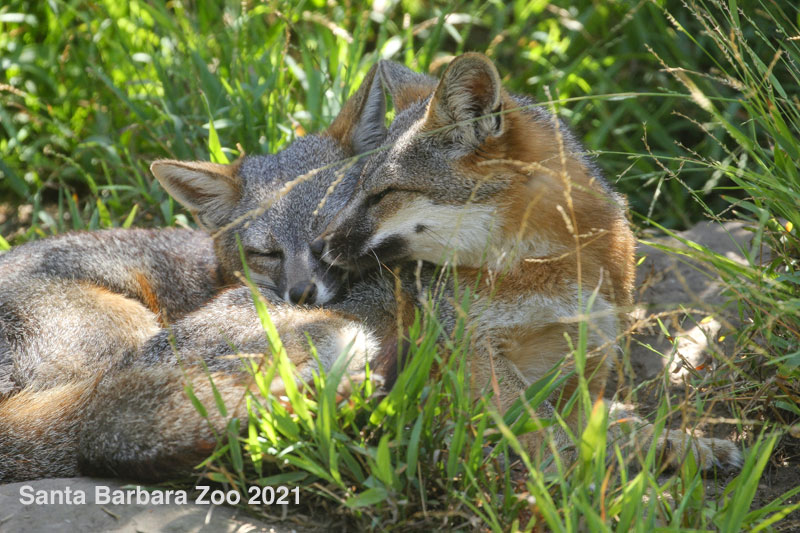
The Santa Barbara Zoo was the first to come to the aid of endangered island foxes and they participate in the Island Fox Conservation Working Group. Keepers and veterinary staff helped develop the care and feeding protocols for island foxes in captive breeding facilities from 2001–2006. The zoo has provided a home for a few island foxes and was the first to successfully breed island foxes in captivity. Today, all of the island foxes living in mainland zoos are rescued wild individuals that do not have the skills to survive in the wild. 

Lewis and Clark (above) are brothers who were abandoned by their parents in the midst of drought on San Clemente Island. Today these two island foxes play an important role for their wild relatives. Because they live in a controlled environment with ready access to veterinary care, they are health advocates for other island foxes. They provided samples to the island fox microbiome research study. 


Early in the pandemic it was discovered that Covid-19 could be passed to canines. As the pandemic grew there was concern for island foxes in the wild. Could biologists handle island foxes for health checks as they had in the past? Might island visitors pass Covid-19 to island foxes?

Island foxes are very susceptible to introduced diseases. Many vaccinations for dogs are not safe for island foxes. In the controlled environment of the Santa Barbara Zoo, Lewis and Clark were vaccinated against Covid-19. They had no ill side-effects. Zoo veterinarians monitor whether the vaccine continues to protect the two foxes. If necessary we know island foxes can be safely vaccinated for Covid-19.

Beau at the Living Desert

Island Foxes at other Zoos

Living Desert in Palm Springs - Home to Beau (above) a male abandoned as a pup during drought on San Clemente Island

Female gray fox and island fox sisters at CALM
 

California Living Museum in Bakersfield - Home to two sisters (above) abandoned as pups during drought on San Clemente Island

San Diego Safari Park - Home to Sage a female with a chronic health condition from Catalina Island

FIF is thankful for the continued support of island fox conservation from our Zoo Friends.

Wednesday, September 10, 2014

Fresno Chaffee Zoo Selects FIF for Five Year Grant

Fresno Chaffee Zoo representatives visiting Santa Cruz Island
The Animal Care Staff from the Fresno Chaffee Zoo has long supported island fox conservation. They first raised funds for radio-tracking collars in 2006.

The Fresno Chaffee Zoo awards conservation grants to a variety of worldwide conservation efforts each year. Over the past eight years, Friends of the Island Fox has received support from the Fresno Chaffee Zoo to fund:
This summer, we received notification that a five-year grant has been awarded to Friends of the Island Fox for island fox conservation. Of 66 applications only 8 were extend 5-year support. Among the grant recipients, FIF is the only organization working with a North American species in the United States!

We are thrilled by the support from our friends at the Fresno Chaffee Zoo. While Fresno may be over the hills from the Pacific Ocean and the Channel Islands, FIF has participated in Fresno's Earth Day celebration and found their visitors very interested in the island fox and its survival.


The success of island fox conservation is based on local support and dedicated partnerships. The first year of the Fresno Chaffee Zoo grant supported important serology or blood testing looking for the presence of canine diseases among island foxes and the replacement of equipment important to annual counting and health checks.

Their second year of support will continue supporting fieldwork by replacing 43 of the field capture cages that safely enable island foxes to be captured for annual counting and health checks.

During the annual evaluation of the six populations, approximately 100 specially adapted capture cages are employed on each island. To ensure disease is not transferred between islands, each Channel Island has its own set of field equipment. With the financial support from our island fox friends at the Fresno Chaffee Zoo, Channel Island fox conservation enters its 17th year with much needed new equipment.

Tuesday, April 08, 2014

Studying Island Fox Blood

What is the biologist doing to that island fox?


Blood samples play an important role in not only monitoring island fox health, but also in alerting biologists to potential diseases island foxes may have been exposed to. When an animal comes in contact with a disease, their immune system creates antibodies to fight against the disease threat. 

By testing island fox blood samples for titers, levels of antibodies, biologist can determine if island foxes have encountered new disease threats. They also can tell if individuals are carrying antibodies from vaccinations at high enough levels to protect them against know diseases like rabies and distemper.  

Serology, studying blood samples, may not sound very exciting, but it is very important to the recovery of the endangered island fox. Thanks to a $2,000 grant from our friends at the Fresno Chaffee Zoo, island fox blood samples taken during annual fall health checks last fall will be examined for antibodies to various canine diseases (distemper, parvo, etc.).

Thursday, September 08, 2011

Zoos Helping Island Foxes

wild island fox wearing radio collar funded by Fresno Chaffee Zoo
Zoos of the 21st century are active partners in conservation. Friends of the Island Fox salutes our Zoo friends.

The Fresno Chaffee Zoo has awarded a conservation grant to Friends of the Island Fox for 5 years in a row. They have sponsored 20 radio collars to monitor island foxes in the wild! These radio collars are vital to maintaining a healthy wild population and demonstrate the role modern zoos play in supporting conservation efforts to preserve and restore healthy wild ecosystems. Thank you to the keepers and staff of Fresno Chaffee Zoo for being true island fox friends. Visit the Fresno Chaffee Zoo.

The Santa Barbara Zoo is home to four island foxes, three San Clemente island foxes born in captivity and a Santa Rosa island fox with a chronic health condition. The keepers and staff of the Santa Barbara Zoo wrote the book on keeping captive island foxes healthy and on successfully breeding them. When island foxes became endangered in the wild (the crisis years - northern islands, Catalina Island), the knowledge gathered at the Santa Barbara Zoo helped to establish successful captive breeding programs on four islands. Zoo veterinarians have also provided vital healthcare to wild island foxes. The Santa Barbara Zoo is home to Finnigan, the education island fox, helping to bring the story of this endangered species to thousands of local people every year. Thank you to the keepers and staff of the Santa Barbara Zoo for being true island fox friends. Visit the Santa Barbara Zoo.

Size of golden eagle presented at AZAD Conference
The docents of the Los Angeles Zoo and Botanical Gardens have made educating the local community about the endangered island fox a priority mission. This September they carried their education outreach back to Memphis, Tennessee to the national conference of the Association of Zoo and Aquarium Docents. The success of island fox recovery depends on active partnership between scientists, conservation organizations, government agencies and an educated local community. The Friends of the Island Fox grew out of the docent program at the Los Angeles Zoo and these dedicated volunteers continue to be some of our greatest supporters. (Annual Earth Day event) Thank you to the docents of the Los Angeles Zoo and Botanical Gardens for being true island fox friends. Visit the Los Angeles Zoo.    Become a docent.