Showing posts with label Channel Island fox. Show all posts

Monday, March 10, 2025

"Date with a Fox" - Investigating Causes of Death in Island Foxes

Join Friends of the Island Fox for an insightful look into island fox health with veterinary pathologist, Leslie Woods, Ph.D. 

"Date with a Fox" Zoom Program

Mortalities in the Channel Island Fox 

(Urocyon littoralis)

The important role of postmortem examinations

Tuesday, March 18 at 6:30 pm PT


Leslie Woods, Professor Emerita of the California Animal Health and Food Safety Laboratory at the School of Veterinary Medicine at U.C. Davis has been investing island fox health since 2010.

Though retired, she continues to teach and performs all of the necropsies on island foxes.

What are the current health threats to island foxes? Why is it important to evaluate cause of death for wild animals? Professor Woods is a wonderful teacher and a true detective. 

Watch Recorded Video Program

(Be advised this program contains images of dead island foxes and bodily organs. Examination to determine cause of death is important, but the subject may not appeal to all viewers.)


Professor Wood's work provides factual scientific evidence so land managers can make informed decisions to help keep island fox populations healthy and safe.


Friday, February 04, 2022

Love is in the Air for Island Foxes, Too


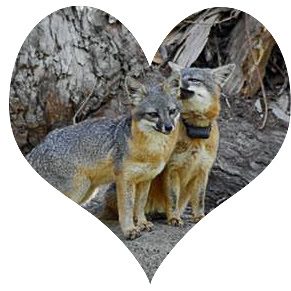
February isn't just the month of romance for humans, it is also when island fox pairs find a den and mate.

Island foxes are more monogamous than their gray fox ancestors. Territory and resources are limited on the Channel Islands and a pair of island foxes works together to protect their territory from other island foxes. They also work together to provide food for their pups. 

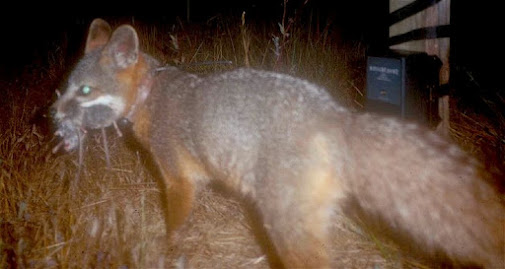
For the first month or so of the pups' lives, the female island fox stays close to the den to feed the pups and help keep them warm. She needs a male partner she can depend on to bring her food. A male island fox may bring his lady love a dead deer mouse or a small bird, to show that he is a good provider.

He also will protect their territory to keep the pups safe (and to keep other male island foxes away from his mate). 

A mouse gift may not seem as romantic as chocolates to us, but to a female island fox the gift of a deer mouse means her mate will be dependable and committed to helping her raise healthy pups. 


Friday, February 12, 2021

Unique As An Island Fox


We talk about the island fox being a unique and rare species, but what do we mean?

Unlike most North American fox species, the island fox (Urocyon littoralis) lives in very small, isolated habitats. Because each subspecies of island fox is limited to its specific island, all are restricted by geography to small populations. The smaller islands–San Miguel and San Nicolas–can only support a maximum of 400–500 individual island foxes. The largest two islands–Santa Cruz and Santa Catalina–appear able to sustain 2,000–2,500 individuals. Even at their maximum, these are small vulnerable populations. Current status

Island foxes are descended from one of the most, if not the most, ancient of living fox species, the gray fox (Urocyon cinereoargenteus). (island fox beside gray fox). As such, island foxes maintain some ancient traits that are shared with felines and other carnivore species, but not with other more modern canines–like wolves and red foxes.

Island foxes can rotate their front paws to climb. It is not unusual to see them up in small trees or large shrubs.

During captive breeding efforts to save island foxes from extinction, it was discovered that females do not go into a seasonal breeding heat. Female island foxes only have a hormonal surge and ovulate after contact with a male. This is called induced ovulation. Island foxes are the only known canine species to exhibit this reproductive trait, which is typical of cat and bear species. It is a primitive trait of Order Carnivora. This trait is most likely true for gray foxes, but because they are numerous in the wild, their reproduction has not been closely studied.

While the island fox evolved from an ancient canine lineage, it is a recently evolved species. Mitochondrial DNA places the island fox splitting away from the gray fox ancestor approximately 9,000 years ago.


Island foxes are the smallest fox species in North America. (island fox vs. fennec) Their small size is the result of island dwarfism. They also are impacted by island syndrome: changes in behavior and characteristics that have evolved over time due to the conditions in their island environment.

Island foxes are more active during the day than most gray foxes, because they lack a natural predator on the islands.

Resources on the Channel Islands are limited. Therefore, island foxes are highly omnivorous and eat a range of native fruits.

Living in a limited area, they sometimes experience higher density than most other fox species (more individuals living per square kilometer). Island foxes can be more accepting of other foxes in their territory during some parts of the year, but display higher levels of aggression and territoriality toward other foxes during breeding season. Observing island fox behavior

Island foxes have shortened tails. The number of vertebra in the tail ranges from 15–22 (depending on the subspecies). The cause or benefit for this adaptation remains unknown.

Perhaps the most unique trait of island foxes is their long and close relationship with humans. Living on the Channel Islands for thousands of years with indigenous peoples and then generations of ranchers, island foxes are habituated to people. They are wild creatures that are comfortable in the company of people. It is an amazing experience to share trails on the island with these bold little foxes. Step aside and they walk right past you.


In the following weeks we'll compare California's other fox species with the island fox.  

Series installments:

Red Fox: Life on the Edge

Gemini Foxes: Kit Fox and Swift Fox

Arctic Fox: Fox of the Tundra

The Island Fox's Origin - The Gray Fox

References

Coonan, Timothy J., Catherin A. Schwemm, and David K. Garcelon. 2010. Decline and Recovery of the Island Fox. Cambridge, UK: Cambridge University Press

Wang, Xiaoming and Richard H. Tedford. 2008. Dogs: Their Fossil Relatives & Evolutionary History. New York: Columbia University Press


Friday, January 29, 2021

Fox Foto Friday - Island Foxes Healthy Inside and Out


While we're all stuck at home, the word from the islands is that island foxes are thriving. Across the Channel Islands biologists are reporting healthy looking individuals and a fair number of pups.

2020 was a normal rain year with a hot summer. Populations may have adjusted down from the record highs of 2019, but that is to be expected. The rains across the islands this week, will help increase resources for island foxes throughout 2021. What do island foxes eat?

During 2020 health checks, island foxes on Santa Cruz, Santa Rosa, San Miguel, San Clemente, and San Nicolas joined their cousins on Santa Catalina by being swabbed for their microbiome. Samples have arrived at the lab for DNA analysis. Find out more about Dr. DeCandia's island fox microbiome research.

To survive into the future, island foxes need to be healthy inside and out. That's why FIF is helping investigate the biodiversity in the microbes and bacteria on their skin and throughout their bodies.

Sunday, October 11, 2020

Remember This Fox Face? - Fox Foto Day

 Do you remember this island fox face? 


This is F257–a female island fox on Santa Rosa Island. She first started wearing a radio-tracking collar (funded by FIF) last December when she was captured as a youngster.

In 2020, F257 is 18 months old and a mature female. It surprised everyone when she was caught in the exact same place she was found last year. This means she didn't disperse, or travel away, from her parents' territory.

It is typically expected that island fox pups will move away to find their own territory as they mature. Female offspring sometimes stay close to their parent's territory and that seems to be what F257 is doing.

She is looking healthy and happy in her territory adjacent to the coastline.

Friends of the Island Fox sends a "Hello" and "Thank You" to the biologists working across the Channel Islands. They are finishing up health checks and annual island fox counting. FIF is hearing good news from the field. Individual island foxes look healthy and populations appear stable.

Radio collars, like the one F257 is wearing, provide an important conservation monitoring system that provides an early alert system regarding threats to island foxes.

Your donations help to fund radio-tracking collars for island foxes.

Friday, August 23, 2019

Fox Foto Friday - The Endangered Species Act Saved This Fox

 Just over two years ago, the Channel Island fox was removed from the Endangered Species List.

The Endangered Species Act saved this fox!

 Survival shouldn't be political.


Saving a species is a very complicated task, and it requires a coalition of people all working together to make it happen. 
We shouldn't abandon the Endangered Species Act.
We should embolden it, embrace it, and help the world become a better place. 


The Endangered Species Act (ESA) has provided the necessary protection and attention to help save four subspecies of Channel Island foxes from extinction.

Wednesday, July 03, 2019

Fox Foto Friday - Radio Collars Going On Island Foxes

photo courtesy of M. Navarro, CINP
Island foxes on Santa Cruz Island are receiving health checks and being fitted with newly refurbished radio tracking collars RIGHT NOW!

You refurbished these radio collars and today they are going on island foxes.

Friday, September 21, 2018

FIF Research Grant to Investigate Island Fox Diet Through Whiskers

photo courtesy of P. Bronstein
Island foxes have lots of long black whiskers. These specialized hairs hold important information on diet that could inform decisions on island fox conservation.

Friends of the Island Fox is happy to announce: 

Juliann Schamel is the recipient of the first FIF Research Grant

Schamel is a Biological Science Technician at Channel Islands National Park and the $5,000 grant will help fund research on "The Channel Island Food Web–A Decade of Dietary Resource Use in Channel Island Fox: Implications for Reproduction, Recruitment, and Resilience in a Changing Climate."

It's a big title reflecting the broad range of important data that may be revealed. 

Schamel's work will build on important past research.

island fox scat (or poop)
In 2009, researchers collected island fox scat samples to look at seasonal diet across all six islands. Their 2014 paper revealed diet varied from island to island and included a higher frequency of insects and fruit than expected. They cautioned that islands with poor native plant diversity offered fewer food options for island foxes in the event of drought. 

photo courtesy of P. Bronstein
Just as the science warned, during the consecutive years of the recent drought, island foxes were challenged to find enough food on San Miguel and San Nicolas Islands. Decline of San Nicolas Island fox. During this time a new parasite entered the San Miguel Island fox's diet causing fox deaths.

While scat successfully reveals visual items, (insect exoskeletons, cactus fruit skin and seeds), it may not visually capture everything in the fox's diet. Also, scat data is limited to recording diet in an individual over a short time period, a few days.

In 2010, building on work done on the San Joaquin kit fox, a small sample of island fox whiskers were investigated using stable isotope analysis. 

You are what you eat. Food items (prey and plant) have their own isotope fingerprint. Carbon and nitrogen isotopes consumed by the fox are laid down in the hair shaft documenting an individual's diet over months. 

Since 2010, biologists have been gathering whisker samples from individual island foxes during health checks on the northern islands. These samples have been cataloged by year and with individual fox identification. 

FIF is excited to support Schamel's research using whiskers because it has the potential to:
  • Compare diet between successful mothers and unsuccessful mothers
  • Discover dietary differences between coastal living island foxes and interior living foxes
  • Document changes in diet over the past 9 years, through the drought and as the fox populations have grown
  • Possibly reveal prey items that are a vector for the intestinal parasite on San Miguel Island which has caused fox deaths
Whiskers are amazing! Not only do they offer an opportunity to invest in greater knowledge about the secret lives of island foxes, whiskers grow back and their collection is non-invasive. 

FIF will be bringing you more on Juliann Schamel and her research as her work progresses.

Thank you to all of the 2018 grant applicants for sharing your research goals with FIF. There is so much more to learn about island fox health, behavior, and interactions with other species.


Application for the 2019 Research Grant
will be available April 15, 2019

Friday, August 03, 2018

Fox Foto Friday - Surviving the Heat

Summer heat is impacting the Channel Islands and island foxes just as much as the mainland.


High temperatures and low rainfall increase the challenge for island foxes to find food. Just like with people, high temperatures put greater stress on the young and the old. 

Island fox numbers are good across the islands (See the Island Fox Update 2018), but fox biologists warn that 2018 may be a harder year for island foxes.

Thank you to Michael Lawshe for this great photo of an island fox searching in the dry grass.

Friday, June 15, 2018

Fox Foto Friday - What is that fox doing?


You guessed it! She is marking her territory with urine. Island foxes are very territorial. Territory = food resources. Food means she and her mate can support a litter of pups.

Thanks to Daniel for taking this great photo on a trip to Santa Cruz Island with Friends of the Island Fox. Interested in traveling to see island foxes? Subscribe to the FIF newsletter for info on upcoming trips.

Marking territory with urine communicates through scent to other island foxes. Both male and female island foxes mark territory with urine and with scat. 

Island fox scat tells lots of stories:
Island fox diet and scat
Genetic science and island fox scat
Plants and island fox scat 

Friday, February 02, 2018

Island Foxes With a Sweet Tooth


What is that island fox doing?

On a December trip to Santa Cruz Island several observers documented a number of island foxes busily searching the ground under the eucalyptus trees.

courtesy of Douglas E. Welch
Initially we thought they were finding food debris left by campers, but the more we watched the more it became apparent that the island foxes were licking something on the leaf litter. The December day was unusually warm and dry. (This was while the Thomas Fire in Ventura was blazing.) We watched foxes in close proximity to each other completely engaged in their search and paying no attention to us or each other. At one point there were seven foxes in this small area. -
Douglas Welch

bloom after island fox licked it

The red gum eucalyptus trees were in bloom. One young island fox stood on its hind legs and pulled down a low branch so it could access the flowers. One at a time, it stuck it's muzzle into the eucalyptus blooms, licking and nibbling them. I've been visiting Santa Cruz for over 10 years. I've never seen this behavior before. - Keri Dearborn 


Little beads of sticky sap were on the tables and benches. I touched my finger to the sap and tapped it on my tongue–it was sweet.  - Michael Lawshe

One island fox wandered within several feet of me. Each time it found a drop of sweet sap, it would lick it up and make a soft sound, almost like a purr. - Keri Dearborn
 
On this dry hot day in December, the island foxes were licking up the sweet eucalyptus sap. While this is not known to be a typical behavior, it is another example of the adaptive nature of these unique canines. Typical island fox diet. Island foxes eating toyon berries that same day.

Friday, December 22, 2017

Fox Foto Friday - Island Foxes Staying Warm


On a December trip to Santa Cruz Island, Nancy Beach from North Carolina captured this image of an island fox snuggling in for a nap.

"I was surprised the foxes were so easy to spot - our eastern red foxes are nocturnal, so I've only seen maybe a half dozen in my entire life," said Nancy. She saw numerous island foxes and remarked, "Beautiful animals!"

Island foxes stay warm against the winter chill by curling up in a ball. They tuck their legs under their body and use their fluffy tail to cover their face. While island fox fur is not as thick as foxes that live in snowy climates, it still insulates these tiny hunters from the cold.

Monday, November 06, 2017

Re-examining Island Fox Diet

What do island foxes eat?

Island fox scat with native fruit seeds
It is a common question and examining island fox scat (or poop) has provided some of the best answers. In 2009 a year-long study examined island fox scat over four seasons and across the six islands where they live. New Findings on Island Fox Diet.

The findings from this study, however, were done before multi-year drought impacted vegetation across California and on several islands. Have island foxes shifted their diet to other foods to make-up for the decreased availability of some plant foods or prey species?

Island fox scat with insect exoskeleton remnants
In 2009, island fox populations were recovering on four islands from near extinction and their population numbers were still relatively low. Most fox pairs could establish a territory in an area with abundant resources. Now that the populations have recovered, are island foxes eating a more diverse diet to meet their food needs? Are beetles and insects still the most frequently eaten prey? Have island foxes in marginal territories started to consume other food items? 


In addition to scat, whisker samples can provide evidence of what an island fox has eaten over several months. Whiskers are specialized hairs that grow over an extended amount of time. Trimming an inch or two off the end of a whisker, can provide researchers with information on what a specific individual fox has been eating. Isotopes laid down in the hair shaft document the kinds of proteins and plant matter consumed.


 While we don't think of island foxes eating marine animals, during a limited test study, one individual island fox was found to have isotope markers that signaled it was eating marine proteins, fish or crustaceans. Was this individual unusual?

Research on island fox diet is an on-going project. Biologists in the field counting island foxes on the northern islands were taking whisker samples this year.

Whether it is scat or whisker samples, it is time to add a new chapter to research on island fox diet.

Friday, September 15, 2017

Fox Foto Friday

Photo by Douglas E. Welch (http://Douglasewelch.com) June 1, 2013
An island fox (Urocyon littoralis) takes advantage of its natural camouflage to hide among the dry grasses of Prisoners Harbor on Santa Cruz Island.

Find out more about the properties of island fox fur that enhance camouflage and how identifying individual island foxes goes beyond color markings.

Wednesday, September 06, 2017

Tracking An Island Fox

Welcome guest writer Mike Watling. As a certified wildlife tracker and member of Ventura County Wildlife Trackers, Mike shares his expertise in identifying island fox tracks.

Visiting Santa Cruz Island this past winter, I was more excited than usual as it had rained a few days prior to the trip. The miracle of mud, following a rain, provides an excellent medium for studying the tracks left behind by animals. As a naturalist and wildlife tracker, I was looking forward to spending my day carefully observing the minute details of the delicate tracks of the Channel Island fox.

The island fox and its mainland cousin the gray fox are the only fox species capable of climbing trees. The island fox is the island's largest mammal and main predator; the top dog if you will.

Unlike the gray fox, which is primarily a nocturnal hunter, the island fox is active both day and night and can be readily observed foraging for lizards, insects, and fruit that comprise a large portion of its diet. To help conserve energy, foxes will often travel on the roads and trails found throughout the Channel Islands, leaving behind tiny tracks for the observant naturalist to find. 

Like all species in the Canidae family, the fox places its feet on the ground in a manner known as digitigrade. To put it simply, while they are moving, their body weight is being supported by the digits (toes) rather than the entire foot structure. In contrast, humans and bears are plantigrade, meaning the body weight while in moition is being supported by the entire sole of the foot. This characteristic is evident in the tracks left behind.

Consistent with all canids, the island fox has five toes on each forefoot. Toe one, the dew claw, is greatly reduced and located above the carpal pad on the inner leg. Only four toes typically appear in a track. The metacarpal pads, or palm,are fused together to form a larger rounded, yet triangular pad. The space between the toes and the pad, known as the negative space, forms an “H”.

The hind feet have four toes, and like the front, the pads are fused to form a narrow heel pad, which only partially registers in a track.  The negative space forms an “X”.
 
Island fox tracks are small, mostly symmetrical, approximately 1 to an 1 1/4 inches long by 13/16 of an inch wide, with the front track larger than the hind. The two inner toes tend to be close together and are often angled inward towards each other. Often the fur surrounding the foot will leave a visible impression in the track as well. The claws of the island fox are semi-retractable and slightly curved, and may not register. Even in mud, the claws appear very fine if at all. 

 
Island foxes generally move throughout their territory in a slight under-step trot. Having the shortest leg-to-body ratio of all the wild canines, the resulting track pattern is such that the front toes are visible ahead of a complete hind track.

While hiking the Channel Islands, take time to look closely on the side of the trail where you’ll likely encounter the tracks of the island fox, as well as other island inhabitants.  Quietly observe the entire area; look around for other pieces of evidence and you may be able to determine what the animal was doing.  Give pause, and for that moment, walk with the Island Fox. - Mike Watling

Tuesday, August 08, 2017

Visiting the Island Fox on Santa Cruz Island

What is like to visit the island fox at home? Walk along with our guest blogger - Douglas E. Welch

Island Journal - My First Visit to Santa Cruz Island


It took me over 25 years living in California to make my first visit to Santa Cruz Island. The Channel Islands have always intrigued me, but they seemed so difficult to visit.

Finally, the day arrived when our entire family boarded a boat for Santa Cruz Island. This was a trip sponsored by the Friends of the Island Fox. They took care of organizing our transport and acted as interpreters for all we hoped to see that day. The sun was shining brightly when we left Ventura Harbor, but as we got closer to the island a deep fog set in. Santa Cruz had to be out there somewhere, but we also could have been in the middle of the Pacific for all we knew. It was only by looking at my gps position on my iPhone that I knew we had to be close.


Suddenly a pier faded into view and then a shoreline and then Santa Cruz Island’s mountains. Within a few minutes, we were on dry land again and beginning our exploration of this very wild portion of California.


Because of the island’s isolation, everything looked familiar–but different. Of course, the island foxes only inhabit the Channel Island; they were completely new to me. It was amazing to see something so rare (and so darn cute) up close. They are smart, too. One fox even tried to raid a backpack while its owner napped nearby. Something you always need to be on-guard about when you visit the islands.


The flora and bird life were slightly different too. The giant coreopsis takes on huge proportions when compared to their mainland counterparts. What looked similar to a mainland scrub-jay turned out to be an island scrub-jay, also endemic to the islands. Again, familiar–but different.

For me, another unique feature of the island was the sound the cobbled rocks made as the surf washed them first onshore and then retreated. The stones rolled back and forth clinking and clunking like a stone xylophone. I watched and listen to that sound for quite a long time as we waited to board our boat home. I was amazed at its musicality.


Since this visit, I now take every opportunity to visit the Channel Islands. It is always an amazing day of unique flora and fauna and striking scenic vistas that seem to faraway, but are right here in our own backyard. - Douglas E. Welch  

Other Island Journal entries:


Monday, June 19, 2017

Island Fox Behavior in 2017

courtesy of K. Schafer
In 2017, visitors to the Channel Islands have the opportunity to see something that was rare just a few years ago: wild island foxes interacting with each other.

When island foxes faced extinction in 2000, surviving individuals were brought into captive breeding facilities. From 2000-2006, seeing an island fox was a momentous occasion. Since 2008, all island foxes have been returned to the wild (with the exception of a few in mainland zoos). As the populations recovered across the islands, the opportunity to see island foxes hunting and interacting with each other has increased. (seeing island fox behavior on Santa Cruz Island 2015).

Witnessing interactive behavior between island foxes is a gift provided by the successful recovery of this once endangered species. Here are some of the behaviors we saw in late May:

Vocalization: Yes, island foxes vocalize. They bark, growl, and pups make soft whimpering and eecking sounds. 

  • Barks are typically high pitched and evenly spaced. Barks may be repeated multiple times. In the distance, we heard an island fox bark eleven times in a row. This vocalization is used to warn an interloper that they have trespassed on an individual's territory. Island foxes may bark at each other or, occasionally, at humans. If an island fox barks at you, you are too close. Hear an island fox barking.
  • The Growl of an island fox is low and soft. Typically this sound is used to warn off another island fox that has approached too close. We saw an island fox curled up sleeping by the side of a dry creek bed. A second island fox approached it, coming within five feet. The fox laying down, growled at the approacher. The second fox stopped, turned around, and went the other direction.
  • Pup Sounds are typically only heard by parent foxes. The following pup vocalizations were recorded at the Santa Barbara Zoo from a pup that was abandoned by its parents. Hear island fox pup vocalization

Aggressive Territorial Behavior: Island foxes are very territorial. (Territory size) Living on an island with limited resources means quality territory is vital to survival. A pair of island foxes mates for life to protect their territory and the resources needed to feed themselves and their offspring. Challenges over territory can occasionally lead to aggressive behavior.

  • Vocalizations (see above) are used to warn other foxes and avoid physical confrontation.
  • Chasing can occur when an island fox intrudes into the territory of another island fox or pair. We saw one adult island fox chasing another adult island fox out of the campground area.
  • Physical Altercations can occur between island foxes, especially over territory. Island foxes with floppy ears are typically older individuals who have had altercations with other island foxes. The cartilage of the external ear can be damaged by bites or twisting from other foxes. Over time, repeated damage leads to ears that flop down or may even be torn off. Bites to legs are also frequent injuries. Limping island foxes are often individuals that have been bested in a squabble.
island fox with damage to ear caused by another island fox
parent island fox with two pups

Affiliative Behavior: Island foxes are family oriented and pair bonded. They demonstrate caring and friendly behavior to family members. Female offspring remain in the same area as their parents and on occasion friendly behavior may occur between adult offspring and their parents or siblings.

  • Care for Pups includes teaching pups to hunt and find food. It is not unusual during the summer to see an adult island fox leading a younger island fox around, showing them where to find specific food resources. Parents lick pups to groom them and also accept playful pounces from youngsters. Parents may discipline a misbehaving pup with a warning snarl, lifting the lips to show the teeth. The pup will show submission by lowering the head and body, flattening the ears, and licking the chin of the parent. Island Fox Pups
  • Familial Recognition or recognizing family members is a behavior that is being seen more as fox families build generations. This May we saw a young adult island fox (1-2 years old) approach an elder island fox sleeping curled up along the dry creek bed. The younger fox came right up to the older fox and sniffed it. The older fox did not growl or demonstrate any aggressive behaviors and the younger fox did not try to chase the old fox or intimidate it in any way. This interaction was completely different from the aggressive behavior seen between two other adults on the same day (see The Growl above). Do island foxes continue to recognize family members throughout their life and maintain friendly behavior toward them? (See - Two adult island foxes meet) This is definitely an area that needs further research. 
island fox pup shows submissive behavior to parent
It is exciting that there are questions to be researched regarding island fox behavior. If we had lost the island foxes on Santa Cruz, Santa Rosa, San Miguel, and Santa Catalina Islands seventeen years ago, we would have also lost the opportunity to know this species better, to understand how it behaves, and how island isolation has changed its behavior from the mainland gray fox.