Over the past three days, you've responded with overwhelming support and raised the funds to pay for special orthopedic surgery needed for this young injured island fox. Her story
Thank you to:
FIF's long-time donors
Our Instagram followers
Our "X" followers especially our "Hijinkai" who love island foxes from afar in Japan
You all have helped to give this island fox a second chance on life.
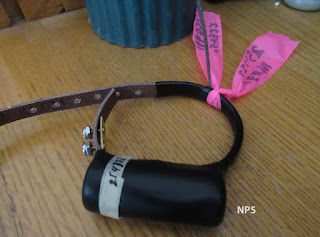
This radio collar will send signals to biologists for the next 2–3 years. The signal will help locate M173 and the type of signal informs the biologist if he is moving around normally or if something might have happened to him. In the case of a mortality signal, biologists can follow the signal to find the island fox's body and determine what happened. If there is a threat to other island foxes, action can be taken quickly.
For the 2023 health check season Friends of the Island Fox has supplied:
Even with her face covered, F257 from Santa Rosa Island is a stunning island fox. Her coat is lustrous, her weight is good, she looks healthy. The mask/muzzle helps keep her calm during her health check.
You might remember F257 from 2021, 2020, and 2019.
F257 continues to live in the Old Ranch area on Santa Rosa Island. This is the same area where she was born and first seen.
In August, National Park biologists were happy to see F257 during island-wide counting of island foxes. Biologist Juliann Schamel says "[F257] has been captured every summer on the [Old Ranch] grid, and has never shown signs of having reproduced, although she is in good condition/health. She's still quite young and most foxes on Rosa did not reproduce in 2020 or 2021, so this isn't surprising."
You can see from her data sheet that F257s health check and the replacement of her radio-collar took only 12 minutes.
After two and a half years, F257's radio collar needed a new battery. Her collar was replaced and the old collar will be refurbished so it can be used again. In the video below, you'll see F257 be released after her health check.
Did you notice F257 looked back at the biologist multiple times. Maybe she recognizes the biologist, too.
With her radio-tracking collar F257 is helping to monitor island fox survival on Santa Rosa Island.
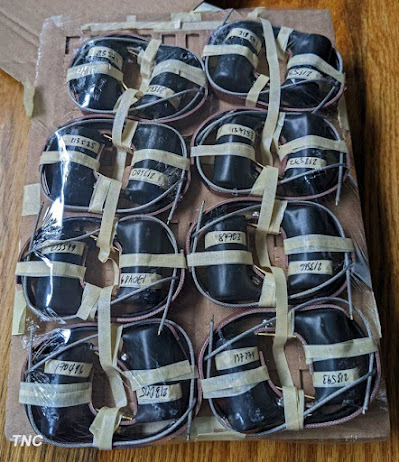
These radio-telemetry collars, still in their packaging, have just arrived for island foxes on Santa Cruz Island. They come packaged as pairs of collars set inside each other with their antennae wrapped around.
The Fresno Chaffee Zoo Wildlife
Conservation Fund provided FIF with a special year-end grant that funded these 15 refurbished radio collars and will fund serology testing for Catalina Island foxes this summer.
The Santa Barbara Zoo and the Fresno Chaffee Zoo have long been champions of island fox conservation. They are the perfect example of how zoos can make a real conservation difference.
After these radio collars are prepped and banded with color-coding, they will be ready to be fitted on island foxes.
You are an important partner in island fox conservation, too. Donors like you are matching the Fresno Chaffee Zoo's grant!
This winter donors have funded 14 refurbished collars and 2 new collars.
FIF hopes to fund 20 more radio collars this season!
Radio collars are the number one way to monitor island fox health and survival in the wild.
Your donations help FIF provide important radio collars for island foxes!
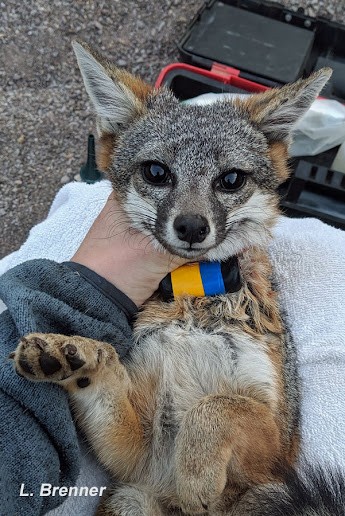
Meet M181! This young male island fox on Santa Rosa Island was fitted with a radio collar funded by YOU.
Channel Island National Park biologists have been fitting radio collars on individual foxes, conducting health checks, and counting island foxes throughout August.
Each radio collar has a signal at a specific individual frequency that is picked up by a radio receiver. The fox does not hear the collar's signal.
Biologists can only hear the signal if they have a receiver tuned to the correct frequency and are within a specific proximity to the fox.
Radio collars are small and light weight so they do not bother the island fox. Each radio collar is fitted with a "two-finger fit" so that it is not too tight, yet not so loose that it might get caught on something.
Watch and Listen to the video below
WATCH as M181 is released back into the wild after his check-up and radio collar fitting.
LISTEN for the beeps from the receiver as the biologist checks the functioning of the radio collar.
Island Foxes on San Miguel Island will be getting their radio collars next.
Catalina Island foxes will be getting their radio collars and vaccinations soon.
You can still help fund a refurbished radio collar $220
Tuesday May 18, 2021 Friends of the Island Fox Board members participated in the annual Island Fox Conservation Working Group meeting (via a virtual space hosted by the Santa Barbara Zoo).
We thought we'd try something new and share the FIF Update with you so you could see exactly where your donations have gone this past fiscal year and where we are focusing our efforts right now.
We can't say it enough "Radio collars, radio collars, radio collars!" This season's radio collars and vaccinations will be shipping out in the next few weeks, along with the bill.
Your donations help fund these vital efforts to protect island foxes.
Biologists, researchers and pathologists from across the Channel Islands also reported on island fox status and health.
Friends of the Island Fox is thrilled to welcome Lara Brenner to its Board of Directors.
Lara is a wildlife biologist and scientific writer who has been working
with island foxes on Santa Catalina and Santa Cruz Island since 2017.
She has a degree in Environmental Studies from Carleton College and a
Master of Science in Wildlife Biology from the University of Montana.
She brings the unique experience of working with island foxes in the field.
Lara says: Compared to most mesocarnivores, island foxes are a joy to work with. Their relative docility takes a lot of the uncertainty out of catching and handling them, while their curiosity and fearlessness inspire some truly cheeky behaviors (like trying to steal a bag of bait right out of your hand!).
First-time observers are often amazed to see an island fox sitting calmly on a biologist's lap with few restraints, and I've often heard the comment that they must know we're trying to help them.
I think it's more an artifact of evolution - after around 10,000 years as the apex land predator, they have no concept that they could be in any danger from a larger mammal! Of course, island foxes are still wild animals and it doesn't pay to let your guard down. I wouldn't want to reach into a cage without my trusty leather gloves - a bite from an island fox is no joke!
FIF Welcomes Lara Brenner.
[What's a mesocarnivore? A medium-sized carnivore. (Think raccoon, bobcat, gray fox or feral cat.) Most medium-sized predators have to be feisty in order to catch their prey and also defend themselves from larger predators.]
Once on the brink of extinction, the island fox now roams freely across the Channel Islands. It's a conservation success story. On the four-year anniversary of the official U.S. Fish & Wildlife Service announcement removing the island fox (Urocyon littoralis) from the Endangered Species List (ESL), foxes are stable in number and overall health.
Official numbers reported at May 2020 IFC Working Group
In spite of the fact that this remarkable recovery is still celebrated today, conservation work is never completely done. Island foxes remain a conservation-reliant species. Threats still exist to the foxes from parasites, viruses, and human impacts as the islands are visited more and more each year. Keeping island foxes safe and healthy requires understanding of their diet, reproduction, lifespan, behavior, and disease threats.
On-going research doesn't just benefit the island fox. The lessons learned help other rare species as well. The Sierra Nevada red fox is benefiting from viable population modes that were developed for island foxes on Catalina. While not a one-to-one relationship, it is a reference that provides related information for another fox's demographic needs. It's science for Fox sake!
The power of partnership and focus can realize dramatic results and we have to look no farther than the group of islands off the Southern California coast. Today each spring fox kits are born as helpless little beings that would not survive without their parent's constant attention. In the course of six short months these tiny helpless creatures grow into self-sufficient cinnamon, gray, and black-colored predators that leave their birth den and seek out their own piece of the island. Those long summer days spent with their parents learning fox philosophy ensure the cycle, inherent in the fox's life, completes itself for the continued survival of the island fox. - Mike Watling
Friends of the Island Fox celebrates the recovery and continued success of the island fox with all of our donors, Island Fox Ambassadors, volunteers, and partners, especially:
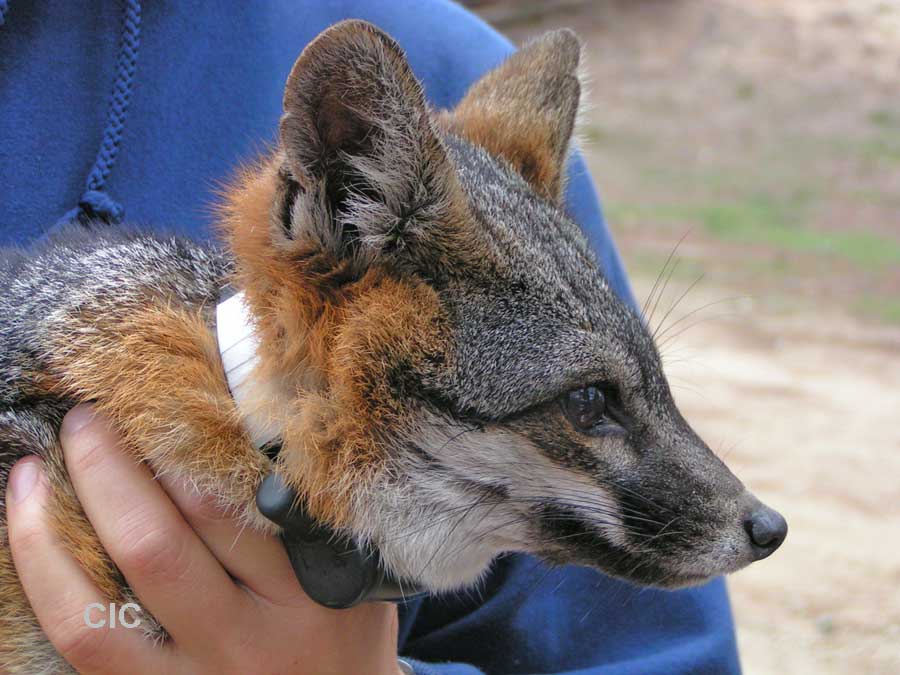
This island fox was captured and counted this week on Santa Cruz Island. She received a health check and her radio-tracking collar was replaced with a newly refurbished collar. Her old collar will come off and be eligible for refurbishing.
Her microchip enables biologists to identify her as a specific individual. If she is caught again this summer, the microchip reader will quickly identify her so that she can be released immediately without being handled.
Your donation of $220 would recycle her used radio collar to be placed on another island fox.
Across the Channel Islands, winter rains have renewed the native island plants and increased food resources for island foxes.
2019 should be a good year for island fox pups!
Most island foxes are born in April. For the first several months of their lives, they depend on their mother for milk. Both parents will then bring food to the youngsters back at the den. Pups, generally, emerge in June and over the summer their parents teach them how to hunt and find native fruit. Healthy island fox parents have a head start in raising healthy pups. You can help keep island foxes healthy and safe.
This year the need for radio-tracking collars is greater than ever.
On each island 50–60 island foxes wear radio-tracking collars. Each year 30% to 50% of the collars need to be replaced or refurbished.
In 2019, Friends of the Island Fox is trying to fund:
These radio collars will be assigned to island foxes this summer and fall during annual counting and health checks. A radio-tracking collar monitors an island fox's movements and signals to biologists when an island fox has died. Radio-tracking collars provide the first alert that disease, parasites, or unexpected predators have killed an island fox. The sooner biologists can respond to a new threat, the more island foxes can be protected.
Friends of the Island Fox is also helping to fund important investigations into new health threats facing island foxes:
Thanks to Friends of the Island Fox a
speed-detecting traffic sign on Catalina Island is back in operation
slowing down drivers.
I'm happy to report that with funding from FIF we have repaired our radar speed detector and deployed it on the landscape! says Lara Brenner, Wildlife Biologist for the Catalina Island Conservancy. In the next few days I will take some time to hide in nearby brush
and monitor the speed machine's efficacy at convincing people to slow
down. Thank you so much for your continued support of our fox program. We
hope to continue working with you to decrease the impact of vehicles on
the Catalina island fox population.
The traffic sign is again alerting drivers to SLOW DOWN and watch for island foxes.
Thank you to ALL of our DONORS who helped fund this important fox-safety effort on Catalina. Working with the Catalina Island Conservancy, we can make sure Catalina Island foxes continue to have a solid recovery and healthy future.
In 2015, Friends of the Island Fox began working with the Catalina Island Conservancy (CIC) on a project to replace deteriorating trash containers that threatened island fox survival. (See the direct and in-direct danger to island foxes)
As of January 2017, FIF has funded the installation of 7 “Fox-Saver” bins. Julie King, Director of Conservation and Wildlife Management with the CIC sent us this exciting report from the field:
The wildlife-proof cans that we installed out at Parson's Landing (remote beach campground) have made a HUGE difference!
Before I would spend 30 minutes each day I was out there [counting island foxes]
picking up trash that foxes and ravens had drug into the bushes. I
would always catch foxes there ... loaded with lice. [They had become]
habituated moochers. This year, it was so different. No trash to be
found on the ground or in the bushes and no foxes caught. To me, no
foxes in camp is a testament to the effectiveness of the new trash cans.
No more free meals. Outside of camp, there were plenty of foxes and
they were all in great shape. Nice to see!
Six new bins have replaced the two large dilapidated wooden containers. The result is healthier island foxes, no foxes coming to the area for free food and becoming more likely to be hit by automobiles, and no foxes trapped inside deathtrap trash cans.
We know what works. Removing an unnatural food source also reduces unnatural concentrations of island foxes thereby decreasing the possible spread of disease. Prevention of problems is financially cost effective and reduces the need to react to crisis situations.
Friends of the Island Fox supports conservation measures that are proven to work:
The annual meeting of the Island Fox Conservation Working Group in 2015 reported that the general status of the six subspecies of California's Channel Island foxes is GOOD.
However, four of six islands saw dips or declines in population in 2014. The historic drought and its impacts on food resources is believed to be the cause. Biologists on Santa Catalina have documented a direct connection between rainfall levels and island fox reproduction. Years with drought-level precipitation result in reduced plant food and prey, thereby causing fewer island fox pups to be born or to survive. The extent of drought impact varies significantly by island.
Minimal drought impacts on Santa Cruz Island, 2015
Despite the drought, recovery of the four endangered subspecies of island fox has been very successful and this spring (March 2015), the US Fish and Wildlife Service (USFWS) announced initiation of a status review of the four subspecies. Introduced disease continues to threaten all island foxes and a lack of canine distemper virus (CDV) vaccine safe for use in island foxes has been a major concern for two years. The Working Group took urgent steps, and Friends of the Island Fox participated, to determinethe effectiveness of a newly available CDV vaccine.
courtesy of E. Gotthelf
All island fox subspecies are maintaining stable populations and there are no issues which put any Channel Island fox subspecies in eminent threat of extinction. The continuing drought, however, has more severely impacted island foxes on San Miguel and San Nicolas Islands. As seen in the past, each island faces its own concerns and challenges.
San Miguel Island - 520 (low of 15in the year 2000). Population recovered with over 500 individuals since 2010. Slight population dip. Concern: Threat from new parasites continues, as do drought impacts (see below)
Santa Rosa Island - 874 (low of 15 in the year 2000). Population recovery stalled by drought, but stable.
Santa Cruz Island - 1,750* (low of 62 in the year 2002). Population recovered and robust with over 1,000 individuals since 2009. No discernible drought impacts.
Santa Catalina Island - 1,717 (low of 103 in the year 2000). Population recovered and stable with over 1,000 individuals since 2010. Slight population dip. Concern: Drought impacts and human related impacts, including car strike, and high risk for introduced disease.
San Clemente Island - 1,230* (not Endangered). Population stable. Concern: Continued fatalities to automobile strike.
San Nicolas Island - 263* (not Endangered). Population has declined ~41% since 2012 because of drought impacts. Concern: Habitat destruction has left island foxes dependent on non-native plants and prey which have declined dramatically in the drought, see below.
The graph above shows population numbers on even years, therefore the dip from 2013 is not represented. For more detailed graphs see the Island Fox Update document. The numbers represented are the official 2014 population figures reported at the Island Fox Conservation Working Group Meeting 6/16/15. *Population figures represent adults only.
Concerns: Healthy plant and animal populations fluctuate normally with available resources. Recovered island fox populations naturally dip when there is not enough food, water, or territory. There is a natural limit to the number of island foxes an island can support, also known as carrying capacity. Low rainfall has impacted food resources across the Channel Islands. However, islands have not been impacted equally. Some islands appear to have greater natural drought tolerance. As recently discovered by analyzing island-fox diet, Santa Catalina and Santa Cruz Islands have greater native plant biodiversity than the other smaller islands. Native island vegetation evolved with periods of drought. Native plants are better able to survive and produce fruit vital for the survival of island animals. The greater the native plant biodiversity, the greater the survival options for island foxes.
island fox footprints among ice plant on San Nicolas
The island-fox-diet study pointed out that island foxes
on San Miguel and San Nicolas Islands were dependent on plant and
invertebrate species which had been introduced to their islands,
replacing native plant habitat. Unfortunately, these introduced plant
species, especially, ice plant, and the non-native creatures that live
in it–snails and earwigs, have declined dramatically during the last two
years of extreme drought. The impact has been greatest on San Nicolas
Island where average island-fox weight has declined and the population
has dropped 41% since 2012.
Restoring native vegetation is the best long term solution for healthy island fox populations on these two islands. (for more on this topic, see the Island Fox Update 2015 pdf document above) A secondary impact of the drought has been increased complications with parasites. Changes in diet and decreased general health leave island foxes more vulnerable to internal and external parasites. Here again, each island has its own specific parasite challenges. (See Island Fox Update 2015 pdf for details) (Spiny-headed worm on San Miguel Island first detected in 2013). Introduced disease continues to pose a threat to all island foxes, especially on islands visited by people. Dogs, cats, and introduced species, like raccoons, are all avenues for disease to be transported to isolated and disease-naive island foxes. Efforts to verify the effectiveness of a new CDV vaccine for island foxes is currently underway.
Positive Notes:
courtesy of D. Mekonnen
There are early anecdotal signs that the small amount of rain this spring and summer may be improving resources on the islands. More island fox pups have been spotted this summer than during the last two summers. However, the official impact on the populations will not be known until counting begins in fall. Monitoring with radio collars continues to provide important information to land managers. Radio collars have helped verify that no golden eagles have returned to eat island foxes on the northern islands. Radio collars were instrumental in determining the cause of island-fox decline on San Nicolas Island. And they continue to provide early warning of disease introduction. Radio monitoring collars will also enable land managers to ethically determine the effectiveness of the new CDV vaccine. Annual island fox health checks, serology testing, and counting identify threats to island fox survival early, so that actions can be taken to protect island populations.
‘Fox-Saver’ bins on Santa Catalina and the Navy's education outreach on San Clemente are all helping to reduce the number of island foxes hit and killed by cars.
Thank you to the Island Fox Conservation Working Group and all of the important work that has helped island foxes recover from the brink of extinction. Thank you also to the many participants on our June Santa Cruz Island Trip that have allowed us to show you their photographs.
Once again, people working together have helped protect the endangered island fox!
The lethal combination of old trash cans, enticing human trash, and proximity to roads with car traffic has created a growing problem for island foxes on Santa Catalina Island. Double Action to Save Island Foxes Early winter 2014, eleven Catalina island foxes were hit by cars. Most were near areas of known trash problems.
But thanks to support from a wide range of private individuals and organizations, Friends of the Island Fox has met its goal to raise $6,000 to fund three "Fox-Saver" bins on Santa Catalina Island. The three bins will be placed in high-use areas where fox fatalities have been growing.
Thank you to everyone who helped raise funds for this important project.
These bins not only help endangered island foxes, they create a healthier environment for people and other island species.
Help Friends of the Island Fox reduce a major threat to the Santa Catalina Island fox (Urocyon littoralis catalinae):human trash.
Yes,
eating human food is bad for island foxes. Adults dependent on human
food fail to teach hunting skills to their offspring. (Island fox diet) However, the greater threat is the attraction of trash and the behavior
island foxes engage in to reach readily available human food waste.
Once inside, island foxes
have a difficult time getting out of these containers. Trash can lids are designed to push open from the outside. Catalina Island biologists have
documented numerous cases of island foxes dying inside trash cans.
photo courtesy of Julie King, CIC
The
second issue is that accessible trash cans encourage island foxes to cross roads and enter dangerous areas. Notice the island fox under the left side of the trash can pictured here. It is pulling trash out of the rusted bottom of this can.
Catalina Island Conservancy biologists Julie King and Calvin Duncan report:
Between April and May 2014, four foxes were hit and killed by vehicles in close proximity to open trash cans near Bird Park in Avalon and two more were hit and killed there in November. It is unknown how many other foxes may have been hit by vehicles in the area but did not immediately succumb to their injuries, and were therefore not accounted for.
courtesy of Julie King, CIC
Car strike has become the greatest killer of island foxes on
Catalina Island. The island fox pictured to the right was killed by a
car, notice the trash can on the other side of the road (to the left). Clusters of unnecessary island fox deaths are occurring in areas adjacent to public spaces with numerous trash cans.
New "Fox Saver" trash bins
But there is a solution to the double threat: trash bins that island foxes can not access.
“Fox
Saver” bins are the same sturdy containers used at Yellowstone and
Yosemite National Parks to keep bears out of human trash. Opening the
bin requires long human fingers. There is no opening for an island fox to easily enter.
Once
the attraction of available human food waste is eliminated, we hope there will
be less motivation for island foxes to cross roads, and maybe less
attraction to venture into Avalon.
Purchasing these all-steel
bins, shipping them to Santa Catalina Island, and installing them on a
cement pad comes with a sizable price tag. Each bin costs $2,000. The Catalina Island
Conservancy has a goal of replacing 150 trash bins across the island.
Friends of the Island Fox aims to raise $6,000 to fund three “Fox-Saver” bins to be placed in Avalon's Bird Park area. This should actively reduce island fox deaths along one of Santa
Catalina's busiest roads. Your donation will help meet this goal and save island fox
lives.






web.jpg)


