Showing posts with label Santa Rosa island fox. Show all posts

Friday, September 16, 2022

Do You Remember This Fox? It's F257


Even with her face covered, F257 from Santa Rosa Island is a stunning island fox. Her coat is lustrous, her weight is good, she looks healthy. The mask/muzzle helps keep her calm during her health check.


You might remember F257 from 2021, 2020, and 2019

She received her first health check when she was a pup in July of 2019. In the winter of 2019, she was fitted with her first radio tracking collar.

F257 continues to live in the Old Ranch area on Santa Rosa Island. This is the same area where she was born and first seen.


In August, National Park biologists were happy to see F257 during island-wide counting of island foxes. Biologist Juliann Schamel says "[F257] has been captured every summer on the [Old Ranch] grid, and has never shown signs of having reproduced, although she is in good condition/health. She's still quite young and most foxes on Rosa did not reproduce in 2020 or 2021, so this isn't surprising." 

Low rainfall frequently correlates with fewer resources and female foxes tend to have fewer pups or no pups. Santa Rosa Island may also have reached maximum population size. F257 may not be able to find a mate or adequate territory to support having pups. Being single, may also be a choice. She looks great.


You can see from her data sheet that F257s health check and the replacement of her radio-collar took only 12 minutes.

After two and a half years, F257's radio collar needed a new battery. Her collar was replaced and the old collar will be refurbished so it can be used again. In the video below, you'll see F257 be released after her health check.


Did you notice F257 looked back at the biologist multiple times. Maybe she recognizes the biologist, too. 

With her radio-tracking collar F257 is helping to monitor island fox survival on Santa Rosa Island. 

Your donations to Friends of the Island Fox fund radio-tracking collars and important research across the Channel Islands.

Sunday, October 11, 2020

Remember This Fox Face? - Fox Foto Day

 Do you remember this island fox face? 


This is F257–a female island fox on Santa Rosa Island. She first started wearing a radio-tracking collar (funded by FIF) last December when she was captured as a youngster.

In 2020, F257 is 18 months old and a mature female. It surprised everyone when she was caught in the exact same place she was found last year. This means she didn't disperse, or travel away, from her parents' territory.

It is typically expected that island fox pups will move away to find their own territory as they mature. Female offspring sometimes stay close to their parent's territory and that seems to be what F257 is doing.

She is looking healthy and happy in her territory adjacent to the coastline.

Friends of the Island Fox sends a "Hello" and "Thank You" to the biologists working across the Channel Islands. They are finishing up health checks and annual island fox counting. FIF is hearing good news from the field. Individual island foxes look healthy and populations appear stable.

Radio collars, like the one F257 is wearing, provide an important conservation monitoring system that provides an early alert system regarding threats to island foxes.

Your donations help to fund radio-tracking collars for island foxes.

Friday, July 27, 2018

Island Journal - Sometimes You See Where A Fox Has Been

The opportunity to visit Channel Island foxes in their natural environment is part of the success of saving island foxes from extinction. Friends of the Island Fox loves to highlight individual experiences. On Santa Cruz Island there are locations where you almost always see island foxes (Scorpion Campground and Prisoners Harbor). Guest writer Michael Lawshe has a different story from Santa Rosa Island.


Island Journal: Santa Rosa Island, June 16, 2018

We took an 8 am boat out of Ventura, with Island Packers, directly to Santa Rosa Island. The sky was overcast and the sea was remarkably flat. We crossed the channel, passing Anacapa and Santa Cruz Islands to...


Taking a hike, we noticed dozens of great little caves and crevices in the hillsides. 


Perfect for a fox!

Sometimes you see a fox, sometimes you see where they have been! 


Here is a path to a secluded fox resting place.


Do you see the little footprints in the sand?


They're a little bigger across than the size of a quarter. 

We didn't see the island fox, but we are pretty sure they were watching us. It was a great day. - Michael Lawshe

More on: 
reading island fox tracks
seeing island foxes
Experiencing Santa Rosa Island
A Day with Biologists On Santa Rosa 

Tuesday, March 15, 2016

Insight on Channel Island Fox Territory Size & Habitat Use

A newly published study on Home-Range Size and Habitat Selection by Male Island Foxes (Urocyon littoralis) in a Low-Density Population by Elizabeth M. Drake, et al. reveals the largest documented territory ranges for male island foxes and new information regarding use of habitat at specific times of day. 

Prior to the catastrophic decline of island foxes on Santa Rosa (1996-2000), the population numbered over 1,700 individuals with a density of ~4 adult foxes per square km. Recovery on Santa Rosa was a slower process than on the other islands and this provided an opportunity to study territory size as the population recovered. The new study was carried out on Santa Rosa Island from 2009-2010, when the population was under 400 individuals and the density of adult foxes was less than 1 per square km. 

Santa Rosa Island
Drake found that in this period of low-density, male Santa Rosa Island foxes averaged territories of 3.39 square km in size. This is considerably larger than the less than .5 square km territories documented both on San Clemente (Sanchez, 2012) and on Santa Cruz prior to the population decline (Roemer et al., 2001). It is also much larger than the ~1 square km territories found on Santa Catalina when the population was well into recovery (King et al., 2014). 

While it is not surprising that island foxes expand territory size when there is less population density, the need for resources does not appear to be the driving force. During this period of fewer foxes, resources were plentiful. Therefore less territory was actually needed to provide adequate food for an individual island fox.

Drake found little overlap of territory between the individual males. In most cases, only minor overlap occurred at territorial borders, suggesting vigorous protection of territory.

Since Drake's data collection the population on Santa Rosa has more than doubled. As the density increases will the lack of territory overlap remain constant and will territory size decrease? Additional study is needed to answer these and other questions.

The study also looked at use of specific habitat. Surprisingly, there did not seem to be habitat types that were more desirable. But they did find significant data on use of habitat type at different times. 

The researchers found island foxes avoided bare landscape and grasslands during the day, but spent a significant amount of time in these areas at night. This use of specific terrain at night may suggest nocturnal hunting for deer mice and insects. Daylight hours were more typically spent in scrub and woodland areas. 

Link to Full Paper
http://www.bioone.org/doi/abs/10.1894/SWNAT-D-14-00021.1

Referenced papers above:
King, J. L., C. L. Duncan, and D. K. Garcelon. 2014. Status of the Santa Catalina Island fox 13 years after its decline. Western North American Naturalist. 7:382396.

Roemer, G. W., D. A. Smith, D. K. Garcelon, R. K. Wayne. 2001. The behavioural ecology of the island fox (Urocyon littoralis). Journal of Zoology London 255:114.

Sanchez, J. N. 2012. Spatial ecology of disease spread in the island fox. M.S. thesis, Humboldt State University, Arcata, California 

Wednesday, July 21, 2010

Visiting the Island Fox

Summer is a great time to visit the California Channel Islands. As island fox populations recover from disease and predation by golden eagles that nearly pushed them to extinction, more people are having the opportunity to see island foxes in the wild. (Why island foxes are endangered)
Observing an endangered animal in the wild is a rare experience and it comes with responsibility. Here are a few important tips to remember when encountering an island fox:
  1. Do Not Feed Them - Island foxes are smart and they know people have food. But feeding an island fox can threaten its life. Human food is not good for island foxes and does not provide the necessary nutrition. Wild foxes, especially juveniles, that become dependent on handouts never learn to forage for natural food and can die when their free food source disappears.
  2. Store Food Appropriately - Island foxes are clever. Even campers who do not intentionally feed island foxes can sometimes become a source of food. We have heard cases of a single island fox taking an entire plastic bag with eight hamburger buns right off of a picnic table. Plastic and food wrappers can appear to be food and cause injury to island foxes. (see island fox and fishing hook) The NPS campgrounds offer food lockers to secure food items.
  3. Island Foxes Are Wild Animals - Even though the island foxes are cute and friendly, they are wild animals. A woman feeding an island fox on Santa Catalina Island was bitten. The Center for Disease Control can require that any fox that bites a person be euthanized to insure that it is not carrying rabies.
  4. Leave Your Pets At Home - Island foxes can acquire diseases from domestic dogs and cats. The distemper virus, which can be carried by dogs, caused the death of over 88% of the island foxes on Catalina in the late 1990s. As wild animals, island foxes can also carry diseases that are dangerous for pets–parvovirus, coronavirus and internal parasites. Some of these diseases can be transferred simply through animal droppings and do not require animal-to-animal contact. While many island foxes are vaccinated for rabies and distemper, not all of them are. It is illegal to take pet dogs or cats on to any of the islands that make up Channel Islands National Park. On Catalina Island dogs are required to be leashed. Several island foxes have been attacked and killed by free-roaming domestic dogs.
  5. Watch for Wildlife on Road - The increase of island foxes on Santa Catalina means that more foxes are being seen along the islands few roads. Because of their small size and gray coloring, island foxes can be hard to see especially at twilight. The number one cause of death for island foxes on Catalina is being hit by a car. Roadsigns
Southern Californians have worked very hard to save the island fox from extinction. The reward is that now we can see island foxes in the wild again. If we all act with respect and responsibility toward our friend the island fox, we can insure their continued success toward sustainable populations.

On Santa Cruz Island and Santa Rosa Island, in Channel Island National Park, visitors can see island foxes around the campgrounds, landing areas, and along hiking trails. Channel Islands National Park

On Santa Catalina Island, the increase of island foxes means that more individuals are being seen around the town of Avalon and the golf course. Island foxes can also be seen in the island’s interior. Catalina Island Conservancy

If you can’t travel out to the Channel Islands, you can visit island foxes in several local zoos.

Photos courtesy of Kevin Pease.

Wednesday, April 08, 2009

Island Fox Questions

Friends of the Island Fox is committed to connecting the community with the problems and issues concerned with protecting island foxes. When we receive questions, we want to bring you answers directly from the people in the field with these endangered animals. We received a great question from a student and were able to get a first-hand response.

hi this is a student from balboa middle school. i loved the presentation we got on Wednesday March 11, 2009. the video they showed us was very cute!!!! i have a few questions:
  • how often do the island foxes get hurt?
  • when you take them to the hospital does it hurt the foxes?
  • how long was it until you let the foxes free from cativity?
from a true inpired girl, Anastasia p.s. what are the people , who help the foxes????

Sara is an Island Fox Technician for Channel Island National Park on Santa Rosa Island, she answered:


Hi Anastasia,

Good questions.

Most of the injuries to island foxes have come from mate aggression during breeding (winter/spring) season. This was more common in our captive [breeding] population but has been documented in the wild population as well. These injuries include minor bites and tears around the ears, to more significant trauma involving rips, bites and abscesses (infected pockets under the skin) in various places. The foxes are actually fairly aggressive and scrappy toward one another during this time of the year.

Other common injuries include foxtails stuck in an eye or ear and torn toenails, these usually don't require any additional treatment beyond the time of observance. And, every now and then with the captives, we would find a case of ringworm, exciting.

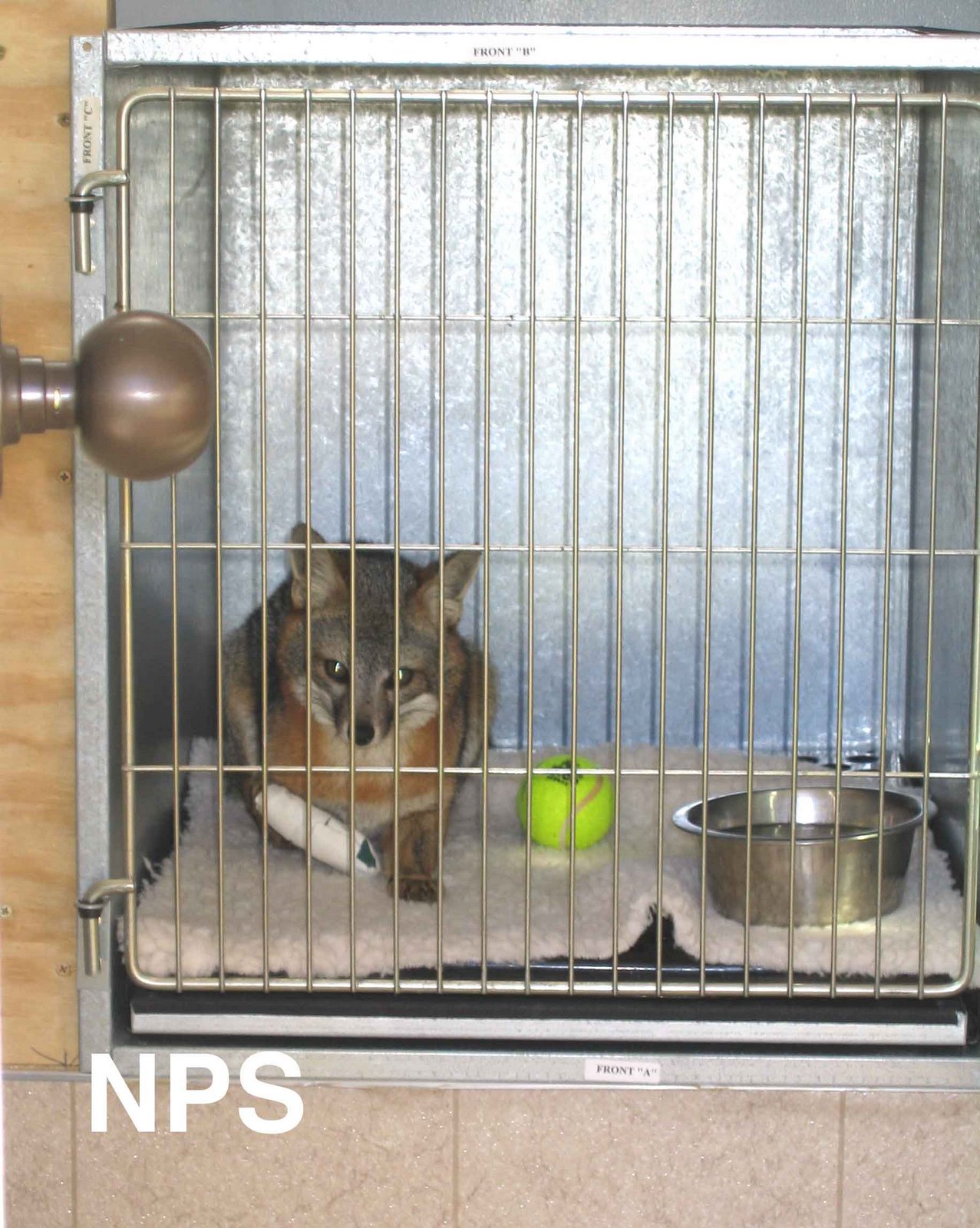
Each island has a clinic called a "Foxpital" and is set up like a small veterinary clinic with all the necessary equipment to properly care for an ill or injured fox. When a fox requires care, they are brought into the foxpital and given an initial assessment by one of our staff fox biologists, from there a veterinarian is consulted to determine the best course of treatment. If necessary, we have veterinarians on call who can come out and perform emergency procedures on the island. Each animal's stay is dependent on the nature and extent of their injury. Most often, if an injury requires a stay in the foxpital, the animal is in for a week or so. In very rare cases we have cared for animals as long as three months.

Thanks for your interest in the island fox,

Sara

Island Fox Technician
Channel Islands National Park
Santa Rosa Island


Other stories on injured foxes:
Fox and the Fishing Lure
Burnie Boots

Your Donations to Friends of the Island Fox support conservation efforts across all of the Channel Islands to help island foxes.

Thursday, February 07, 2008

Island Romance - Island Fox Mating Season


Island Romance - Island Fox Mating Season

Are you contemplating romance and Valentine’s Day? So are the island foxes. The cold blustery days from December to February are the perfect season for California’s Channel Island foxes to pair up and settle down in a cozy den.

During autumn, island fox families tend to split up. The youngsters, now over six months old, head off on their own and the parents take a vacation from family life and each other. With the arrival of winter, the monogamous mates come back together. (About the island fox)

Island foxes make their dens in a sheltered location, sometimes underground, in a tree stump or in amongst dense undergrowth. The male and female establish a territory around their den site and settle down to finding food for a family.

A few island foxes born last spring, will also be out looking for a mate. Even though they are less than a year old, some will become parents this spring. Because population numbers are still far below normal on San Miguel, Santa Rosa, Santa Cruz and Santa Catalina Islands, island foxes are breeding younger and having more offspring than they usually would. The abundance of island deer mice and other food items makes it possible for a pair of island foxes to raise five pups instead of the typical two or three.

Valentine’s Day 2008 will be very special on San Miguel and Santa Cruz Islands. For the first time since emergency captive breeding began in 2000, ALL of the island foxes on these two islands are once again free-roaming and choosing their own mates.
(2007 fox release on San Miguel Island) (2007 fox release on Santa Cruz Island).

Captive breeding programs saved the island foxes from extinction on both of these islands, but human matchmakers are never as good as the foxes themselves. We can all hope that this year there will be an increased number of island fox pups born on San Miguel and Santa Cruz Islands.

Eleven of the island foxes released in Channel Islands National Park are wearing radio-tracking collars funded through donations to Friends of the Island Fox. (radio collars)

Pups born in the spring and foxes slated for release from the captive breeding facility on Santa Rosa Island will soon be needing there own radio tracking collars. Your donation to Friends of the Island Fox helps to provide radio tracking collars vital to monitoring the recovery of endangered island foxes. You can donate through the PayPal and Cause for Good buttons in the upper right .

This Valentine’s Day give a truly romantic gift.
Help support a solution.

Working together we can SAVE the island fox.