Monday, March 12, 2012

Santa Cruz Trip with FIF

Join Friends of the Island Fox for:

A Trip to Santa Cruz Island
Saturday, May 5, 2012
to Look For The Island Fox

Please join us when we visit Santa Cruz Island for a tour with our educators.  We will look for the endangered island fox, plus the many other endemic species, both plants and animals, found only on this island and nowhere else.  On the trip over to Santa Cruz (about 1 hour) there is the possibility of seeing many marine species.

Tickets for adults will be $65.00 per person, children $55.00. A percentage of the fee will go to support island fox recovery efforts.

We will take the Island Packers boat from Ventura Harbor leaving at noon and returning around 5 PM on Saturday May 5, 2012.  Check in will be required at 11:15 AM

Reservations are limited and will be provided on a first come basis. To book reservations, please download the Reservation Booking Form (Click Here to download pdf)  

Island fox trying to take food from backpack.
Send the completed form with your check, made payable to the "Friends of the Island Fox" to the address on the form.  Reservations will be taken in the order received, and no reservations can be accepted without payment.

Before the island visit you are welcome to join us at 9:30 AM at the Channel Islands National Park Visitors Center at 1901 Spinnaker Drive, Ventura.  We will tour the native plant garden, visit the Center and you will have the chance to view the Channel Islands National Park film “Treasure in the Sea” narrated by Kevin Costner. 

At the time of booking you will receive further details of the trip, including where to meet, what to pack, the suggested clothing and other items of interest. Note the photo above. Food items will need to be secured at all time. What to remember when visiting the island fox.

Tuesday, March 06, 2012

Climate and Island Foxes

Santa Catalina Island
Across the six islands that are home to island foxes (Habitat), pairs like Tani and Tiptu are breeding and finding an appropriate den site. Island fox pups are typically born in late April.

Like all wild animals, island fox reproduction is impacted by the amount of local resources–food, water and territory. As endangered populations of island foxes have recovered, there have been several years where female foxes have had large litters of pups. Typically two pups are born in a litter, but when resources are abundant there can be as many as five pups.

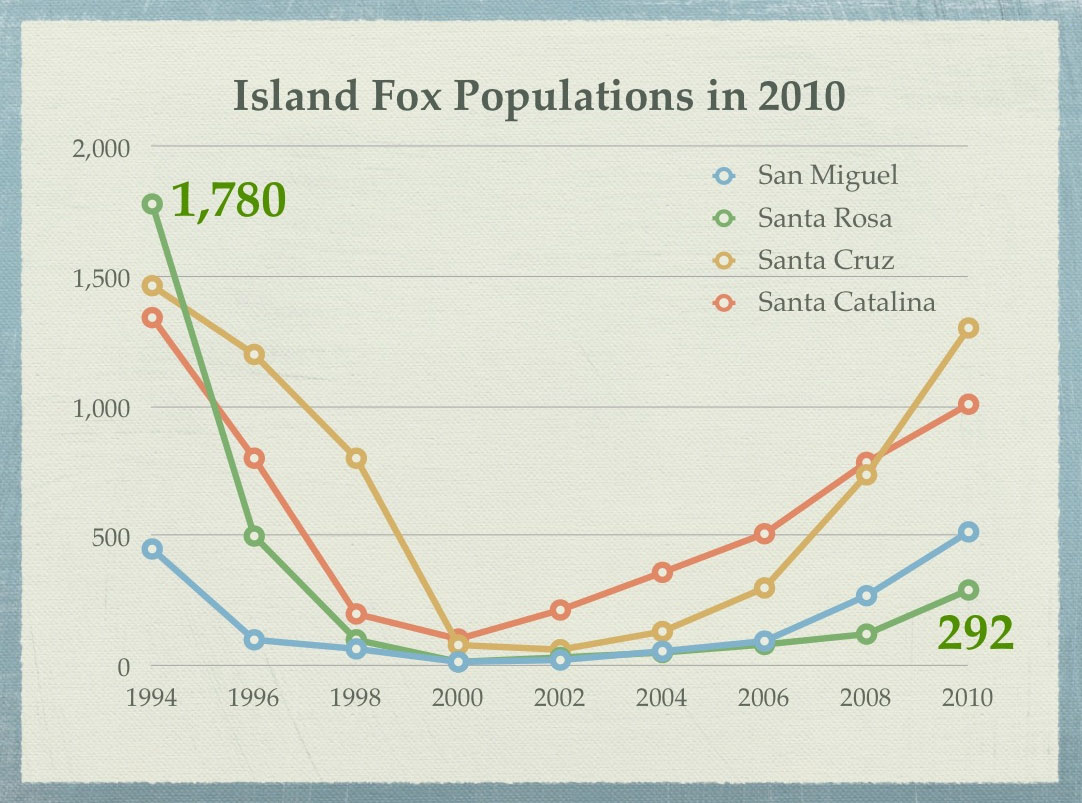
Because the recovering endangered populations were small, there was little competition for territory and food. In the mid-2000s, it was not unusual for island foxes on San Miguel to have litters of three to five pups. With large litters of offspring the San Miguel Island population, that had nearly gone extinct in 2000 when there were only 15 surviving individuals, was able to exponentially increase each year.  Graph

But severe climate can greatly reduce the resources available to island foxes. 2007 was the driest year on record in southern California since National Weather Service records began in 1878; less than four inches of rain fell. The lack of rainfall reduced the plant foods on the islands which reduced the deer mice, insects and bird life. Without winter rains, the Catalina cherry, native currants, toyon and other fruit producing plants produced less fruit for the foxes to eat. Less food, meant fewer island fox pups were born or survived. The winter seasons of 2008 - 2011 averaged approximately 12 inches of rain, the low side of normal, but still enough that Channel Island wildlife flourished.
 

This winter season is showing early signs of drought. As mid-March approaches the Los Angeles area has received less than six inches of rain. This year if spring rains do not arrive, we may see fewer island foxes born and fewer that will survive. Climate fluctuations act to moderate animal and plant populations, but climate change means greater weather extremes. Drought in 2012 could make it more difficult for young island foxes like Tani to successfully reproduce and could slow down the recovery of endangered island foxes.

Tuesday, January 31, 2012

Restoring Habitat for Island Foxes

courtesy of Kevin Pease
Across the Channel Islands efforts are being made to restore the natural ecosystems that the island fox depends on for survival. One such project is the restoration of a wetland area at Prisoner’s Harbor on Santa Cruz Island, in the Channel Islands National Park.

Prior to large scale ranching on Santa Cruz, the canyon at Prisoner’s Harbor had a seasonally flowing stream that created a rare coastal lagoon. This wetland would have attracted amphibians, fish, reptiles, small mammals and migrating birds. It would have provided important food and water for the island fox.

Currently the Channel Islands National Park and the Nature Conservancy are digging out the tons of gravel and dirt that were used to fill in the wetland. Eucalyptus trees that were introduced as wind breaks are being removed and native species are being replanted. You can see some of the work in progress in a video interview by the Ventura County Star with Russell Galipeau, Channel Islands National Park Superintendent.


courtesy of Kirin Daugharty
The hillsides surrounding Prisoner’s harbor have become home to Tani and Tiptu, FIF’s island foxes on twitter. What changes will the island foxes see as the wetland is restored? Will ducks and other migrating bird species visit the area this year? Or will it take years for nature to reestablish itself in this island lagoon?

Restoring native habitat comes in stages: removing introduced species, reintroducing native species that have disappeared, understanding all of the elements of reestablishing nature’s balance.

For more information on the Prisoners Harbor Coastal Wetland Restoration

Friday, January 13, 2012

An Island Fox Den

courtesy of Will Campbell

Island foxes are different from their mainland ancestors the gray fox in many ways. One of those differences is that island foxes do not dig dens. Instead they seem to look for locations that are already somewhat protective. Right now, island foxes like Tani and Tiptu are searching for a den site that is just right. (Follow the adventures of Tani and Tiptu on Twitter, in the black box at the right, and on facebook).


They might chose a den location between rocks on a hillside, under dense shrubs or a combination of the two. Because island foxes are so small, usually between 3-6 lbs., even a space under a fallen tree can make a comfortable den.


When an island fox pair comes together between December and January, they are thinking about having a family. Island fox pups born in the spring will be blind and helpless. A successful den must offer warmth and protection for the pups first 6 weeks of life. (Tani was born almost a year ago.)


Young island fox pairs, like Tani and Tiptu, do not have the experience of their parents.  They will have to learn by trial and error which locations will provide a warm, dry den site with access to nearby food.

Friday, December 23, 2011

Channel Island Fox Heroes

courtesy National Park Service
 Many plants and animals across the country are facing challenges to their survival, but few endangered species have as many everyday heroes as the Channel Island fox.

Some heroes are the biologists and technicians that work in the field across the six Channel Islands. They count the island foxes in the wild, provide health checks and are the first line of defense protecting island foxes. Fox Biologists.

Some heroes are school children like Hannah H. and her third grade class from Montecito Union Elementary School. Hannah told her school mates about the endangered island fox and made a Fox Box to collect donations. The students from Montecito Union raised enough funds to provide a radio tracking collar for a wild island fox. Radio collars provide the second line of defense for this endangered species. (More About Radio Collars) The goal across the islands is to annually have 60-70 individual foxes on each island wearing radio collars.

Vaccinations for distemper and rabies are also vital to protecting endangered island foxes.  When Friends of the Island Fox gave presentations to the second- and third-grade students at Poinsettia Elementary School, student Shawn D. realized he could make a positive difference for this local animal. Shawn saved up his allowance to vaccinate an island fox. Vaccinations for island foxes.

2011 has been filled with heroes:


A huge thank you to all of our Channel Island Fox Heroes. This year you helped the endangered island fox move ever closer to recovery. (Current Population Update)

Island fox pairs are coming together across the islands. Follow Tani, the young female island fox, on twitter or facebook as she settles into her own territory and finds a mate.

Tuesday, November 15, 2011

Island Fox Population Update

courtesy of Anita Machlis
Every year biologists count island foxes across the California Channel Islands in the late summer and early fall. Island foxes are captured in safe traps so they can be given health checks, fitted with radio collars and given vaccinations. When the biologist from the six different islands meet for the annual Island Fox Conference in June, they share their official population numbers and discuss the successes and challenges from each island.


The official population estimates from 2010 are:
  • San Miguel Island - 516
  • Santa Rosa Island - 292
  • Santa Cruz Island - 1302
  • Santa Catalina Island - 1008
  • San Nicolas Island - ~500
  • San Clemente Island - 1127

The numbers show that island fox recovery has been very robust on San Miguel, Santa Cruz and Santa Catalina Islands. The island foxes on Santa Rosa Island are recovering, but at a much slower rate. Each island fox population has its own challenges. For the current status of island foxes by island Download - Island Fox Update 2011 pdf

Stay tuned for updates on 2011 population numbers as they come in from the autumn field counts. 

Monday, November 07, 2011

A Radio Collar for Tani, the Island Fox!

photo courtesy of Kevin Schafer
Across the Channel Islands young island foxes are striking out on their own. They have spent the summer playing with their siblings and growing up. Their parents have taught them to hunt and find native fruit. Island fox food. Now, it is time for them to search out their own territory.

Tani, the young island fox that we have been following on Twitter, has left her parents and faced some challenges. Tani. A few days ago she tangled with another adult island fox female and was injured. Island foxes depend on the resources in their territory and they will protect their territory from other island foxes. Tani was lucky to only be injured on her ear, but the infection she suffered left her weak and vulnerable. Fortunately, on the Channel Islands biologists in the field are able to provide some medical care to wild island foxes. (Channel Islands National Park, Santa Catalina Island and the U.S. Navy islands)

When Tani received medical treatment she also was fitted with a radio collar to track her movements. The radio collar will provide information on how far she travels from her parents home range and enable biologists to understand where a young fox establishes its own territory. 

Across the islands young island foxes face challenges surviving without their parents. In the past two months several young island foxes have been hit by cars on Santa Catalina Island. Territory along roads can be attractive, but inexperienced youngsters don't know how to avoid cars. Support Watch for Foxes Signs.


This autumn Friends of the Island Fox funded our 72nd radio collar to track island foxes on the Channel Islands. Radio collars provide information on island fox movements and also alert biologists when an island fox has died. If the animal stops moving for a 6-8 hours, the collar gives off a special mortality signal. With the aid of the radio collar, biologists can locate the island fox's body and determine if the animals death marks a potential threat to other island foxes. Response to introduced disease and unexpected predation by golden eagles can happen rapidly when biologists have specific information from animals in the field. Radio collars on island foxes have helped the endangered populations on San Miguel, Santa Rosa, Santa Cruz and Santa Catalina Islands to make unprecedented recoveries.


photo courtesy of Kevin Pease
Tani is wearing her new radio collar and hopefully it will help biologists track her recovery and her activities as she becomes an adult island fox and establishes her own territory.

Follow Tani on Facebook and on Twitter.

Tuesday, October 25, 2011

Island Foxes Say Thank You

Across the Channel Islands endangered island foxes are successfully making a come back from the brink of extinction. You and your friends and neighbors are helping to make a positive difference. Friends of the Island Fox extends our thanks to the following special friends that have made extra efforts on behalf of endangered island foxes.


This summer Native Foods Cafe raised funds for the island fox during a day of business. Their event raised $500 for island fox conservation.


In May, Island Fox Program Director Pat Meyer and Keri Dearborn, Education Director, were interviewed on Cynthia Fox's Sunday morning show "Spotlight on the Community" on KLOS Radio. Listen to the Interview. Cynthia Fox continued her support by sponsoring a fox radio-tracking collar.


This summer private donors supported another radio-tracking collar to bring our total number of collars funded to 72!


Because of your support and concern this local endangered species is recovering. Your involvement on behalf of the island fox is allowing images like the one below to be natural once again. Watch as an island fox ventures into a bald eagle nest at night looking for tidbits of food that the bald eagle chick has dropped. This is a brave little island fox, notice the bald eagle chick (bigger than the island fox) sleeping in the lower right corner. 


Island foxes across the Channel Islands thank all of you who care and are taking action to support health checks and vaccinations, radio collars and education to make a positive difference on their behalf.

Wednesday, September 21, 2011

Science and the Island Fox

Get ready to explore, discover and be a scientist. On Oct. 1, 2011 Friends of the Island Fox will join our friends the Santa Barbara Zoo in a day of science fun.


Science Day at the Santa Barbara Zoo
Saturday Oct. 1, 2011
10 AM - 3PM


Included in the price of admission, there will be family friendly activities that focus on science learning. Teachers are encouraged to come and discover activities that meet California state science standards and can be replicated in the classroom. Admission for teachers and their families is FREE with preregistration. Visit the Santa Barbara Zoo website for more information.


Friends of the Island will be exploring the Channel Island fox’s great sense of smell. Why does an island fox nose work better than a human nose? Could you find your way home using only your nose?


Tani, the juvenile island fox, has a brother called Acorn that went exploring. He had to find his way back to the family den using his sense of smell. Follow the adventures of island fox pups born this spring on Facebook and twitter.

Thursday, September 08, 2011

Zoos Helping Island Foxes

wild island fox wearing radio collar funded by Fresno Chaffee Zoo
Zoos of the 21st century are active partners in conservation. Friends of the Island Fox salutes our Zoo friends.

The Fresno Chaffee Zoo has awarded a conservation grant to Friends of the Island Fox for 5 years in a row. They have sponsored 20 radio collars to monitor island foxes in the wild! These radio collars are vital to maintaining a healthy wild population and demonstrate the role modern zoos play in supporting conservation efforts to preserve and restore healthy wild ecosystems. Thank you to the keepers and staff of Fresno Chaffee Zoo for being true island fox friends. Visit the Fresno Chaffee Zoo.

The Santa Barbara Zoo is home to four island foxes, three San Clemente island foxes born in captivity and a Santa Rosa island fox with a chronic health condition. The keepers and staff of the Santa Barbara Zoo wrote the book on keeping captive island foxes healthy and on successfully breeding them. When island foxes became endangered in the wild (the crisis years - northern islands, Catalina Island), the knowledge gathered at the Santa Barbara Zoo helped to establish successful captive breeding programs on four islands. Zoo veterinarians have also provided vital healthcare to wild island foxes. The Santa Barbara Zoo is home to Finnigan, the education island fox, helping to bring the story of this endangered species to thousands of local people every year. Thank you to the keepers and staff of the Santa Barbara Zoo for being true island fox friends. Visit the Santa Barbara Zoo.

Size of golden eagle presented at AZAD Conference
The docents of the Los Angeles Zoo and Botanical Gardens have made educating the local community about the endangered island fox a priority mission. This September they carried their education outreach back to Memphis, Tennessee to the national conference of the Association of Zoo and Aquarium Docents. The success of island fox recovery depends on active partnership between scientists, conservation organizations, government agencies and an educated local community. The Friends of the Island Fox grew out of the docent program at the Los Angeles Zoo and these dedicated volunteers continue to be some of our greatest supporters. (Annual Earth Day event) Thank you to the docents of the Los Angeles Zoo and Botanical Gardens for being true island fox friends. Visit the Los Angeles Zoo.    Become a docent.