Showing posts with label island fox habitat. Show all posts

Wednesday, December 15, 2021

A San Miguel Island Fox Gets A Radio Tracking Collar


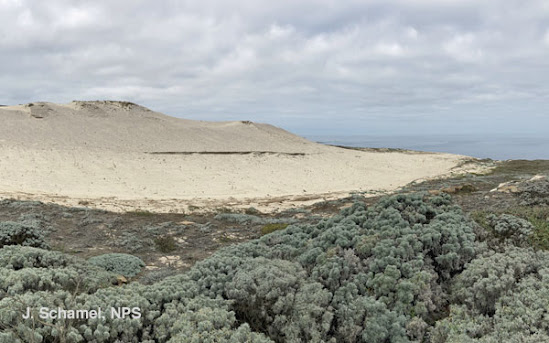
San Miguel Island is a windswept, treeless place. The most northwest of the California Channel Islands, and part of Channel Islands National Park, few people visit, but this island provides vital habitat for the rare San Miguel Island fox.

This fall during fox counting, a young male island fox was captured in this area of dunes and sage. Few pups were captured in 2021 on any of the Channel Islands; continued drought conditions reduced available food resources resulting in fewer pups being born. 
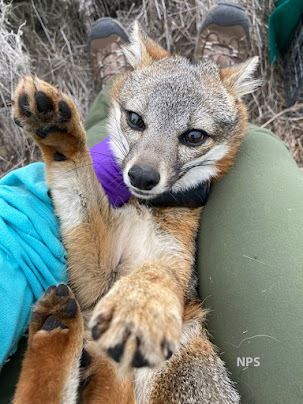
Male M515 is one of the few island fox pups documented in 2021. Following his health check, he was fitted with a radio-tracking collar funded by Friends of the Island Fox. This radio collar will enable biologists to monitor his survival and track his movement. 

As a young adult, M515 has yet to establish his territory. Will he stay in this dune area or roam to more shrubby parts of the island?

Will he stay close to the coastline or will he find a home in the island's interior? Which area will provide the greatest quantity and quality of resources? How large of a territory will he patrol? These are important questions that researchers are trying to answer.

Young male island foxes are on the move in autumn and winter. Is his priority finding a territory or a mate? We don't really know. As a youngster, however, he will have competition for territory from other males. The population of island foxes on San Miguel Island was estimated at 277 individuals in 2020. (2021 population estimates are currently being calculated.) Because the current population is down from an estimated high of 453 in 2019 (an average rainfall year), M515 may have an easier time finding a territory of his own.
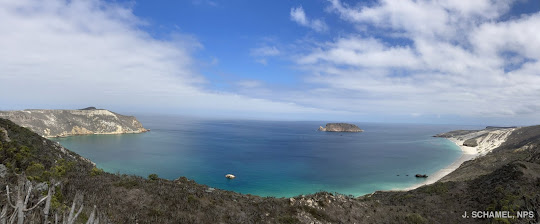
His island is a beautiful, if rugged place to live. If he's lucky, winter rains will bring renewed plant growth and prey species. He might find a mate and father pups before his first birthday in April.

Through it all, his radio collar will allow biologists to track his survival and see where he ends up on the island. If you donated to Friends of the Island Fox - M515 might be wearing a collar you helped provide! 

Every Donation Helps Island Foxes

More about San Miguel Island

Tuesday, July 19, 2016

Restoring native Habitat for Island Foxes Part 2


What are these families doing on Santa Cruz Island?


They were part of a second trip underwritten by LUSH Cosmetics that brought Friends of the Island Fox together with Channel Islands Restoration to remove invasive oyster plant (Tragopogon) from the Channel Island fox's habitat. Our June crew consisted of families, teachers, and inspired individuals. 


We split into two groups. The main group headed up onto the hillside to cut the seed heads off this invasive plant to stop its reseeding in the fall.

The smaller group continued our work in Scorpion Canyon. 

Did we make a difference? The oyster plant was looking drier in June than it had in May but it was still producing seed heads. The dry dark stalks are the oyster plant. 

This is before.

This is after we removed the seed heads and cut down the stalks. 


It was a job well done. We removed bags of oyster plant seed heads.

Invasive plants reduce the success of native plants that provide food and shelter for island animals. An added benefit - seeing island foxes.

Thank you to our photographers: Keri Dearborn, Jessica Martin, and Bonnie Ferron.
 

Monday, May 16, 2016

Restoring Native Habitat for Island Foxes


Last Saturday, Friends of the Island Fox and Channel Islands Restoration (a native plant restoration group) partnered up to remove invasive plants on Santa Cruz Island. 

Island foxes depend on a healthy native plant community for food and shelter. To survive, they have evolved to be highly omnivorous–eating a range of native fruit, insects, and other small prey

The island deer mouse may be food for the island fox, but in turn it depends on seeds from buckwheat, giant coreopsis, and other native island plants. Island foxes are directly and indirectly impacted when the native plant community is compromised.

Introduced species like this oyster plant (Tragopogon) can quickly invade hillsides pushing out native plants. Though the dandelion-like globe of seeds may look beautiful in the sunlight, it does not provide food or shelter for island wildlife and it is about to spread seed far and wide with the next good breeze.

On a mission to help restore the island's natural habitat and with grant support from LUSH Cosmetics, volunteers headed out to make a positive difference.


We learned about native plants on a hike to Cavern Point, then snipped our way through a quarter-mile section of Scorpion Canyon. 

We filled trash bags with the seed heads, to decrease the invasive plant's reproduction this spring/summer. It was amazing how heavy just the seed heads were as we filled our bags.

And of course, we were thanked by visits from several island foxes during the course of the day.


Smiling faces and black bags filled with invasive-plant seed heads being removed from the Channel Island ecosystem. It feels good to make a positive difference. If you're interested in participating in a plant restoration trip send us an e-mail at islandfoxnews@gmail.com. We hope to go out on a second trip sometime this year.
Thanks to a great day of team work! More bags behind us!
 

Tuesday, January 31, 2012

Restoring Habitat for Island Foxes

courtesy of Kevin Pease
Across the Channel Islands efforts are being made to restore the natural ecosystems that the island fox depends on for survival. One such project is the restoration of a wetland area at Prisoner’s Harbor on Santa Cruz Island, in the Channel Islands National Park.

Prior to large scale ranching on Santa Cruz, the canyon at Prisoner’s Harbor had a seasonally flowing stream that created a rare coastal lagoon. This wetland would have attracted amphibians, fish, reptiles, small mammals and migrating birds. It would have provided important food and water for the island fox.

Currently the Channel Islands National Park and the Nature Conservancy are digging out the tons of gravel and dirt that were used to fill in the wetland. Eucalyptus trees that were introduced as wind breaks are being removed and native species are being replanted. You can see some of the work in progress in a video interview by the Ventura County Star with Russell Galipeau, Channel Islands National Park Superintendent.


courtesy of Kirin Daugharty
The hillsides surrounding Prisoner’s harbor have become home to Tani and Tiptu, FIF’s island foxes on twitter. What changes will the island foxes see as the wetland is restored? Will ducks and other migrating bird species visit the area this year? Or will it take years for nature to reestablish itself in this island lagoon?

Restoring native habitat comes in stages: removing introduced species, reintroducing native species that have disappeared, understanding all of the elements of reestablishing nature’s balance.

For more information on the Prisoners Harbor Coastal Wetland Restoration

Wednesday, April 11, 2007

Six Islands, Six Different Island Foxes


Island foxes are found on six of the eight Channel Islands off the coast of southern California.
(Where does the island fox live? What is an island fox? Experiencing Santa Cruz Island )

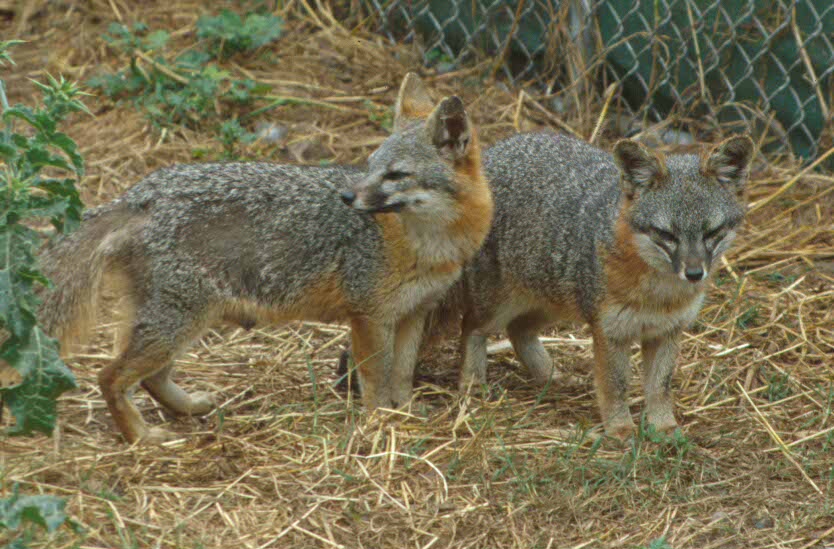
A pair of San Clemente island foxes at the Santa Barbara Zoo. (Where can you see an island fox?)


Island foxes all have similar lifestyles and habits:
  • About the island fox
  • Males consistently weigh more than females
  • What do island foxes eat? Their favorite food is the deer mouse. (Each island has its own subspecies of deer mouse.)
  • Island foxes are good climbers, which allows them to reach bird nests and eggs
  • Island fox pups are born in the spring. Island foxes usually have 2-3, but may have as many as 5 pups


But the foxes on each island are slightly different from each other. The differences are great enough that each island has its own subspecies of island fox.

National Park Service biologist Tim Coonan points out that the San Miguel island fox weighs significantly more than the island foxes on the neighboring island of Santa Rosa.

A San Miguel island fox being fitted for a radio collar.

A pair of Santa Rosa island foxes. (Experiencing Santa Rosa Island)


Tail length is a specific physical trait that varies between the different subspecies. Studies show island foxes from different islands have more or less tail vertebra.

In descending order:
  1. San Nicolas Island 22 tail vertebra
  2. Santa Catalina Island 21 tail vertebra
  3. San Clemente Island 19 tail vertebra
  4. Santa Rosa Island 19 tail vertebra
  5. Santa Cruz Island 19 tail vertebra
  6. San Miguel Island 15 tail vertebra
Between the shortest-tailed island foxes on San Miguel Island and the longest tailed on San Nicolas Island there is a difference of 7 vertebra. Interestingly, Schoenherr, Feldmeth and Emerson point out in Natural History of the Islands of California (Univ. of California Press 1999) that the island foxes on San Nicolas Island appear to have the least amount of genetic diversity. This suggests the San Nicolas population may be descended from as few as a single pair of foxes.


All of the island fox populations are vulnerable because they live in such limited habitats. Small population numbers mean that a single introduction of a disease, like the canine distemper outbreak on Santa Catalina Island, can threaten an entire island fox population. (Santa Catalina island fox Update) Catastrophic events, like the arrival of an unexpected predator–the golden eagle–can cause near extinction.

The island foxes on San Miguel Island were reduced to only 15 individuals because of predation by golden eagles. This genetic bottleneck means future San Miguel Island foxes will be more genetically alike than they were in the past.

Conservation and research efforts are necessary across the islands to preserve and protect the six subspecies of island foxes.

Donations to Friends of the Island Fox supports conservation and education efforts to Help Save all six subspecies of island fox. See how your donations can make a difference.