Showing posts with label trapping island foxes. Show all posts

Monday, October 14, 2013

Counting Channel Island Foxes

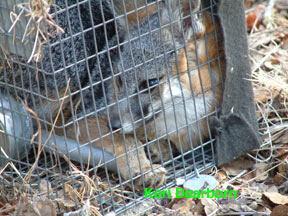
How do you count a population of small animals across an island, when they are so well camouflaged?


How long did it take you to find the island fox?   photo courtesy of M. Jakubowski

Each July to December, across the six Channel Islands where island foxes live, biologists put out special capture cages to catch individual animals. These wire box-traps have a door that snaps shut when the fox steps on a trigger plate at the rear of the box.

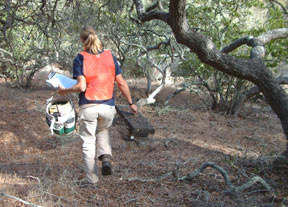
The number of cages put out each night and the manner in which they are arranged differs between islands and land managers. Tim Coonan, senior biologist for Channel Islands National Park explains that on Santa Rosa and San Miguel "Traps are deployed in small grids." These grids typically are stretched over rolling hills. The grid pattern may be two traps by six traps wide or three traps by six traps wide. The capture-trap locations are spaced approximately 250 meters apart with the capture cages usually under bushes or scrub. The cage is covered with  burlap to further protect the fox from the elements.


Cages are baited with fragrant substances particularly interesting to island foxes. Each cage has food and water. The grid of cages is checked each morning. Foxes in the cages are first scanned for their microchip ID. Biologist Calvin Duncan explains why this is important.

Each individually identified island fox is counted. This year's pups are counted separately to determine an estimated fertility rate. Pups born in April are old enough to be on their own, but they usually are somewhat smaller than adults and will not yet have received an ID microchip. While in-hand, the island fox receives a health check, vaccinations and an ID microchip or radio tracking collar if needed.


On Catalina Island capture cages are put out along lines called "strings." On mountainous terrain, strings of cages are more practical than grids. On all of the islands, actual numbers of individual island foxes caught during the fall are entered into various population modeling software to determine the best estimate for the total population. After strenuous weeks of counting in the field, it takes months in the office to produce reliable numbers. That is why the number of island foxes counted in the fall becomes official in June of the following year.

These are the official island fox population numbers through fall of 2012.
  • San Miguel Island - 540, up from a low of 15 in the year 2000
  • Santa Rosa Island - 637, up from a low of 15 in the year 2000
  • Santa Cruz Island - 1,354 , up from a low of ~62 in the year 2002
  • Santa Catalina Island - 1,502 , up from a low of ~103 in 2000


Notice how Santa Catalina and San Miguel both showed slight population drops last year. Biologists believe this a sign the populations are stabilizing at their natural levels. Drought this year may impact populations as well. Notice too how Santa Rosa is finally showing robust population increase. We hope this population will continue to recover. Whether the numbers are up or down, counting island foxes is the only way we can have the best estimate of population recovery.

Saturday, November 10, 2007

Counting Island Foxes

If you are a fox biologist on the Channel Islands, late summer through early autumn is a busy season. During this short window of time, island fox populations are counted and individual animals receive health check-ups. To get their hands on these pint-sized, but sharp-toothed predators, special box-type traps are put out in specific areas.

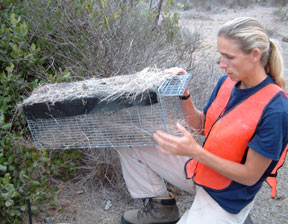
In September, Friends of the Island Fox rode along with Julie King, fox biologist for the Catalina Island Conservancy. The day on Santa Catalina Island started very early, because all of the traps on a string must be checked before the day starts to get warm.


Most foxes are captured in the evening or during the night. Even so, the traps are set in shaded spots so that a fox won’t become overheated. Each trap has a covering over the top and grass or hay inside to make it more comfortable

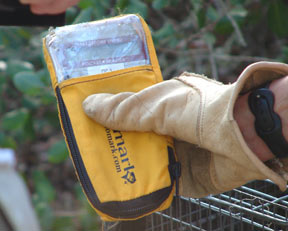
The fox is first identified by its “pit tag.” A scanner responds to the microchip tag and displays the animals identification number.

Endangered island foxes on Santa Catalina, San Miguel, Santa Rosa and Santa Cruz islands are given microchip identification tags like those you would use on your pet dog. The fox in the trap is scanned with the microchip reader to identify it. In this way, the biologist knows when the fox was last caught and whether or not it needs vaccinations, a health check or radio collar maintenance.


If the fox does not have a microchip or pit tag, it will receive one.

If it has already been caught this season and has had its health check, the biologist will release the fox and reset the trap. If not, then the island fox will spend 15-20 minutes with the biologist getting a full health workup.

Join us November 20th for an audio podcast as biologist Julie King does a health check on an island fox.