Showing posts with label threats to island foxes. Show all posts

Friday, July 08, 2022

2022 Island Fox Status Update

Island fox populations remain stable, but continuing drought raises concerns.

This is the update from across the Channel Islands as compiled from notes by Friends of the Island Fox at the Island Fox Working Group Meeting held May 11, 2022 at the Santa Barbara Zoo (hybrid meeting).

Reported population numbers are official estimates from each land manager as calculated during the 2021 counting period. (How are island foxes counted)

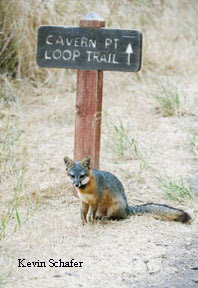
 

Overview: While adult island foxes appeared healthy across the islands in 2021, record low rainfall correlated with an extremely low number of births. As California and the Channel Islands face a second year of drought in 2022, island foxes will experience greater survival challenges. Concern is heightened for the San Miguel and San Nicolas Island foxes because they are naturally smaller populations and the native plant communities on these islands have been slow to recover from historic overgrazing.

The leading threats to island foxes in 2022 are:

  • climate warming: increasing regional temperatures and decreasing annual rainfall reduce food resources, decrease reproduction, increase wildfire threat, and promote greater parasite numbers
  • biosecurity: threats of introduced viruses, disease, and/or non-native animal species

Greatest Concern: The connection between island fox reproduction and rainfall was first documented on Catalina Island. A lack of rainfall reduces resources and depresses island fox reproduction. This is a natural way for canine populations to adjust downward so that individuals can find adequate food and territory.

Notice how the yellow bar (Santa Cruz, above) and the red bar (Catalina) decline from 2017 to 2018, a year of extreme drought. The following year (2019), above normal rainfall returned and all island fox populations benefited. While 2020 provided a minimum average rainfall of 12 inches, it was followed by historic low rainfall in 2021. Most island fox populations adjusted downward.

The 2021 estimates for Santa Rosa and Santa Cruz Islands may be slightly inflated. It is possible that in the face of food instability, a greater number of adult island foxes may have gone into capture cages for a meal. At the same time, the number of pups documented on these two islands was only 2 and 3 individuals, respectively. There was virtually no observed reproduction in 2021. Expected age range models can get out of balance when no pups are born into the population and the surviving island foxes continue to age. 

Further impacts from drought and increased temperatures: 

  1. San Nicolas Island recorded a decline in fox body weight 
  2. Multiple islands cited increases in fleas, lice, and/or ticks
  3. Activity research noted a possible trend in foxes shifting to increased nocturnal behavior during hotter summers

Island foxes enter a second year of drought with minimal reserves. 

 Smaller Islands:

The smaller islands remain stable, but did adjust downward after two years of reduced rainfall. Both San Miguel (lime green) and San Nicolas Island (pink) appear to be balancing out at lower population levels than in the past. This may be due to reduced food availability and a diet shifting away from nonnative ice plant which died off in earlier drought years.

San Miguel Island - (lime green line) The lower density of foxes on this island combined with higher levels of moisture from fog supported more pups than on the larger islands. Adults had a 85% probability of surviving the year. 

San Nicolas Island - (pink line) Lower density also benefited island foxes on this island–11 pups received health checks. While still a low number, this was the highest pup count seen across the islands in 2021. Adenovirus (dog flu) was unexpectedly found in a high number of foxes on this island, but fortunately no fatalities were found. The source of the virus's introduction remains a mystery. Friends of the Island Fox worked with U.S. Navy biologists to educate Navy personnel about island fox behavior and life cycle. The number of island foxes hit by cars was reduced from the same period of time the previous year.

San Clemente Island - (blue line) Island foxes appeared healthy, but only 3 pups were recorded in 2021. Concerted education efforts by Institute for Wildlife Studies biologists and the U.S. Navy dramatically decreased car strike fatalities in 2021 - though the low number of young foxes may have also helped decrease the number of animals on the roads.


Larger Islands:
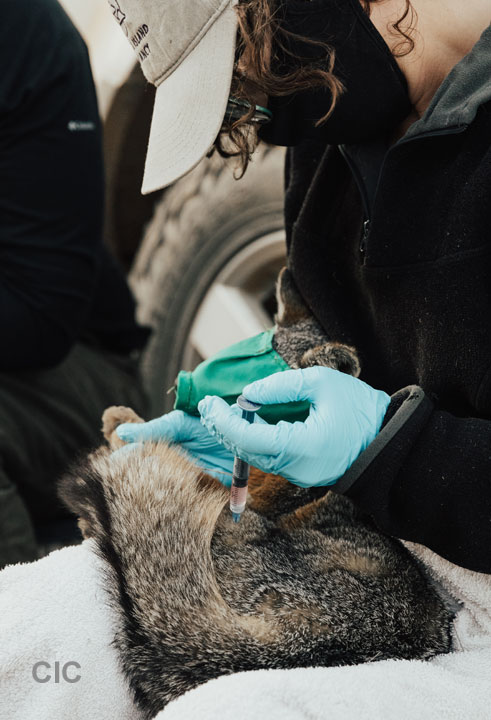
island fox being vaccinated


Santa Catalina Island - (red line) The recovery of this population is well established and the population naturally fluctuates around 1500 individual island foxes. Biosecurity is a daily challenge. Vaccination efforts have increased to every fox in-hand except sentinel foxes. In 2021 Adenovirus increased to 80% of the fox population; fortunately no fatalities are known. Testing for introduced disease is vitally important and there are hopes to increase this effort.

Santa Cruz Island - (green line) The recovery of this population is also well established. The population naturally fluctuates around 2,300 individuals with a fairly high density of 9.86 foxes per square kilometer. [for reference Disneyland's Magic Kingdom in Anaheim, CA is 1 sq. km] Biosecurity is also a heightened concern on this island. As well as monitoring with radio collars, new wildlife cameras are being established at island entry points to watch for introduced species that could be carrying disease. Adult survival rates declined to a 69% chance of surviving the year and there is concern that continuing drought will challenge adult survival in 2022.

Santa Rosa Island - (pink line) With the plateauing of the island fox population on Santa Rosa Island, it is believed this island has fully recovered and reached carrying capacity. The next few years should see adjustment toward a naturally sustainable population level. Currently the island has a density calculated at 12.4 foxes per square kilometer; a very high density. Continuing drought could impact the ability of older island foxes to maintain territory and access to resources. Two GPS research projects supported by Friends of the Island Fox will be watching the movement, diet, territory size, and interaction of island foxes very closely this summer on Santa Rosa Island.

*Note line graphs show population estimates from even years, with the exception of the most current year 2021. Population graphs with all years show greater fluctuation. See bar graph "Island Fox Populations of the Last 5 Years" at top of page.

Monday, July 01, 2013

Microchipping 500 Island Foxes

What is small and makes a BIG difference for endangered Channel Island foxes?

Microchips or Passive Identification Tags (PIT)

This summer you can help make a big difference for island foxes. With help from kids, friends, baseball fans and even a dog, Friends of the Island Fox has raised $2,500 for 250 microchips for island foxes on the northern islands that are part of Channel Islands National Park.

At the annual meeting of the Integrated Island Fox Recovery Team, FIF learned that 250 microchips are also needed to provide individual identification for young island foxes on Santa Catalina Island.

The biologists on Santa Catalina Island work hard to keep island foxes safe from a variety of threats:


the tiny microchip goes under the skin
An identification microchip allows biologists to positively identify each individual island fox

As the number of island foxes on Santa Catalina stabilizes at approximately 1,500 individual animals, more resources are need to monitor their success.

For just $10 you can fund a microchip that will provide an island fox with lifelong identification. Use the PayPal button in the upper right corner to Donate Now.

Be part of the most successful recovery of an endangered species!


Monday, May 09, 2011

Raccoon Spotted on Catalina

The Catalina Island Conservancy reports that a raccoon was spotted in the Two Harbors Campground on Catalina Island. Despite a rapid response setting up capture cages, the raccoon has not been apprehended. This raccoon poses a serious threat to island foxes and other endemic island species.


Raccoons are not native to the California Channel Islands and they are now believed to have been the source of the distemper virus that killed over 88% of the Catalina Island foxes between 1998 and 2000.
More on the threat posed by raccoons.

For information on what to do if you see a raccoon on a boat: Raccoon Awareness Flyer


If you should see the raccoon on Catalina Island please contact the Catalina Island Conservancy. For the safety of the island fox and other island species it is imperative that this raccoon is apprehended as soon as possible.

Thursday, November 04, 2010

Raccoons Don't Belong on Channel Islands


When is a cute raccoon a serious threat? When it is mistakenly transported to the Channel Islands.

The masked face of a raccoon makes us sigh and their antics can make us laugh, but raccoons pose a serious threat to native wildlife on the Channel Islands. Raccoons are not native to our California islands. Species like the island fox, spotted skunk and island birds have all evolved without raccoons and without the diseases and parasites that raccoons can carry.

Recent research has pointed to a raccoon as the origin of the distemper virus that nearly wiped out the island fox population on Santa Catalina Island between 1998-2000. Raccoons carry many diseases, like rabies, parvo and distemper, that are fatal to canines. The introduction of a single disease-infected raccoon could have drastic consequences for endangered island foxes and other unique island species. Support vaccinations.

How does a raccoon get all the way from Los Angeles or Santa Barbara to the Channel Islands?
In the past few years, raccoon populations have grown in harbor areas. This means that occasionally they wander onto private boats. Unsuspecting boat owners may have a stowaway raccoon that they unknowingly transport to the islands. While this scenario may seem unbelievable, it has happened on Catalina Island several times in the last two years. Because Catalina is fairly populated and Avalon is the primary port of entry, the Catalina Island Conservancy has been alerted to the arrival of  these raccoons. Usually the animal is caught within a short window of time, but one raccoon traveled to the interior of the island in just three days.

A raccoon accidentally introduced to Channel Islands National Park might go undetected for sometime, potentially coming in contact with numerous island animals.

Friends of the Island Fox urges all boat owners traveling to any of the Channel Islands to make sure there are no stowaway animals on your boat before leaving the harbor. Pass this information on to friends and family that may be boaters along the southern California coast.

Download the following Raccoon Awareness Flyer from the Catalina Island Conservancy and PASS IT ON. 

Public awareness can make the difference between survival and extinction for the endangered Channel Island fox.

Tuesday, November 20, 2007

Island Fox Health Checks on Catalina Island

The Santa Catalina Island fox became endangered when an outbreak of disease, believed to be canine distemper, killed over 85% of the population in just a few years. To help prevent such catastrophic events in the future, biologists across the Channel Islands use the late summer and early fall to count island foxes and give them health checks.

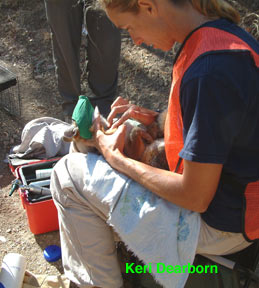
In September, Friends of the Island Fox went out in the field with Julie King, fox biologist for the Catalina Island Conservancy as she did health checks on wild island foxes.

Click to Listen to Island Fox Talk Podcast in the field with Julie King as she examines a young female island fox.

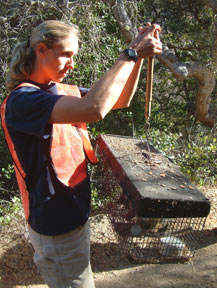
An island fox health check involves:
  • taking the weight - The island fox is weighed while still in the trap.
  • evaluation of over all physical status - The biologist feels the fox’s body for any lumps, bumps or wounds. (photo above)

  • visual check of teeth, coat - Teeth are checked for wear and breakage (this female fox was under 2 years old but had a broken tip on an upper canine tooth); the coat is examined for overall heath and the presence of parasites, fleas and ticks.
  • ear exam - An otoscope is used to look in the fox’s ears. The biologist is looking for ear mites, inflammation and disease.


  • vaccinations - Island foxes receive vaccinations to help reduce the chance of disease.
  • drawing a blood sample - The blood sample provides additional information on health and possible disease exposure. A mask is put over the foxes eyes to reduce the animal's stress while being handled by humans.


How was the island fox caught for the health check?

The island foxes on Santa Catalina are increasing in number, but a new threat is causing them problems, ear mites. Cancerous tumors are forming in the ears of island foxes on Catalina. The relationship between the ear mites and the cancer is currently being studied. Friends of the Island Fox would like to help the Catalina Island Conservancy in their quest to solve this mystery that is posing a new danger to island foxes.
You can help by making a donation through the "Pay Pal" or "Donate Now" buttons at the top right of the page.

Through generous donations Friends of the Island Fox has funded 17 radio collars in the past 2 years so island foxes can be monitored in the wild. Your donation to Friends of the Island Fox helps fund conservation efforts across all of the Channel Islands to help save the island fox.

Thursday, May 17, 2007

Fire and Foxes on Catalina Island - Update

Just a quick Update on the island foxes on Santa Catalina Island.

Friends of the Island Fox has been in communication with the Catalina Island Conservancy (CIC). The few individual island foxes that are in captive care for health problems and Tachi, CIC's education fox, are all fine. (For more about Tachi)

As of Thursday May 17, the fire is completely out. Now biologists are beginning the task of trying to locate radio collared island foxes to determine if there were any fatalities due to the fire.

CIC will make their full report at the Fox Conference in mid June. A complete summary of all island fox conservation successes and issues will be posted here following the Conference. (most recent look at island foxes on Santa Catalina Island)

Thank you for your concern about the island foxes in the face of this recent fire threat.