Showing posts with label Santa Catalina island fox. Show all posts

Friday, April 03, 2020

Mites, Microbes, and Cancer in Santa Catalina Island Foxes by Alexandra DeCandia

(Thank you to our guest blogger Alexandra DeCandia a doctoral candidate at Princeton University)

Over the last few decades, we've realized that organisms are far more complicated than they initially appear. What may look like an individual fox is actually an ecosystem containing trillions of microorganisms on every square inch. [Figure 1]

Despite their tiny size, microbes influence important host functions, such as development, digestion, stress tolerance, behavior, and even immunity. Therefore learning more about these hidden actors can inform wildlife conservation of at-risk species in the modern molecular era.

Looking into the ear canal of an island fox.
Microbes may be particularly important to species that lack genetic diversity, such as Channel Island foxes, especially where disease threatens long-term persistence. On Santa Catalina Island, scientists discovered extremely high rates of ear canal tumors, where roughly half of adult foxes have growths in their ears. Although the exact cause is unknown, researchers linked ear mite infection to tumor growth and development. The most prominent hypothesis states that infection with ear mites leads to inflammation and rampant cell growth in the ear canal, which in turn leads to tumors. Thankfully, treating foxes with the acaricide Ivermectin has already decreased mite burdens and tumor rates in these foxes.

However, there's more to this story. We still don't fully understand how mite infection leads to tumor growth. In particular, my collaborators and I wondered whether microbes play a role in this system. For example, do mites disrupt healthy microbes and cause secondary bacterial infections? And do those infections then contribute to the chronic inflammation that precedes tumor growth?

Figure 2: Island fox is swabbed during health check
To address these questions, my collaborators at the Catalina Island Conservancy collected microbe samples by swabbing ear canals (and a few other body sites) of healthy and mite-infected foxes. [Figure 2] (This process is similar to cleaning your ears with a cotton swab, except you don't throw away the swab afterwards.) Once a bunch of foxes were swabbed, all samples were sent to New Jersey, where I extracted DNA, collected genetic sequences, and analyzed the data.

 The results came back loud and clear: microbes differed between mite-infected and uninfected ear canals. Rather than a rich community of diverse microbes (as seen in healthy ears), mite-infected ear canals had fewer microbial species present. We further found that the balance of microbes (know as "relative abundance") differed between infection groups.  [Figure 3]

Figure 3: Classes of bacteria found in swab samples
As it turned out, this pattern was almost entirely driven by an overabundance of one bacterial species: Staphylococcus pseudintermedius (Class: Bacilli, shown in brown in Figure 3).

Even though this microbe is commonly found on canid species (such as domestic dogs and foxes), it can become an opportunistic pathogen when healthy communities are disrupted. Once it proliferates, it can be incredibly difficult for the immune system or even antibiotics to eradicate, leading to chronic inflammation.

We now hypothesize that mite infection and secondary bacterial infection with Staphylococcus pseudintermedius contribute to chronic inflammation and tumor growth in Santa Catalina Island foxes. 

Photo courtesy of Glenn Jensen
Although further tests are needed to definitively establish causation, these insights into the microbial dynamics of mite infection can help us monitor the population for antibiotic resistant forms of Staphylococcus pseudintermedius that could cause a disease outbreak. They can further help us explore other open questions, such as why Santa Catalina Island foxes are the only subspecies with ear canal tumors, despite ear mites on other islands. As always in science, answers lead to more questions. But at least one thing is clear: there's more to this story (and indeed, to all organisms) than what initially meets the eye.  

Alexandra DeCandia, Department of Ecology & Evolutionary Biology, Princeton University, Princeton, New Jersey.

Read the full paper: Ear mite infection is associated with altered microbial communities in genetically depauperate Santa Catalina Island foxes (Urocyon littoralis catalinae)

More Research Regarding Island Foxes:
More 

Monday, July 01, 2013

Microchipping 500 Island Foxes

What is small and makes a BIG difference for endangered Channel Island foxes?

Microchips or Passive Identification Tags (PIT)

This summer you can help make a big difference for island foxes. With help from kids, friends, baseball fans and even a dog, Friends of the Island Fox has raised $2,500 for 250 microchips for island foxes on the northern islands that are part of Channel Islands National Park.

At the annual meeting of the Integrated Island Fox Recovery Team, FIF learned that 250 microchips are also needed to provide individual identification for young island foxes on Santa Catalina Island.

The biologists on Santa Catalina Island work hard to keep island foxes safe from a variety of threats:


the tiny microchip goes under the skin
An identification microchip allows biologists to positively identify each individual island fox

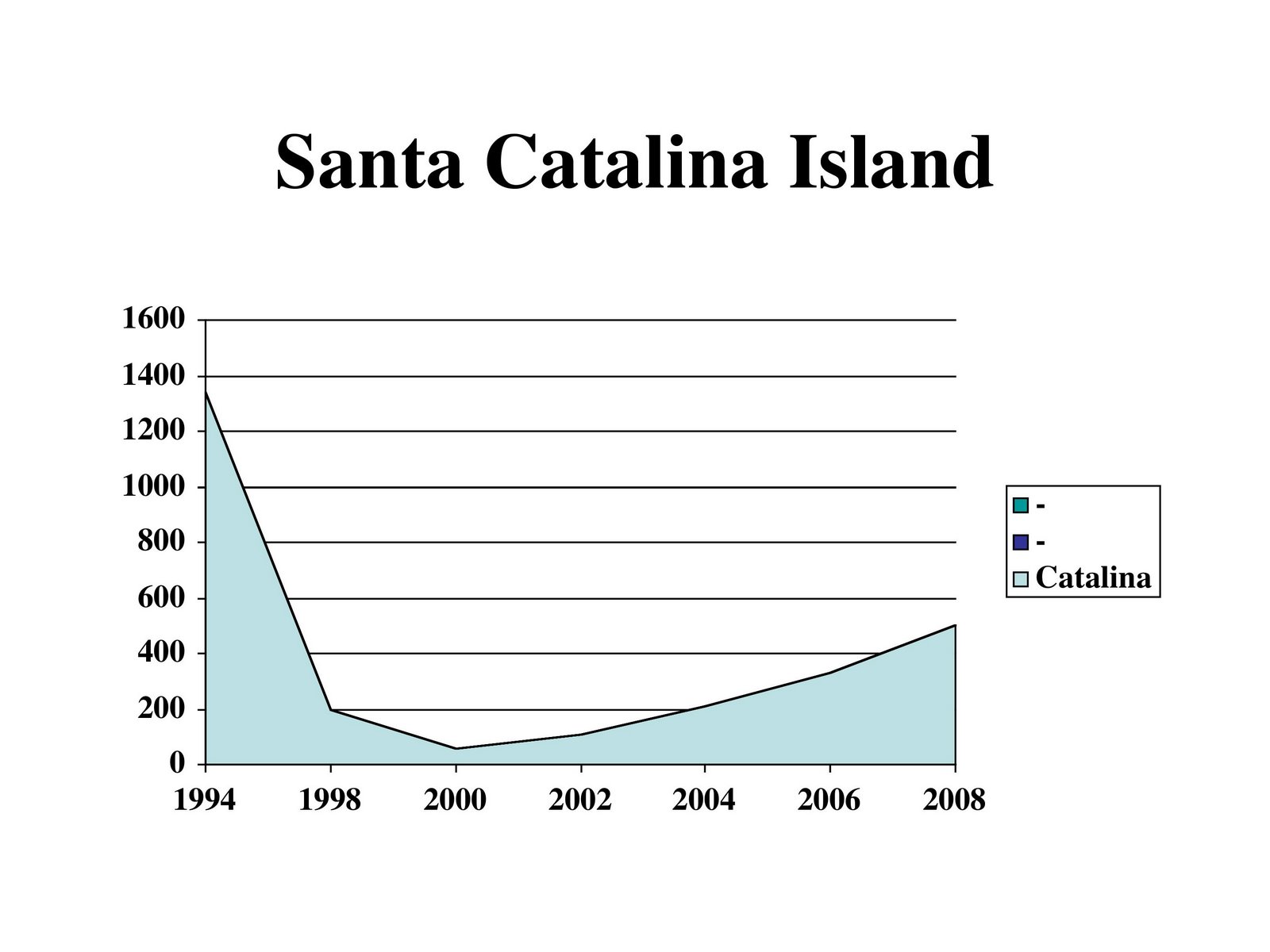
As the number of island foxes on Santa Catalina stabilizes at approximately 1,500 individual animals, more resources are need to monitor their success.

For just $10 you can fund a microchip that will provide an island fox with lifelong identification. Use the PayPal button in the upper right corner to Donate Now.

Be part of the most successful recovery of an endangered species!


Sunday, June 16, 2013

Good News on Channel Island Fox Recovery

Have you heard the good news? 

All four of the subspecies of endangered Channel Island foxes are doing well. In fact, three of the subspecies are considered to be close to recovered. What constitutes recovery?

  1. Population numbers that have returned to healthy levels
  2. Reduction of threats (those that caused the original near extinction and/or new challenges to survival)
  3. Stability of the first two for at least five years

A graph of the population figures from Santa Cruz and Santa Catalina Islands shows the rapid declines toward extinction in the late 1990s. (Caused by unnatural golden eagle predation on Santa Cruz and introduced distemper virus on Santa Catalina.) 


From 2000 to 2007 island foxes increased in captive breeding facilities on each of the islands and were gradually released into the wild. Once the threats to their survival were reduced, populations of island foxes increased rapidly in the wild. Golden eagles were relocated and bald eagles were reestablished on the northern islands, while vaccinations for distemper and rabies were instituted across the islands.

On both Santa Cruz and Santa Catalina the island fox populations now fluctuate around a number that represents the carrying capacity or maximum population that can survive on each island's resources. The population of any living species alters naturally in response to available food, water and habitat.

The population numbers for island foxes are compiled annually by biologists in the field each autumn. These hard-working people  from across the six islands come together each year in June with veterinarians, scientists and government officials to discuss the status and threats to each of the six subspecies of island fox. We will have more from the annual meeting of the Integrated Island Fox Recovery Team as we compile our notes. It's been a happy busy week.

Thursday, November 04, 2010

Raccoons Don't Belong on Channel Islands


When is a cute raccoon a serious threat? When it is mistakenly transported to the Channel Islands.

The masked face of a raccoon makes us sigh and their antics can make us laugh, but raccoons pose a serious threat to native wildlife on the Channel Islands. Raccoons are not native to our California islands. Species like the island fox, spotted skunk and island birds have all evolved without raccoons and without the diseases and parasites that raccoons can carry.

Recent research has pointed to a raccoon as the origin of the distemper virus that nearly wiped out the island fox population on Santa Catalina Island between 1998-2000. Raccoons carry many diseases, like rabies, parvo and distemper, that are fatal to canines. The introduction of a single disease-infected raccoon could have drastic consequences for endangered island foxes and other unique island species. Support vaccinations.

How does a raccoon get all the way from Los Angeles or Santa Barbara to the Channel Islands?
In the past few years, raccoon populations have grown in harbor areas. This means that occasionally they wander onto private boats. Unsuspecting boat owners may have a stowaway raccoon that they unknowingly transport to the islands. While this scenario may seem unbelievable, it has happened on Catalina Island several times in the last two years. Because Catalina is fairly populated and Avalon is the primary port of entry, the Catalina Island Conservancy has been alerted to the arrival of  these raccoons. Usually the animal is caught within a short window of time, but one raccoon traveled to the interior of the island in just three days.

A raccoon accidentally introduced to Channel Islands National Park might go undetected for sometime, potentially coming in contact with numerous island animals.

Friends of the Island Fox urges all boat owners traveling to any of the Channel Islands to make sure there are no stowaway animals on your boat before leaving the harbor. Pass this information on to friends and family that may be boaters along the southern California coast.

Download the following Raccoon Awareness Flyer from the Catalina Island Conservancy and PASS IT ON. 

Public awareness can make the difference between survival and extinction for the endangered Channel Island fox.

Wednesday, July 21, 2010

Visiting the Island Fox

Summer is a great time to visit the California Channel Islands. As island fox populations recover from disease and predation by golden eagles that nearly pushed them to extinction, more people are having the opportunity to see island foxes in the wild. (Why island foxes are endangered)
Observing an endangered animal in the wild is a rare experience and it comes with responsibility. Here are a few important tips to remember when encountering an island fox:
  1. Do Not Feed Them - Island foxes are smart and they know people have food. But feeding an island fox can threaten its life. Human food is not good for island foxes and does not provide the necessary nutrition. Wild foxes, especially juveniles, that become dependent on handouts never learn to forage for natural food and can die when their free food source disappears.
  2. Store Food Appropriately - Island foxes are clever. Even campers who do not intentionally feed island foxes can sometimes become a source of food. We have heard cases of a single island fox taking an entire plastic bag with eight hamburger buns right off of a picnic table. Plastic and food wrappers can appear to be food and cause injury to island foxes. (see island fox and fishing hook) The NPS campgrounds offer food lockers to secure food items.
  3. Island Foxes Are Wild Animals - Even though the island foxes are cute and friendly, they are wild animals. A woman feeding an island fox on Santa Catalina Island was bitten. The Center for Disease Control can require that any fox that bites a person be euthanized to insure that it is not carrying rabies.
  4. Leave Your Pets At Home - Island foxes can acquire diseases from domestic dogs and cats. The distemper virus, which can be carried by dogs, caused the death of over 88% of the island foxes on Catalina in the late 1990s. As wild animals, island foxes can also carry diseases that are dangerous for pets–parvovirus, coronavirus and internal parasites. Some of these diseases can be transferred simply through animal droppings and do not require animal-to-animal contact. While many island foxes are vaccinated for rabies and distemper, not all of them are. It is illegal to take pet dogs or cats on to any of the islands that make up Channel Islands National Park. On Catalina Island dogs are required to be leashed. Several island foxes have been attacked and killed by free-roaming domestic dogs.
  5. Watch for Wildlife on Road - The increase of island foxes on Santa Catalina means that more foxes are being seen along the islands few roads. Because of their small size and gray coloring, island foxes can be hard to see especially at twilight. The number one cause of death for island foxes on Catalina is being hit by a car. Roadsigns
Southern Californians have worked very hard to save the island fox from extinction. The reward is that now we can see island foxes in the wild again. If we all act with respect and responsibility toward our friend the island fox, we can insure their continued success toward sustainable populations.

On Santa Cruz Island and Santa Rosa Island, in Channel Island National Park, visitors can see island foxes around the campgrounds, landing areas, and along hiking trails. Channel Islands National Park

On Santa Catalina Island, the increase of island foxes means that more individuals are being seen around the town of Avalon and the golf course. Island foxes can also be seen in the island’s interior. Catalina Island Conservancy

If you can’t travel out to the Channel Islands, you can visit island foxes in several local zoos.

Photos courtesy of Kevin Pease.

Wednesday, January 21, 2009

Good News for Island Foxes

The numbers are gradually coming in from the biologists on the six Channel Islands that are home to the island fox. On the four islands where island foxes are endangered, San Miguel, Santa Rosa, Santa Cruz, and Santa Catalina, the populations continue to increase.

Each autumn, island foxes are counted by trapping them in specially designed containment traps. This allows biologists to determine the number of island foxes on each island, check their health, give them vaccinations for distemper and rabies, and fit radio tracking collars.


For more on Health Checks on Catalina Foxes.

Last year the number of island foxes
physically counted on Santa Catalina Island was 365. This year over 500 have been individually counted!

Endangered island fox populations are recovering successfully on all four islands, but we still have a long way to go to reach the population numbers before disease struck Santa Catalina Island and ecosystem imbalance resulted in golden eagles hunting island foxes on the northern islands. Why are island foxes endangered?

Island fox recovery has been possible because of broad reaching conservation efforts on their behalf.

You can help !

Donations To Friends of the Island Fox Help:
  • purchase radio collars to monitor wild island foxes. Learn More
  • supply vaccinations against disease transmitted from domestic dogs and species transported onto the islands. Learn More
  • fund necropsies to study the cause of death in island foxes. Learn More
  • support education programs to teach school children and community groups about this local endangered species and the Channel Island Ecosystem. Learn More
You can Donate by clicking on the PayPal or Network for Good buttons at the top right corner.

Stay Linked In. As soon as the final population numbers are available, we will post them here on the Friends of the Island Fox website.

For detailed information on each island fox population as well as research summaries, video and podcasts - Click on the Library button in the directory bar.

Saturday, November 10, 2007

Counting Island Foxes

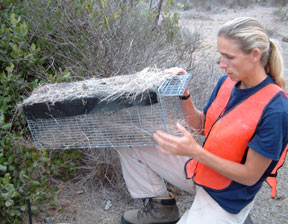
If you are a fox biologist on the Channel Islands, late summer through early autumn is a busy season. During this short window of time, island fox populations are counted and individual animals receive health check-ups. To get their hands on these pint-sized, but sharp-toothed predators, special box-type traps are put out in specific areas.

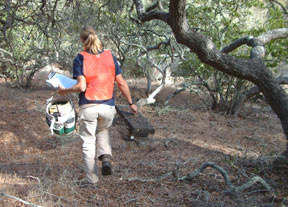
In September, Friends of the Island Fox rode along with Julie King, fox biologist for the Catalina Island Conservancy. The day on Santa Catalina Island started very early, because all of the traps on a string must be checked before the day starts to get warm.


Most foxes are captured in the evening or during the night. Even so, the traps are set in shaded spots so that a fox won’t become overheated. Each trap has a covering over the top and grass or hay inside to make it more comfortable

The fox is first identified by its “pit tag.” A scanner responds to the microchip tag and displays the animals identification number.

Endangered island foxes on Santa Catalina, San Miguel, Santa Rosa and Santa Cruz islands are given microchip identification tags like those you would use on your pet dog. The fox in the trap is scanned with the microchip reader to identify it. In this way, the biologist knows when the fox was last caught and whether or not it needs vaccinations, a health check or radio collar maintenance.


If the fox does not have a microchip or pit tag, it will receive one.

If it has already been caught this season and has had its health check, the biologist will release the fox and reset the trap. If not, then the island fox will spend 15-20 minutes with the biologist getting a full health workup.

Join us November 20th for an audio podcast as biologist Julie King does a health check on an island fox.