
Island fox populations remain stable, but continuing drought raises concerns.

This is the update from across the Channel Islands as compiled from notes by Friends of the Island Fox at the Island Fox Working Group Meeting held May 11, 2022 at the Santa Barbara Zoo (hybrid meeting).
Reported population numbers are official estimates from each land manager as calculated during the 2021 counting period. (How are island foxes counted)

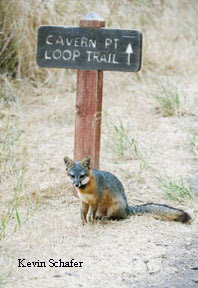
Overview: While adult island foxes appeared healthy across the islands in 2021, record low rainfall correlated with an extremely low number of births. As California and the Channel Islands face a second year of drought in 2022, island foxes will experience greater survival challenges. Concern is heightened for the San Miguel and San Nicolas Island foxes because they are naturally smaller populations and the native plant communities on these islands have been slow to recover from historic overgrazing.
The leading threats to island foxes in 2022 are:
- climate warming: increasing regional temperatures and decreasing annual rainfall reduce food resources, decrease reproduction, increase wildfire threat, and promote greater parasite numbers
- biosecurity: threats of introduced viruses, disease, and/or non-native animal species
Greatest Concern: The connection between island fox reproduction and rainfall was first documented on Catalina Island. A lack of rainfall reduces resources and depresses island fox reproduction. This is a natural way for canine populations to adjust downward so that individuals can find adequate food and territory.

Notice how the yellow bar (Santa Cruz, above) and the red bar (Catalina) decline from 2017 to 2018, a year of extreme drought. The following year (2019), above normal rainfall returned and all island fox populations benefited. While 2020 provided a minimum average rainfall of 12 inches, it was followed by historic low rainfall in 2021. Most island fox populations adjusted downward.
The 2021 estimates for Santa Rosa and Santa Cruz Islands may be slightly inflated. It is possible that in the face of food instability, a greater number of adult island foxes may have gone into capture cages for a meal. At the same time, the number of pups documented on these two islands was only 2 and 3 individuals, respectively. There was virtually no observed reproduction in 2021. Expected age range models can get out of balance when no pups are born into the population and the surviving island foxes continue to age.

Further impacts from drought and increased temperatures:
- San Nicolas Island recorded a decline in fox body weight
- Multiple islands cited increases in fleas, lice, and/or ticks
- Activity research noted a possible trend in foxes shifting to increased nocturnal behavior during hotter summers
Island foxes enter a second year of drought with minimal reserves.

The smaller islands remain stable, but did adjust downward after two years of reduced rainfall. Both San Miguel (lime green) and San Nicolas Island (pink) appear to be balancing out at lower population levels than in the past. This may be due to reduced food availability and a diet shifting away from nonnative ice plant which died off in earlier drought years.

San Nicolas Island - (pink line) Lower density also benefited island foxes on this island–11 pups received health checks. While still a low number, this was the highest pup count seen across the islands in 2021. Adenovirus (dog flu) was unexpectedly found in a high number of foxes on this island, but fortunately no fatalities were found. The source of the virus's introduction remains a mystery. Friends of the Island Fox worked with U.S. Navy biologists to educate Navy personnel about island fox behavior and life cycle. The number of island foxes hit by cars was reduced from the same period of time the previous year.
San Clemente Island - (blue line) Island foxes appeared healthy, but only 3 pups were recorded in 2021. Concerted education efforts by Institute for Wildlife Studies biologists and the U.S. Navy dramatically decreased car strike fatalities in 2021 - though the low number of young foxes may have also helped decrease the number of animals on the roads.

Larger Islands:
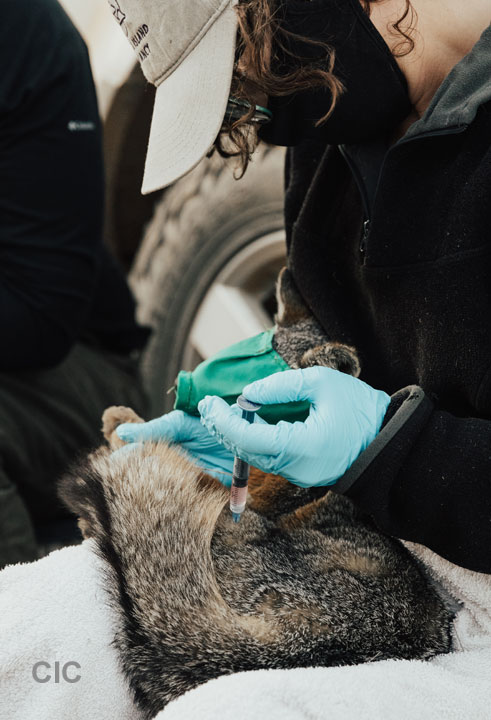 |
| island fox being vaccinated |
Santa Catalina Island - (red line) The recovery of this population is well established and the population naturally fluctuates around 1500 individual island foxes. Biosecurity is a daily challenge. Vaccination efforts have increased to every fox in-hand except sentinel foxes. In 2021 Adenovirus increased to 80% of the fox population; fortunately no fatalities are known. Testing for introduced disease is vitally important and there are hopes to increase this effort.
Santa Cruz Island - (green line) The recovery of this population is also well established. The population naturally fluctuates around 2,300 individuals with a fairly high density of 9.86 foxes per square kilometer. [for reference Disneyland's Magic Kingdom in Anaheim, CA is 1 sq. km] Biosecurity is also a heightened concern on this island. As well as monitoring with radio collars, new wildlife cameras are being established at island entry points to watch for introduced species that could be carrying disease. Adult survival rates declined to a 69% chance of surviving the year and there is concern that continuing drought will challenge adult survival in 2022.
Santa Rosa Island - (pink line) With the plateauing of the island fox population on Santa Rosa Island, it is believed this island has fully recovered and reached carrying capacity. The next few years should see adjustment toward a naturally sustainable population level. Currently the island has a density calculated at 12.4 foxes per square kilometer; a very high density. Continuing drought could impact the ability of older island foxes to maintain territory and access to resources. Two GPS research projects supported by Friends of the Island Fox will be watching the movement, diet, territory size, and interaction of island foxes very closely this summer on Santa Rosa Island.
*Note line graphs show population estimates from even years, with the exception of the most current year 2021. Population graphs with all years show greater fluctuation. See bar graph "Island Fox Populations of the Last 5 Years" at top of page.


