Showing posts with label Juliann Schamel research on island fox diet. Show all posts

Friday, May 10, 2024

Date With A Fox - Island Fox Research with Juliann Schamel and Dr. Alexandria DeCandia

Friends of the Island Fox's Virtual Program on current island fox research.

"Date With A Fox"

with guests Juliann Schamel and Dr. Alexandra DeCandia

from Tuesday, April 30th

The April program highlighted current findings on island fox diet and microbiome. Microbiome investigations can help us understand how island foxes and island spotted skunks are using resources in the island ecosystem. Dietary investigations analyzing stable isotopes in whisker samples are revealing changes in island fox diet as their population size recovers and potential resource competition with island spotted skunks. 

Both research presenters are past recipients of Friends of the Island Fox Research Grants.


Dr. Alexandra DeCandia is an Assistant Teaching Professor in the Biology Dept. at Georgetown University and works with the Center for Conservation Genomics at the Smithsonian's National Zoo and Conservation Biology Institute. Her work has been published in Molecular Ecology and she is currently working on a joint project with Juliann Schamel supported by Friends of the Island Fox.


Juliann Schamel is a Biological Science Technician working with island foxes at Channel Islands National Park and a graduate student in ecology and conservation at the University of Aberdeen, Scotland. Her work has been published in PLOS ONE and she presented a poster on island fox and island spotted skunk dietary overlap at the California Island Symposium. 

Informed conservation decisions for island foxes and island spotted skunks depend on scientific knowledge.


Friends of the Island Fox is currently 

accepting applications for our 2024 FIF Research Grant.


Subscribe to the FIF bi-monthly e-newsletter for invitations to upcoming "Date with a Fox" presentations.

Friday, March 15, 2024

FIF 2023 Research Grant to Investigate Individual Island Fox Impact


FIF awarded a second Research Grant in 2023 to Juliann Schamel, NPS biologist and graduate student in Ecology and Conservation at University of Aberdeen, Scotland...

Juliann Schamel in the field with island fox
 

and Dr. Alexandria DeCandia, biology professor at Georgetown University...

Dr. Alexandria DeCandia
 

for their project: From Microbes to Habitats: How Individual Fox Foraging Behavior Cascades Through an Ecosystem.

Schamel and De Candia are combining their respective work in stable isotope diet analysis and microbiome research to investigate the specific interconnections between 15 male island foxes and the island ecosystem. The team says, "Recent research has revealed that the island fox displays a high level of individual specialization, from their diet, to activity patterns, to the germination rate of scat-dispersed native seeds." This work builds on stable isotope diet analysis that Schamel presented at the Channel Island Symposium that demonstrated that diet specialization is occurring on Santa Rosa Island

GPS radio collar deployed on Santa Rosa Island

The 15 island foxes to be studied were part of a territory range investigation monitoring island fox movement with GPS radio collars by FIF 2021 Research Grant recipient Katie Elder. The final collection of data occurred in December 2023 when the island foxes were recaptured and their GPS collars removed.

Combining specific daily movement data (over the course of a year) with stable isotope diet data from individual whisker samples and microbiome swabs of gut microfloral offers a unique window into the lives of these individual island foxes. 

Microbiome sample swabs
 

It's easy to assume that island foxes, as a species, have a specifically defined relationship with plants and animals in the island ecosystem. However, Schamel's island fox dietary data has revealed a great deal of individualism in dietary choice, especially when resources are abundant. Some island foxes are eating beach foods, some are fruit specialists, others prey predominantly on deer mice.

Island fox whisker sample being collected
 

This investigation will try to reveal "a more holistic understanding of island foxes," DeCandia says. "[H]ost-associated microbes are critical to ... digestion and immunity,... By linking gut microbial communities with individual diet, movement, and activity patterns, we can begin to untangle the eco-evolutionary factors shaping these island hosts, their microbes, and the ecosystem in which they live."

Comparing microbiome of island fox and island spotted skunk, A. DeCandia
 

Friends of the Island Fox is proud to invest in this cutting-edge, multidisciplinary scientific investigation that brings together academic and governmental organizations and investigators. Whisker samples will be processed and analyzed by Julianne Schamel and Seth Newsome at the Center for Stable Isotopes at the University of New Mexico. DNA from microbiome swabs will be extracted by Alexandria DeCandia at the Center for Conservation Genomics at the Smithsonian's National Zoo and Conservation Biology Institute. Undergraduate researchers at Georgetown University, University of New Mexico, and California State University Channel Islands will actively participate in sample collection, laboratory preparation, data analysis and interpretation, and co-authorship of findings. 

Your donations help grow scientific knowledge and the next generation of scientists! 

Applications for FIF's 2024 Research Grant 

will be available March 22

Friday, March 08, 2024

Stable Isotopes Document Decade of Dietary Change in Island Foxes


Juliann Schamel has been researching island fox diet using stable isotopes in whisker samples since 2018. Friends of the Island Fox has supported the processing of whisker samples through several Research Grants. In November of 2023, Schamel presented the following poster of her latest work at the California Islands Symposium.

Using Stable Isotopes to Assess a Decade of Dietary Resource Use in Two Sympatric Island Endemics: The Island Fox and the Island Spotted Skunk (link to complete poster)

Island foxes and island spotted skunks live together on two islands, Santa Rosa and Santa Cruz. When island fox numbers crashed due to predation by golden eagles, island spotted skunk numbers appeared to increase dramatically. In 2011, on Santa Rosa Island, there were still fewer than 90 island foxes in the wild. During annual health checks, whisker samples were collected from both island foxes and island spotted skunks in a northern area of the island and stored for later analysis of what food resources each species was using.

In 2011, island spotted skunks out numbered island foxes in the wild. Stable isotope analysis shows that the skunks and foxes were using different resources. 

J. Schamel, 2023 poster
 

Carbon and nitrogen isotopes travel up the food chain leaving a specific isotope signature for plant and animal resources. Literally, you are what you eat and isotopes from a mammal's diet are laid down chronologically in hair or fur. A single island fox whisker can provide 5–6 months of weekly diet data. On the graph above, native terrestrial plant foods, like manzanita berries, are high in Carbon and low in Nitrogen. A deer mouse is the accumulation of its own, mostly plant diet; it has a mid-range Carbon and Nitrogen signature. In the graph above, the blue data points represent island fox diet and the orange data points represent island spotted skunk diet. 

In 2011, when island fox numbers in the wild were low, their diet tended to be higher on the food chain or trophic level: deer mice, birds and reptiles. The data suggested separate diet niches for island foxes and island spotted skunks. The skunks were eating primarily, lower level prey, like insects, and some plant foods.

J. Schamel, 2023 poster

In 2014, continuing drought influenced wildlife survival; island fox and island spotted skunks were nearly even in number on Santa Rosa Island. Island foxes expanded their diet, including marine resources, and island spotted skunks preyed more on deer mice and higher level prey. The two predators began competing for resources.

J. Schamel, 2023 poster

By 2018, the island fox population had recovered, but island spotted skunks appeared to decline in number. (Counting island spotted skunks) As island fox density increased across the island, they dramatically broadened their diet–from native fruit through a range of prey species. The spotted skunks maintained a more narrow diet, but they were now in constant competition with island foxes. What will this mean for the two species?

Schamel's work also revealed that individual island foxes are becoming specialized in their diet.

J. Schamel, 2023 poster
 

In the graphic above, each circle of data points represents an individual island fox and its diet. Some individuals appear to be specializing in fruit and insects, while others are eating predominately terrestrial prey. How is island fox diet continuing to change?

Save the date of April 30th at 6:30 pm PT 

Juliann Schamel will talk about her work on 

FIF's "Date with a Fox" webinar

sign-up for FIF's e-newsletter to receive an invitation

Measuring out a whisker sample

Whisker samples continue to be collected for both species. 

designed by island biologist, Stacy Baker

When you purchase an island spotted skunk pin

you send a sample of island spotted skunk whisker 

to the mass spectrometer to reveal stable isotopes.


Tuesday, April 05, 2022

Island Foxes and Beach Foods


In 2018 Juliann Schamel was the recipient of Friends of the Island Fox's first Research Grant. Her investigation of island fox diet through stable isotopes in whiskers has evolved and deepened to look for connections between diet and surviving drought conditions. 

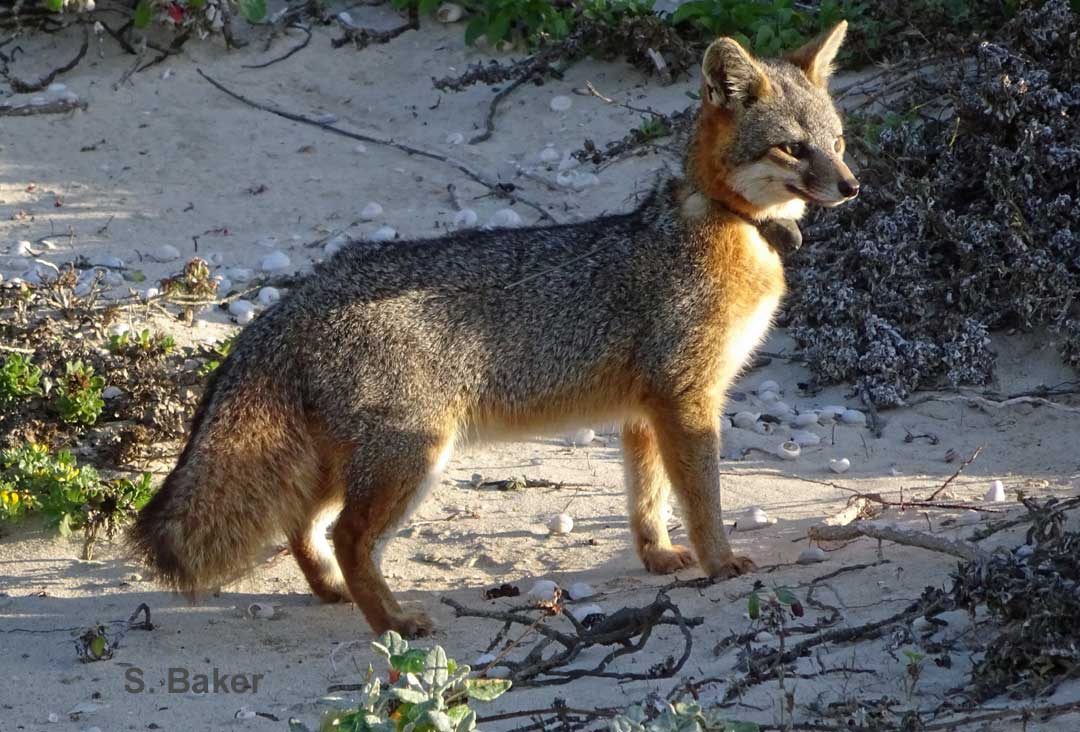
In 2019 FIF continued to fund Schamel's research as she followed the foxes and the potential of "beach foods" in their diet. It is no coincidence that the island fox above is in a beach area. 


If you look closely at the pile of kelp washed up on the beach, or "beach wrack," you'll see island fox foot prints all around it.

photo courtesy of Nick Schooler, UCSB
Combining her stable isotope research with collaborators at the University of California, Santa Barbara, Schamel has revealed that some island foxes are making use of food resources connected to sandy beaches. Tiny arthropods called "beach hoppers" live in the sand and emerge to eat the kelp that washes up on the beach. Look closely and you will see a group of them feeding on the edge of the kelp blade pictured. 

Some island foxes are eating these tiny, quick moving creatures. If you've turned over a clump of beach wrack and seen little hopping critters, commonly referred to as sand fleas, you've seen beach hoppers. They are not fleas at all; they are more closely related to shrimp.

Juliann Schamel recently presented a poster at the 2022 Wildlife Society Conference. POSTER

And her paper Diet of a threatened endemic fox reveals variation in sandy beach resource use on California Channel Islands with Henry M. Page, Marine Science Institute, UCSB, et. al. was published in PLOS ONE. Read the Paper

Your support for FIF helped fund this important research. The island fox and the beach hopper demonstrate an intertwining of terrestrial and marine ecosystems on the Channel Islands.

Monday, September 09, 2019

FIF Research Grant to Investigate Further Into Island Fox Diet


Friends of the Island Fox is happy to announce that Juliann Schamel's research investigating island fox diet through stable isotopes in whisker samples has been chosen to receive the FIF Research Grant for 2019. 

an island fox stash of deer mice
This second year of support will enable analysis of additional data sets to identify seasonal dietary items during drought and important to successful reproduction. It has long been believed that deer mice are a vital food item during breeding and pupping season. Is it true? Does availability to a specific food source influence successful reproduction? If island foxes do not have accesses to abundant deer mice are they less successful as parents?

The grant will also expand the study to look at island fox use of marine resources. Do island foxes use marine foods during drought? If so, which island foxes are able to make use of marine resources?

Island fox whiskers provide an amazing record of what an individual island fox has been eating over 5–6 months. All food items are made up of carbon and nitrogen, but each kind of food has a different balance of elements and therefore a different signature. These individual isotope signatures are recorded in the fox's whisker. More on Schamel's initial research.

Schamel's initial whisker data set went to the lab this spring. At the Center for Stable Isotopes at the University of New Mexico, each individual whisker is divided into tiny sections and processed in a mass spectrometer.

An island fox that eats the same kind of food (all deer mice or all plant fruit) for a period of time will show an isotope graph that is fairly flat. The mixture of carbon to nitrogen will remain the same. But if an island fox changes up its diet dramatically, a spike will appear in the graph showing a change in the isotopes laid down in the whisker.


Comparing these results for known individual island foxes, living in known habitats, will provide valuable data on how sustained drought impacts island fox diet and how diet impacts their ability to survive and thrive.

The FIF Research Grant is completely funded by YOU. Without your donations to FIF this research would still be a dream. 


Donate today to support island fox conservation research.

Thank you to all of the 2019 grant applicants for sharing your research goals with FIF. There is so much more to learn about island fox health, behavior, and interactions with other species.


Applications for the 2020 Research Grant
will be available April 15, 2020
  

Friday, March 22, 2019

Island Fox Whiskers Go to the Lab

Schamel with island fox pup
FIF Research Grant recipient Juliann Schamel has been collecting island fox whiskers to study the diet of island foxes through stable isotope analysis. Her research project is in conjunction with Dr. Seth Newsome and the Center for Stable Isotopes at the University of New Mexico.


Juliann says "Once I learned how stable isotope ecology works and what we could learn about island fox ecology from this method...I was hooked. The invisible chemical world can reveal fascinating connections within food webs and beyond." More on stable isotopes

"This year, with the support of Friends of the Island Fox and [another conservation fund], we are able to investigate a variety of conservation-geared questions about island fox diet on San Miguel and Santa Rosa Islands. We are looking into how diet differs among habitats on the islands, among demographic groups, and between island fox and island skunk. We are also assessing if and how fox diet has changed over time (2010–present) in response to things like density changes in the fox population and rainfall (drought conditions). This last question may have important implications for the ecology of the acanthocephalan worm, a novel parasite that appeared in the San Miguel Island fox in 2012 (at the beginning of the drought) and has spread through the fox population."

The spiny-headed worm, a species of Acanthocephala, has been implicated in the low population numbers on San Miguel in recent years. Parasite threatening San Miguel Island Fox.

"By using whisker samples that are linked to a known individual with a known history within the island fox monitoring program," Schamel says, "we are able to track the diet of individuals over time to see if and how their diet may have fluctuated during the drought or as they moved to a new habitat."

A number of whisker specimens were collected this winter, including in the beach/dune habitat on Miguel and Rosa where island foxes are not typically counted. This will provide data on dietary resources in the marine adjacent habitat that has not been collected before. Schamel says "I am very excited to run these samples!"


Collected whisker samples are sorted, inventoried, and cataloged. Once they are cleaned, rinsed, and dried, each individual whisker is placed in vial.


Newsome and his lab manager at UNM use a razor and tweezers to divide each whisker into sub-samples: 0.2mg (weighed precisely with a micro-scale).

Schamel explains these sub-samples are fed into "the mass spectrometer, which consumes the samples and spits out data on carbon and nitrogen isotope ratios." The ratios are compared to a library of food resources and their known isotope ratios. "The FIF funding is actually paying the mass spectrometer for its time."

Schamel in the field on Santa Rosa Island.
So far ~100 island fox samples from Santa Rosa have been analyzed from a variety of habitats. In addition ~200 island fox whisker samples from San Miguel have been analyzed from 2010–2012, before the drought. Schamel will be at UNM this spring working on samples from 2014–2016. "There are many samples from the same individuals across this time frame, which will be exciting to see!"

Juliann Schamel hopes to present preliminary data at the 2019 Island Fox Conservation Working Group Meeting in May. 

Research like Juliann Schamel's is vital to understanding island fox health and long-term survival.  This research is only possible with donations from people like you.

Applications for the 2019 Friends of the Island Fox Research Grant will be available on islandfox.org on April 15, 2019.

Friday, September 21, 2018

FIF Research Grant to Investigate Island Fox Diet Through Whiskers

photo courtesy of P. Bronstein
Island foxes have lots of long black whiskers. These specialized hairs hold important information on diet that could inform decisions on island fox conservation.

Friends of the Island Fox is happy to announce: 

Juliann Schamel is the recipient of the first FIF Research Grant

Schamel is a Biological Science Technician at Channel Islands National Park and the $5,000 grant will help fund research on "The Channel Island Food Web–A Decade of Dietary Resource Use in Channel Island Fox: Implications for Reproduction, Recruitment, and Resilience in a Changing Climate."

It's a big title reflecting the broad range of important data that may be revealed. 

Schamel's work will build on important past research.

island fox scat (or poop)
In 2009, researchers collected island fox scat samples to look at seasonal diet across all six islands. Their 2014 paper revealed diet varied from island to island and included a higher frequency of insects and fruit than expected. They cautioned that islands with poor native plant diversity offered fewer food options for island foxes in the event of drought. 

photo courtesy of P. Bronstein
Just as the science warned, during the consecutive years of the recent drought, island foxes were challenged to find enough food on San Miguel and San Nicolas Islands. Decline of San Nicolas Island fox. During this time a new parasite entered the San Miguel Island fox's diet causing fox deaths.

While scat successfully reveals visual items, (insect exoskeletons, cactus fruit skin and seeds), it may not visually capture everything in the fox's diet. Also, scat data is limited to recording diet in an individual over a short time period, a few days.

In 2010, building on work done on the San Joaquin kit fox, a small sample of island fox whiskers were investigated using stable isotope analysis. 

You are what you eat. Food items (prey and plant) have their own isotope fingerprint. Carbon and nitrogen isotopes consumed by the fox are laid down in the hair shaft documenting an individual's diet over months. 

Since 2010, biologists have been gathering whisker samples from individual island foxes during health checks on the northern islands. These samples have been cataloged by year and with individual fox identification. 

FIF is excited to support Schamel's research using whiskers because it has the potential to:
  • Compare diet between successful mothers and unsuccessful mothers
  • Discover dietary differences between coastal living island foxes and interior living foxes
  • Document changes in diet over the past 9 years, through the drought and as the fox populations have grown
  • Possibly reveal prey items that are a vector for the intestinal parasite on San Miguel Island which has caused fox deaths
Whiskers are amazing! Not only do they offer an opportunity to invest in greater knowledge about the secret lives of island foxes, whiskers grow back and their collection is non-invasive. 

FIF will be bringing you more on Juliann Schamel and her research as her work progresses.

Thank you to all of the 2018 grant applicants for sharing your research goals with FIF. There is so much more to learn about island fox health, behavior, and interactions with other species.


Application for the 2019 Research Grant
will be available April 15, 2019