Wednesday, April 25, 2012

Island Fox Pups

Across the Channel Islands, island fox pups are being born. For their first months of life they look more like little brown bears than their dramatically marked parents. 

Typically, island foxes become parents in their second year, but sometimes a male or female may become a first-time parent before they are a year old.


Most island fox pairs have 2-3 pups in a litter, but a young female like our Twitter fox, Tani, might have only one pup. 


This year rainfall on the Channel Islands has been low to normal. Weather can also affect the number of pups born because rainfall can impact food resources. Annual rainfall.


island fox bringing 3 deer mice home for family, photo courtesy NPS
While female island foxes are in their dens with their new born pups, the fathers play the role of providers, bringing food to their mate and eventually the pups. 


Over the last year Friends of the Island Fox has followed Tani, an island fox character, as she grew up and became a mother herself. Join us as we follow Tani's mate, Tiptu, and get a male fox's perspective over the next few months on Twitter and Facebook. Tiptu, is "big ears" in Chumash, the local native American language. Tiptu has befriended another rare animal only found on the Channel Islands - an island scrub-jay. 


Island scrub-jays have a family structure similar to the island fox, so Jay will have insight to help his friend the island fox through his first year as a father. The island scrub-jays are nesting as well. Spring brings all kinds of new life to the Channel Islands.

Monday, April 16, 2012

Channel Island Foxes Celebrate Earth Day

Yippee! Channel island foxes have much to celebrate this Earth Day. Across the four islands, where island foxes were listed as endangered in 2005, pups are being born this month. The San Miguel Island fox that nearly went extinct with only 15 surviving foxes has seen a population recovery in record time. Current Island Fox Numbers 


Come Celebrate Earth Day with Friends of the Island Fox at the

Saturday, April 21 and Sunday, April 22
10 AM - 3 PM

April is pupping season! We'll be celebrating the newest generation of Channel Island foxes. Tani, the FIF Twitter fox, has gone into her den preparing for the birth of her offspring. Follow her on facebook. Across the islands wild female island foxes are doing the same thing.

Visit the FIF booth on Earth Day and see:
  • the size of an island fox pup
  • an island fox print that we made on Santa Cruz Island in March
Come to a Fox Talk at the island fox enclosure at Noon & 2 PM both days.


Join in a new activity to challenge your sense of smell. Can you follow a scent trail like an island fox?

Bald eagles reintroduced to the islands are thriving. A record 15 pairs are nesting across the Channel Islands. You can watch bald eagle chicks growing up on the live eagle-cams:
Channel Islands National Park eagle cams
Catalina Island eagle cams

Across the Channel Islands there is much to celebrate. You can see the recovery of wildlife yourself by joining Friends of the Island Fox on a trip to Santa Cruz Island on May 5, 2012.

Tuesday, April 10, 2012

Where to See An Island Fox 2012 Update

Wild populations of island foxes are increasing toward recovery across the California Channel Islands and with each year the opportunity to see an island fox in its natural environment increases.

But not everyone can journey to the islands or spend time in wilderness areas. A small number of island foxes can be found in captive facilities. 

Tachi, Catalina Island Conservancy
On the island of Santa Catalina the Catalina Island Conservancy cares for Tachi, an island fox that can not be released into the wild. Tachi makes appearances at special events on Santa Catalina Island and she can be seen on a special tour into the island's interior.

Several zoos exhibit island foxes from San Clemente Island. This subspecies of island fox is not listed as endangered but is still vulnerable to population declines because it is found only on San Clemente Island and no where else in the world. Captive management of the San Clemente Island fox helped develop husbandry techniques and establish veterinary care procedures for the endangered subspecies of foxes on the northern islands and Santa Catalina Island.

You Can Also See Island Foxes At:

Santa Barbara Zoo

The Santa Barbara Zoo exhibits a male from Santa Rosa Island that requires daily medical care due to a chronic eye condition. They also maintain the Stud Book or breeding records for all the island foxes in captivity on the mainland.

San Clemente island fox at L.A. Zoo

Los Angeles Zoo

The Los Angeles Zoo and Botanical Gardens exhibits a male that was the first island fox born in captivity at the Santa Barbara Zoo. He is an older fox and the father of two pups, that are now adults and living at other facilities.

Friends of the Island Fox participates in an Earth Day celebration of California wildlife in conjunction with the Docent Conservation Committee at the Los Angeles Zoo in April.

Exhibits a Male born at the Santa Barbara Zoo

CuriOdyssey at Coyote Point
Exhibits a Male born at the Los Angeles Zoo

Exhibits a Male born at the Los Angeles Zoo

California Living Museum- Bakersfield
Exhibits a Male from San Clemente Island

Even if you can’t venture over to the Channel Islands, zoos that are helping save the species can give you an opportunity to see an island fox in person. This rare species is one of California’s precious treasures.


What is it like on the islands?

Experiencing Santa Cruz Island
Habitat Restoration on Santa Cruz Island
Experiencing Santa Rosa Island

Travel with Friends of the Island Fox to Santa Cruz Island, May 5, 2012

Getting there - Island Packers

Tuesday, April 03, 2012

Channel Island Fox and Biodiversity

Across the islands female Channel Island foxes are getting ready to have their pups. 

At first glance, the Channel Islands may appear barren, but a closer look reveals a rich diversity of plants and animals. Many of these species, like the island fox, are endemic and found no where else in the world. 
Join Friends of the Island Fox in a Trip to Santa Cruz Island

What can you see on Santa Cruz Island in just a few hours? 

Island Journal - Santa Cruz Island, March 29, 2012

giant coreopsis
Pat Meyer, Michael Lawshe and I went out to Prisoner's Harbor on Santa Cruz Island to investigate the restoration work on the wetland area. Winter rains came late this year, but the hillsides were in bloom with giant coreopsis (the island's strange species of bush daisy, a favorite food of island deer mice), blue dick, island morning glory, scarlet and bush monkey flower and lemonade berry, which provides important food for birds and island foxes. 

bramble-green hair streak; a new species for us
Western swallowtail, painted lady and several species of blue and hair streak butterflies were busy visiting the flowers. Island fence lizards and a side-blotched lizard were out enjoying the sunshine and snacking on the insects.

Insects were also on the menu for a black phoebe, Say's phoebe and barn swallows flying over the restored wetland. In the willows we even spotted a warbling vireo and the rare island scrub-jay.

In all we noted 25 plant species (many of them island endemics), 33 species of birds (including over 1000 migrating western grebes, an osprey and the Channel Island subspecies of Allen's hummingbird and Bewick's wren). Full Bird List.

Then just before we boarded the boat for home, a group of school children spotted an island fox!

Channel Island fox
This is the first island fox we have seen in part of the island and shows how the population recovery is once again making island foxes plentiful across all of Santa Cruz Island.

bottlenose dolphin with calf
When you add this to the common and bottlenose dolphins, and the migrating gray whales we saw during the crossing, it was a fantastic day! (More on the wetland restoration, later) 
- Keri Dearborn, FIF Education Director

You can spend a day on Santa Cruz Island too! 
FIF Trip to Santa Cruz Island, April 6, 2013.

Across the Channel Islands, female island foxes, like Tani and the one seen at Prisoner's Harbor, are separating themselves from their diverse island world and going into the shelter of their dens to prepare for giving birth. The recent spring rains may help support the island biodiversity that the Channel Island fox needs to survive. We can all hope that new pups will help to continue the recovery of the endangered populations.

Island Journal - Santa Cruz Island 
Visiting Island Foxes on Santa Cruz Island
Restoring Habitat on Santa Cruz Island, 2012 
Island Fox Releases on Santa Cruz Island, 2007

Monday, March 12, 2012

Santa Cruz Trip with FIF

Join Friends of the Island Fox for:

A Trip to Santa Cruz Island
Saturday, May 5, 2012
to Look For The Island Fox

Please join us when we visit Santa Cruz Island for a tour with our educators.  We will look for the endangered island fox, plus the many other endemic species, both plants and animals, found only on this island and nowhere else.  On the trip over to Santa Cruz (about 1 hour) there is the possibility of seeing many marine species.

Tickets for adults will be $65.00 per person, children $55.00. A percentage of the fee will go to support island fox recovery efforts.

We will take the Island Packers boat from Ventura Harbor leaving at noon and returning around 5 PM on Saturday May 5, 2012.  Check in will be required at 11:15 AM

Reservations are limited and will be provided on a first come basis. To book reservations, please download the Reservation Booking Form (Click Here to download pdf)  

Island fox trying to take food from backpack.
Send the completed form with your check, made payable to the "Friends of the Island Fox" to the address on the form.  Reservations will be taken in the order received, and no reservations can be accepted without payment.

Before the island visit you are welcome to join us at 9:30 AM at the Channel Islands National Park Visitors Center at 1901 Spinnaker Drive, Ventura.  We will tour the native plant garden, visit the Center and you will have the chance to view the Channel Islands National Park film “Treasure in the Sea” narrated by Kevin Costner. 

At the time of booking you will receive further details of the trip, including where to meet, what to pack, the suggested clothing and other items of interest. Note the photo above. Food items will need to be secured at all time. What to remember when visiting the island fox.

Tuesday, March 06, 2012

Climate and Island Foxes

Santa Catalina Island
Across the six islands that are home to island foxes (Habitat), pairs like Tani and Tiptu are breeding and finding an appropriate den site. Island fox pups are typically born in late April.

Like all wild animals, island fox reproduction is impacted by the amount of local resources–food, water and territory. As endangered populations of island foxes have recovered, there have been several years where female foxes have had large litters of pups. Typically two pups are born in a litter, but when resources are abundant there can be as many as five pups.

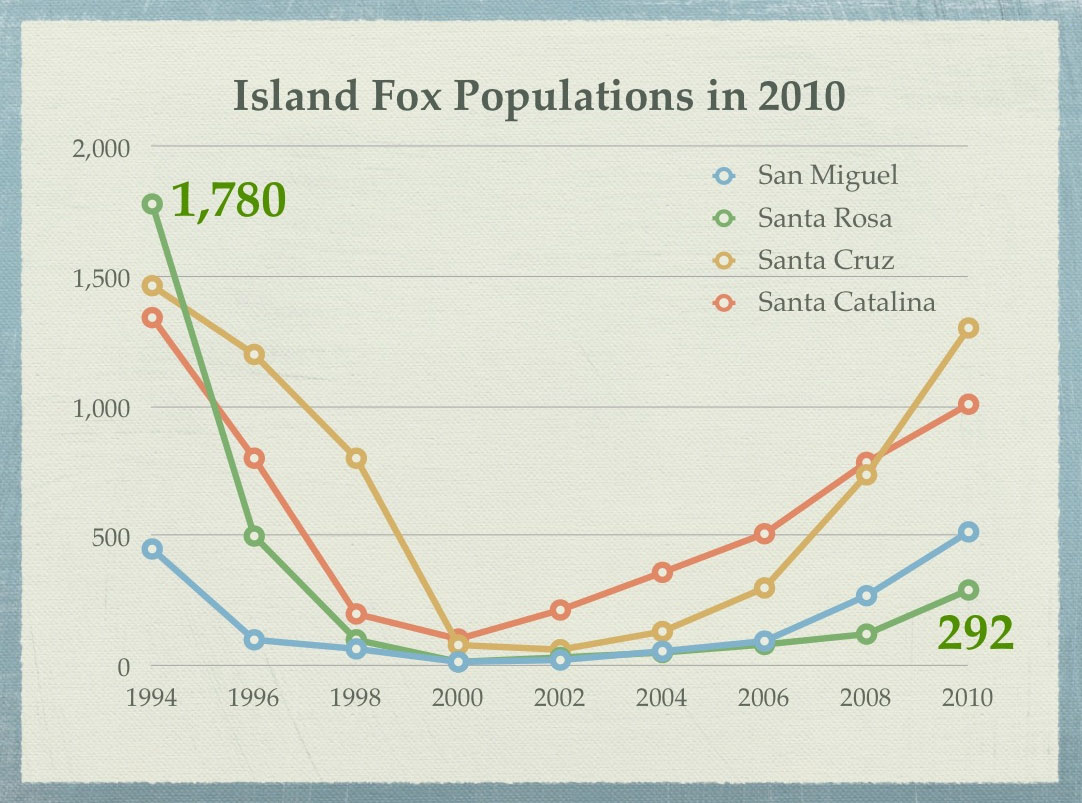
Because the recovering endangered populations were small, there was little competition for territory and food. In the mid-2000s, it was not unusual for island foxes on San Miguel to have litters of three to five pups. With large litters of offspring the San Miguel Island population, that had nearly gone extinct in 2000 when there were only 15 surviving individuals, was able to exponentially increase each year.  Graph

But severe climate can greatly reduce the resources available to island foxes. 2007 was the driest year on record in southern California since National Weather Service records began in 1878; less than four inches of rain fell. The lack of rainfall reduced the plant foods on the islands which reduced the deer mice, insects and bird life. Without winter rains, the Catalina cherry, native currants, toyon and other fruit producing plants produced less fruit for the foxes to eat. Less food, meant fewer island fox pups were born or survived. The winter seasons of 2008 - 2011 averaged approximately 12 inches of rain, the low side of normal, but still enough that Channel Island wildlife flourished.
 

This winter season is showing early signs of drought. As mid-March approaches the Los Angeles area has received less than six inches of rain. This year if spring rains do not arrive, we may see fewer island foxes born and fewer that will survive. Climate fluctuations act to moderate animal and plant populations, but climate change means greater weather extremes. Drought in 2012 could make it more difficult for young island foxes like Tani to successfully reproduce and could slow down the recovery of endangered island foxes.

Tuesday, January 31, 2012

Restoring Habitat for Island Foxes

courtesy of Kevin Pease
Across the Channel Islands efforts are being made to restore the natural ecosystems that the island fox depends on for survival. One such project is the restoration of a wetland area at Prisoner’s Harbor on Santa Cruz Island, in the Channel Islands National Park.

Prior to large scale ranching on Santa Cruz, the canyon at Prisoner’s Harbor had a seasonally flowing stream that created a rare coastal lagoon. This wetland would have attracted amphibians, fish, reptiles, small mammals and migrating birds. It would have provided important food and water for the island fox.

Currently the Channel Islands National Park and the Nature Conservancy are digging out the tons of gravel and dirt that were used to fill in the wetland. Eucalyptus trees that were introduced as wind breaks are being removed and native species are being replanted. You can see some of the work in progress in a video interview by the Ventura County Star with Russell Galipeau, Channel Islands National Park Superintendent.


courtesy of Kirin Daugharty
The hillsides surrounding Prisoner’s harbor have become home to Tani and Tiptu, FIF’s island foxes on twitter. What changes will the island foxes see as the wetland is restored? Will ducks and other migrating bird species visit the area this year? Or will it take years for nature to reestablish itself in this island lagoon?

Restoring native habitat comes in stages: removing introduced species, reintroducing native species that have disappeared, understanding all of the elements of reestablishing nature’s balance.

For more information on the Prisoners Harbor Coastal Wetland Restoration

Friday, January 13, 2012

An Island Fox Den

courtesy of Will Campbell

Island foxes are different from their mainland ancestors the gray fox in many ways. One of those differences is that island foxes do not dig dens. Instead they seem to look for locations that are already somewhat protective. Right now, island foxes like Tani and Tiptu are searching for a den site that is just right. (Follow the adventures of Tani and Tiptu on Twitter, in the black box at the right, and on facebook).


They might chose a den location between rocks on a hillside, under dense shrubs or a combination of the two. Because island foxes are so small, usually between 3-6 lbs., even a space under a fallen tree can make a comfortable den.


When an island fox pair comes together between December and January, they are thinking about having a family. Island fox pups born in the spring will be blind and helpless. A successful den must offer warmth and protection for the pups first 6 weeks of life. (Tani was born almost a year ago.)


Young island fox pairs, like Tani and Tiptu, do not have the experience of their parents.  They will have to learn by trial and error which locations will provide a warm, dry den site with access to nearby food.

Friday, December 23, 2011

Channel Island Fox Heroes

courtesy National Park Service
 Many plants and animals across the country are facing challenges to their survival, but few endangered species have as many everyday heroes as the Channel Island fox.

Some heroes are the biologists and technicians that work in the field across the six Channel Islands. They count the island foxes in the wild, provide health checks and are the first line of defense protecting island foxes. Fox Biologists.

Some heroes are school children like Hannah H. and her third grade class from Montecito Union Elementary School. Hannah told her school mates about the endangered island fox and made a Fox Box to collect donations. The students from Montecito Union raised enough funds to provide a radio tracking collar for a wild island fox. Radio collars provide the second line of defense for this endangered species. (More About Radio Collars) The goal across the islands is to annually have 60-70 individual foxes on each island wearing radio collars.

Vaccinations for distemper and rabies are also vital to protecting endangered island foxes.  When Friends of the Island Fox gave presentations to the second- and third-grade students at Poinsettia Elementary School, student Shawn D. realized he could make a positive difference for this local animal. Shawn saved up his allowance to vaccinate an island fox. Vaccinations for island foxes.

2011 has been filled with heroes:


A huge thank you to all of our Channel Island Fox Heroes. This year you helped the endangered island fox move ever closer to recovery. (Current Population Update)

Island fox pairs are coming together across the islands. Follow Tani, the young female island fox, on twitter or facebook as she settles into her own territory and finds a mate.

Tuesday, November 15, 2011

Island Fox Population Update

courtesy of Anita Machlis
Every year biologists count island foxes across the California Channel Islands in the late summer and early fall. Island foxes are captured in safe traps so they can be given health checks, fitted with radio collars and given vaccinations. When the biologist from the six different islands meet for the annual Island Fox Conference in June, they share their official population numbers and discuss the successes and challenges from each island.


The official population estimates from 2010 are:
  • San Miguel Island - 516
  • Santa Rosa Island - 292
  • Santa Cruz Island - 1302
  • Santa Catalina Island - 1008
  • San Nicolas Island - ~500
  • San Clemente Island - 1127

The numbers show that island fox recovery has been very robust on San Miguel, Santa Cruz and Santa Catalina Islands. The island foxes on Santa Rosa Island are recovering, but at a much slower rate. Each island fox population has its own challenges. For the current status of island foxes by island Download - Island Fox Update 2011 pdf

Stay tuned for updates on 2011 population numbers as they come in from the autumn field counts.