Saturday, July 05, 2008

Experiencing San Nicolas Island

Island Journal - Summer 2008

Visiting California’s San Nicolas Island is a unique opportunity. This remote and wind-swept island is owned by the United States Navy. Friends of the Island Fox President, Pat Meyer, and I were fortunate to receive a special invitation for a short visit.

At first glance, the treeless slopes seem barren, but life here clings low to the ground to survive shifting wind. Delicate verbena flowers rise up from the sandy soil. Giant coreopsis, a species unique to the Channel Islands and the Southern California coast, stand like a forest of gray stick figures. This member of the daisy family grows several feet tall on a woody stem. In spring, the dried trunks come back to life and produce pompoms of lacy green topped with brilliant yellow flowers. (coreopsis photo)

Now, in July, the stems are dormant again, but the coreopsis forest is gradually spreading across 10% of the island. It is a clear sign that native plants are returning.

San Nicolas currently has the largest island fox population and the greatest number of foxes per square kilometer. We came hoping to see wild island foxes and the island didn’t disappoint us.
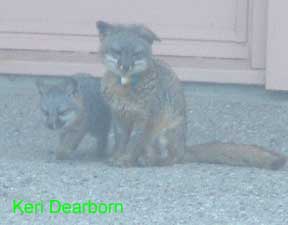
We were even lucky enough to see a litter of four pups born this spring. They were about 2 months old and bold little explorers. This is dad with one of the pups in the early morning fog.

Gazing across the dunes and scrub, it is hard to imagine there is enough cover to hide a fox, but the San Nicolas island foxes are tiny. The individuals we saw were slighter in weight and shorter, than the Catalina island foxes. It might seem impossible, but an island fox can emerge from the short grass along the roadside in a flash and be unseen until the instant it is in front of a car. Signs warning “Watch for Foxes” dot the few roads trying to alert unexpecting drivers. (road signs)
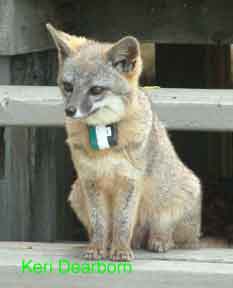
Most of the 12 island foxes we saw were wearing radio collars. Radio-collared foxes can be monitored by biologists and a new automated tracking system is being tested so that the movement of island foxes can be recorded in detail. The biologists are hoping this will provide greater understanding of island fox interactions and territories. Radio-collars also provide the first alert warning system for threats to island fox populations. (more on radio collars)

Dunes and grassland might seem inhospitable to a little fox, but it seems that sand fly larva may be providing an important food source for these foxes.

San Nicolas is a unique ecosystem and also home to endangered island night lizards and snowy plover. We saw one snowy plover and a number of other shore birds, including Western gull chicks. The beaches were busy with breeding California sea lions and resting immature elephant seals.
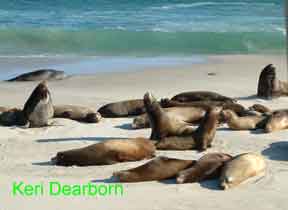

At night, sea lion barks hauntingly drifted up from the beaches. Fog streaked over the dry land. Here and there the wind would tear open a hole to expose the dark black sky with brilliant white stars.

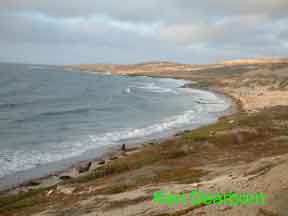
San Nicolas Island is a wedge of sandstone cliffs carved by the waves of the Pacific Ocean. A unique landscape and home to the San Nicolas Island fox. - Keri Dearborn


Links to
Experiencing Santa Cruz Island
Experiencing Santa Rosa Island

Wednesday, June 04, 2008

CSI: Island Fox

What happens when an island fox is found dead?

A Critter Scene Investigation


Just like your favorite crime drama on TV, it takes a team of scientists to understand what has happened when an endangered island fox is found dead.

Determining the cause of death for an animal that has died is a critical component of island fox recovery. Radio collars worn by all released and wild-born foxes provide a unique signal when an animal is motionless for 12 hours. (more about radio collars)

When this signal is detected, field personnel locate the collar and collect the carcass if in fact the animal is deceased. Island fox carcasses are sent to Dr. Linda Munson at the University of California, Davis School of Veterinary Medicine, where she and her staff perform necropsies (autopsies) to determine precisely what killed each animal.

Information from necropsies helped determine the direct association between the island foxes decline and predation by golden eagles on the Northern Channel Islands and disease on Santa Catalina Island.

Helping the island fox comes in a variety of forms. Necropsies continue to provide critical information on disease, health, and continuing predation issues. Each island fox necropsy requires several hours of veterinarian time and follow-up laboratory analysis, and costs approximately $250. Because this program is not otherwise funded, there is a growing need for help in funding this vital part of island fox conservation.

You can help a real CSI, a Critter Scene Investigation. Your donations to Friends of the Island Fox can help to fund important scientific work and island fox necropsies.

To donate through Pay Pal, click on the Pay Pal button at the upper right corner of the page.

Monday, April 21, 2008

Video of Wild Island Fox

What is small, but mighty? Only 3-6 lbs., but willing to stand its ground and protect its territory? An island fox.

Catalina Island Conservancy wildlife biologist Calvin Duncan
approached a wild fox’s territory, he took this video of an island fox on Santa Catalina Island.

Protecting territory is important for a pair of island foxes. They need a hunting area that will provide enough food to support themselves and their pups. How does an island fox let you know you are in its territory? Watch and see.


Images like this of an island fox in the wild are very rare. Island foxes on Santa Catalina Island declined dramatically
between 1998 and 2000 because of a disease, canine distemper, that was passed to them from a domestic dog. Today the estimated population has increased to approximately 572 individuals, slightly more than one third of their original number. Catalina island fox decline

The fact that island foxes are running wild again on Catalina, Santa Rosa, Santa Cruz, and San Miguel Islands is due to the undaunted efforts of biologists, scientists, government agencies, private conservation organizations and concerned individuals like YOU.

When you support island fox conservation efforts YOU HELP to make sure that moments like this will continue into the future.

A special thanks to the Catalina Island Conservancy fox biologists Calvin Duncan and Julie King for sharing their experiences in the field with us. For more on their work with the Catalina island fox: Counting island foxes; Island Fox Health Check.

See video of an island fox release on San Miguel Island. Link

Island fox and fruit
What do island fox pups look like?
What do island foxes eat?

Why are they endangered?
More about island foxes

Monday, April 14, 2008

Earth Day and the Island Fox

This Saturday and Sunday,
Friends of the Island Fox
will be at the

Los Angeles Zoo Earth Day Expo 2008


April 19 and 20, 2008
10:00AM - 4PM


The event will highlight California Wildlife and part of that focus will be the endangered island fox.

The Los Angeles Zoo is home to a male San Clemente Island fox. FIF and representatives from the Channel Islands National Park will be up near the island fox enclosure providing activities throughout the day.

  • 11:30 AM & 2:30 PM Fox Health Check: Participate in all the steps that biologists do in the field to check the health of wild island foxes.

  • Noon & 3 PM Radio Tracking Demonstration: How do biologists find small island foxes on large islands? Come and help us a track a radio collared animal in the zoo.

  • 1 PM Exhibit Talk at the Island Fox Enclosure

Come out to the L.A. Zoo, help celebrate Earth Day and find out how you can help preserve California’s unique wildlife diversity like the endangered island fox.

Happy Birthday to Finnigan, The Island Fox


One of our favorite island foxes just turned 1 year old.

Finnigan, or Finn for short, was born last year at the Santa Barbara Zoo. Because his mother is an older fox, she did not nurse him and the Zoo staff had to hand raise him. See Finn's baby picture.

Fortunately this little island fox had the perfect personality to become an educational representative for all of his wild cousins. Finn makes guest appearances at special events at the Santa Barbara Zoo.

The Santa Barbara Zoo actively participates in island fox conservation and is the home of Finnigan, his parents, and two other island foxes. For more information on visiting the Santa Barbara Zoo and seeing the island foxes that live there.

Friends of the Island Fox sends our best wishes to a hard working island fox.

Happy, Healthy, First Birthday, Finnigan !

Saturday, February 23, 2008

The Island Fox has Friends


If you have seen the Island Fox San Miguel Island 2006 Release video, you have heard the original music of David Lynch.

David’s guitar solos add heart and bounce to the video. One of the themes used in the video has currently climbed to #8 of 2,480 on the Neil Young website for original music. You can help David climb even higher in the ranking by placing your vote for the song "Mahatma"at: neilyoung.com

Complete versions of
David Lynch’s music can be found on his CD “Dozen” available through his website.
David Lynch

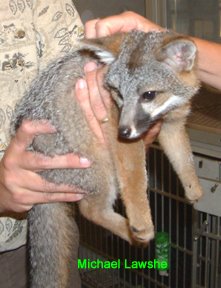
The video was also edited by island fox friend Michael Lawshe. Michael is nominated for a Golden Reel Award this Saturday, February 23 for his work as Sound Supervisor on Smallville. Check out his blog at Soundzgood.info

CLICK the picture to watch the video.


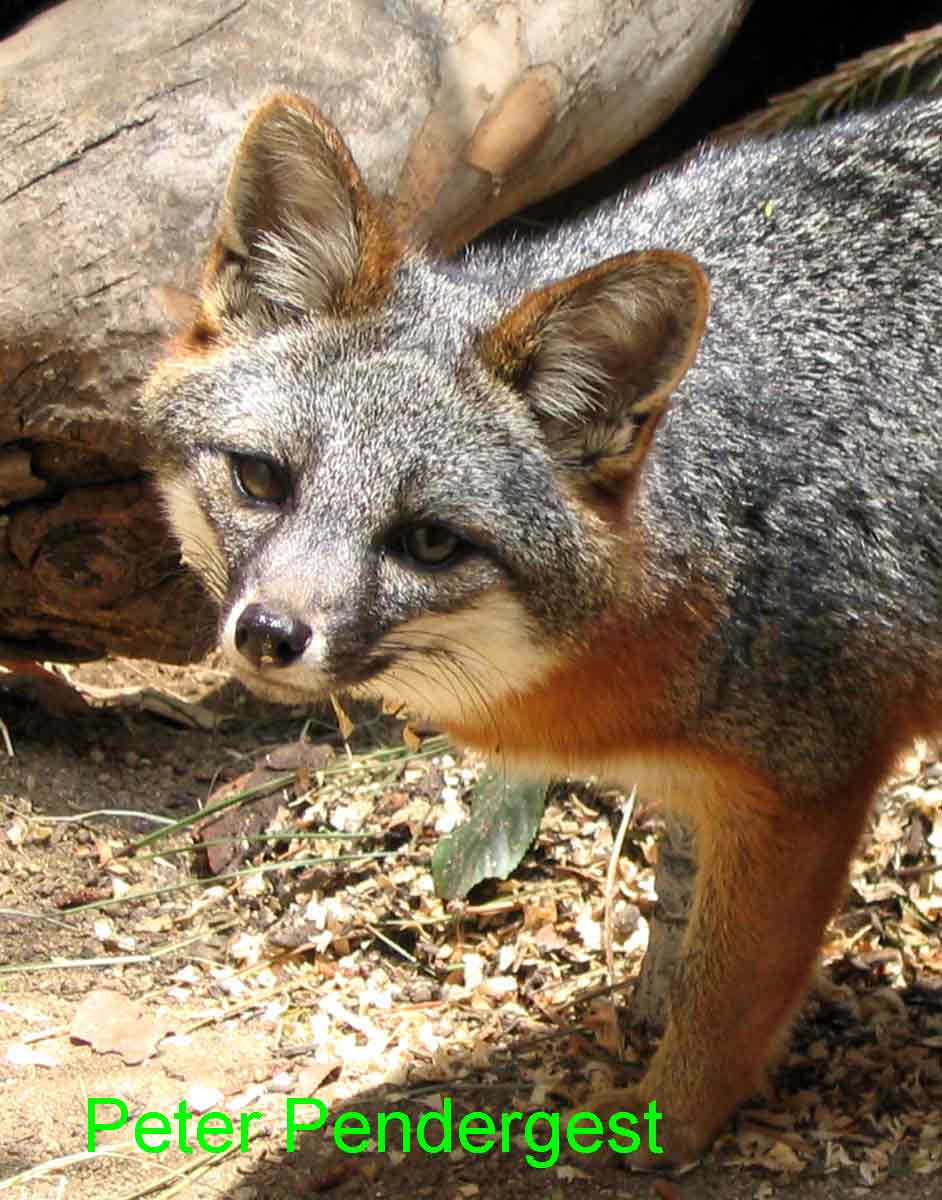
The photo at the top, was taken by Peter Pendergest.

Without help from friends like David, Michael and Peter we wouldn’t have a video of the island foxes to show the public or photos to post on our website. Friends of the Island Fox thanks them for their support of island fox conservation and appreciates their efforts to get involved in helping to save the island fox.

Thursday, February 07, 2008

Island Romance - Island Fox Mating Season


Island Romance - Island Fox Mating Season

Are you contemplating romance and Valentine’s Day? So are the island foxes. The cold blustery days from December to February are the perfect season for California’s Channel Island foxes to pair up and settle down in a cozy den.

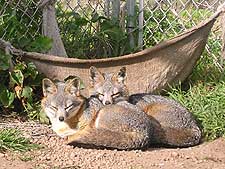
During autumn, island fox families tend to split up. The youngsters, now over six months old, head off on their own and the parents take a vacation from family life and each other. With the arrival of winter, the monogamous mates come back together. (About the island fox)

Island foxes make their dens in a sheltered location, sometimes underground, in a tree stump or in amongst dense undergrowth. The male and female establish a territory around their den site and settle down to finding food for a family.

A few island foxes born last spring, will also be out looking for a mate. Even though they are less than a year old, some will become parents this spring. Because population numbers are still far below normal on San Miguel, Santa Rosa, Santa Cruz and Santa Catalina Islands, island foxes are breeding younger and having more offspring than they usually would. The abundance of island deer mice and other food items makes it possible for a pair of island foxes to raise five pups instead of the typical two or three.

Valentine’s Day 2008 will be very special on San Miguel and Santa Cruz Islands. For the first time since emergency captive breeding began in 2000, ALL of the island foxes on these two islands are once again free-roaming and choosing their own mates.
(2007 fox release on San Miguel Island) (2007 fox release on Santa Cruz Island).

Captive breeding programs saved the island foxes from extinction on both of these islands, but human matchmakers are never as good as the foxes themselves. We can all hope that this year there will be an increased number of island fox pups born on San Miguel and Santa Cruz Islands.

Eleven of the island foxes released in Channel Islands National Park are wearing radio-tracking collars funded through donations to Friends of the Island Fox. (radio collars)

Pups born in the spring and foxes slated for release from the captive breeding facility on Santa Rosa Island will soon be needing there own radio tracking collars. Your donation to Friends of the Island Fox helps to provide radio tracking collars vital to monitoring the recovery of endangered island foxes. You can donate through the PayPal and Cause for Good buttons in the upper right .

This Valentine’s Day give a truly romantic gift.
Help support a solution.

Working together we can SAVE the island fox.

Friday, February 01, 2008

Seventh Annual California Islands Symposium


The islands along California’s coast present a unique collection of habitats with various wildlife and human problems and successes. Island foxes live on six of these islands: Six Islands, Six Different Foxes.

Where can you find the most current information from the experts working in the field?

The 7th California Islands Symposium
5-7 February 2008


This gathering will bring together experts in archeology, anthropology, cultural resources, human history, population biology, ecological processes and systems, systematics, geology, paleontology, oceanography, and climatology.

The Symposium is a forum for the presentation of natural and cultural resource information collected on all of the California Islands - the Channel Islands, the Farallones, and the Baja Mexican islands - and their surrounding marine environments.

This important event will take place at the Embassy Suites Hotel in Oxnard, California. Presenters will include:

On-site registration
Three days: $200
One-day: $75
Student: $125

There will be a poster session and book signing event Tuesday evening, Feb. 5, from 5:30 PM - 8:00 PM

Poster session fee for educators: $10

Book Signing Authors:
  • Torben C. Rick - The Archaeology and Historical Ecology of Late Holocene San Miguel Island
  • Jan Timbrook - Chumash Ethnobotany: Plant Knowledge among the Chumash People of Southern California
  • Araceli Samaniego Herrera, Anny Peralta Garcia, and Alfonso Aguirre Munoz, editors - Vertebrados de las islas del Pacífico de Baja California. Guía de campo (Mammals of the Pacific Islands of Baja California.)
  • Betsy Lester Roberti - San Miguel Island: A Childhood Memoir

For more details and a complete listing of presentations: http://www.californiaislands.org/

Thursday, December 06, 2007

Island Fox Update - Channel Islands National Park

Island Fox Update
with Tim Coonan

Wednesday, December 12th at 7.00 P.M.


As part of the Shore to Sea Lecture Series, Tim Coonan, biologist for Channel Islands National Park, will speak on the most current information regarding the island foxes on San Miguel, Santa Rosa and Santa Cruz Islands.

This is a great opportunity to hear the most up-to-date information on the island foxes on the northern islands.

The free lecture will be presented at:

Channel Islands National Park headquarters
1901 Spinnaker Drive in Ventura


Hear an interview with Tim Coonan.

Good News 2007 island foxes on Santa Cruz Island

Good News 2007 island foxes on San Miguel Island

Counting foxes on Santa Catalina Island

Tuesday, November 20, 2007

Island Fox Health Checks on Catalina Island

The Santa Catalina Island fox became endangered when an outbreak of disease, believed to be canine distemper, killed over 85% of the population in just a few years. To help prevent such catastrophic events in the future, biologists across the Channel Islands use the late summer and early fall to count island foxes and give them health checks.

In September, Friends of the Island Fox went out in the field with Julie King, fox biologist for the Catalina Island Conservancy as she did health checks on wild island foxes.

Click to Listen to Island Fox Talk Podcast in the field with Julie King as she examines a young female island fox.

An island fox health check involves:
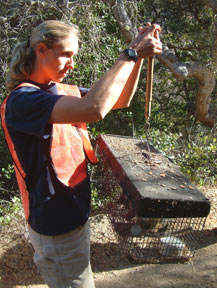
  • taking the weight - The island fox is weighed while still in the trap.
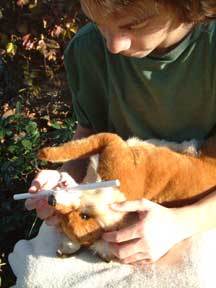
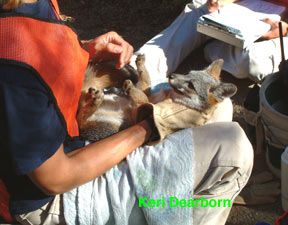
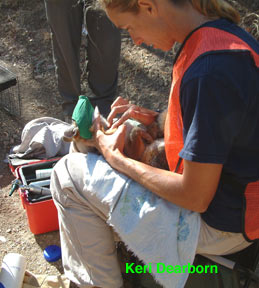
  • evaluation of over all physical status - The biologist feels the fox’s body for any lumps, bumps or wounds. (photo above)

  • visual check of teeth, coat - Teeth are checked for wear and breakage (this female fox was under 2 years old but had a broken tip on an upper canine tooth); the coat is examined for overall heath and the presence of parasites, fleas and ticks.
  • ear exam - An otoscope is used to look in the fox’s ears. The biologist is looking for ear mites, inflammation and disease.


  • vaccinations - Island foxes receive vaccinations to help reduce the chance of disease.
  • drawing a blood sample - The blood sample provides additional information on health and possible disease exposure. A mask is put over the foxes eyes to reduce the animal's stress while being handled by humans.


How was the island fox caught for the health check?

The island foxes on Santa Catalina are increasing in number, but a new threat is causing them problems, ear mites. Cancerous tumors are forming in the ears of island foxes on Catalina. The relationship between the ear mites and the cancer is currently being studied. Friends of the Island Fox would like to help the Catalina Island Conservancy in their quest to solve this mystery that is posing a new danger to island foxes.
You can help by making a donation through the "Pay Pal" or "Donate Now" buttons at the top right of the page.

Through generous donations Friends of the Island Fox has funded 17 radio collars in the past 2 years so island foxes can be monitored in the wild. Your donation to Friends of the Island Fox helps fund conservation efforts across all of the Channel Islands to help save the island fox.