Showing posts with label San Nicolas Island fox. Show all posts

Friday, February 23, 2024

Injured Island Fox Pup Gets Second Chance

 You can help this young island fox


Friends of the Island Fox is raising funds to pay for her orthopedic surgery

During the annual fall 2023 counting and island fox health checks on San Nicolas Island, biologists discovered this female pup with a recently injured right hind leg. The bones just above her foot, the metatarsal bones, had been fractured and the wound was open.

The injury was too severe for treatment on the remote Navy island. According to our friends with the U.S. Navy and the Santa Barbara Zoo: "The cause of the injury could not be determined but her chance for survival without intervention was minimal due [to] the risk of infection and septicemia posed by the open fracture. Releasing her without treatment with such an injury was determined to be both inhumane and life threatening."

island fox in the wild on Santa Cruz Island

Removing an island fox from the island where it lives is a big decision. Having evolved in isolation on their specific islands, once an island fox leaves an island it can not return. The biosecurity risk of introducing disease from the mainland to the wild population is too great.

The young fox was just old enough to be dispersing from her parents. With treatment and several months of observed convalescence, she had a good chance for full recovery. The cost of treatment, however, was being removed from the wild for the rest of her life.


The California Department of Fish and Wildlife (CDFW) gave special authorization to transport the state-protected species off of the island and off of the Navy's federal lands into state jurisdiction. She was flown off of San Nicolas Island and transferred to the Santa Barbara Zoo, which has "extensive experience in caring for orphaned and injured island foxes." A pair of brother San Clemente Island foxes who were abandoned by their parents during a drought year, currently live at the Santa Barbara Zoo. (Lewis and Clark)

In consultation with Dr. Steve Klause, a veterinary orthopedic surgeon, the Santa Barbara Zoo veterinary team initiated a conservative treatment plan. While the little fox responded well, the fracture did not initially heal as hoped. 


The Zoo team reached out to Friends of the Island Fox. The little female island fox needed special orthopedic surgical repair for internal fixation of the fracture. Could we help with some of the unexpected costs? 

FIF determined to raise the $1,900 needed.


On December 16, 2023, the little fox had her surgery and Dr. Julie Barnes Vice-President of Animal Care and Health tells us, she is doing well. The island fox still has several months of recuperation before she is fully healed. The Santa Barbara Zoo says "Once fully recovered, the fox will be transferred to a permanent home ... at an Association of Zoos and Aquariums (AZA) accredited facility where she will serve as an ambassador for the species - the first known San Nicolas Island fox to do so!"

Protecting island foxes is a community effort and saving this individual island fox is no different. People from the U.S. Navy, Santa Barbara Zoo, specialist veterinarians, and FIF are all investing in the future of this island fox.

You can HELP Too! 

Join our list of donors supporting this island fox

  • Recycling for Island Foxes and the Planet: $200
  • school children in Thousand Oaks, CA: $300+
  • FIF Instagram followers: $125
  • FIF "X" followers, including in Japan: $360
  • FIF returning donors: $1,190

Saturday, July 05, 2008

Experiencing San Nicolas Island

Island Journal - Summer 2008

Visiting California’s San Nicolas Island is a unique opportunity. This remote and wind-swept island is owned by the United States Navy. Friends of the Island Fox President, Pat Meyer, and I were fortunate to receive a special invitation for a short visit.

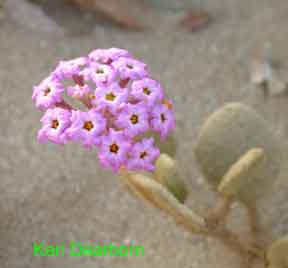
At first glance, the treeless slopes seem barren, but life here clings low to the ground to survive shifting wind. Delicate verbena flowers rise up from the sandy soil. Giant coreopsis, a species unique to the Channel Islands and the Southern California coast, stand like a forest of gray stick figures. This member of the daisy family grows several feet tall on a woody stem. In spring, the dried trunks come back to life and produce pompoms of lacy green topped with brilliant yellow flowers. (coreopsis photo)

Now, in July, the stems are dormant again, but the coreopsis forest is gradually spreading across 10% of the island. It is a clear sign that native plants are returning.

San Nicolas currently has the largest island fox population and the greatest number of foxes per square kilometer. We came hoping to see wild island foxes and the island didn’t disappoint us.

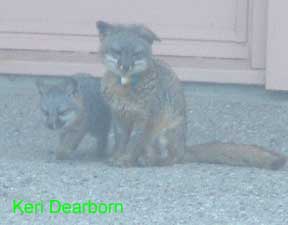
We were even lucky enough to see a litter of four pups born this spring. They were about 2 months old and bold little explorers. This is dad with one of the pups in the early morning fog.

Gazing across the dunes and scrub, it is hard to imagine there is enough cover to hide a fox, but the San Nicolas island foxes are tiny. The individuals we saw were slighter in weight and shorter, than the Catalina island foxes. It might seem impossible, but an island fox can emerge from the short grass along the roadside in a flash and be unseen until the instant it is in front of a car. Signs warning “Watch for Foxes” dot the few roads trying to alert unexpecting drivers. (road signs)

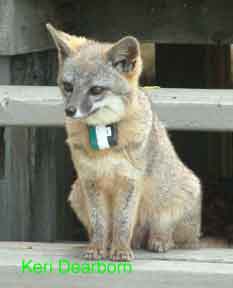
Most of the 12 island foxes we saw were wearing radio collars. Radio-collared foxes can be monitored by biologists and a new automated tracking system is being tested so that the movement of island foxes can be recorded in detail. The biologists are hoping this will provide greater understanding of island fox interactions and territories. Radio-collars also provide the first alert warning system for threats to island fox populations. (more on radio collars)

Dunes and grassland might seem inhospitable to a little fox, but it seems that sand fly larva may be providing an important food source for these foxes.

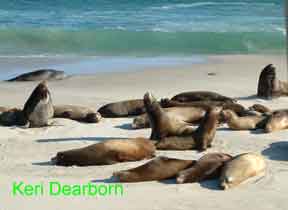
San Nicolas is a unique ecosystem and also home to endangered island night lizards and snowy plover. We saw one snowy plover and a number of other shore birds, including Western gull chicks. The beaches were busy with breeding California sea lions and resting immature elephant seals.


At night, sea lion barks hauntingly drifted up from the beaches. Fog streaked over the dry land. Here and there the wind would tear open a hole to expose the dark black sky with brilliant white stars.

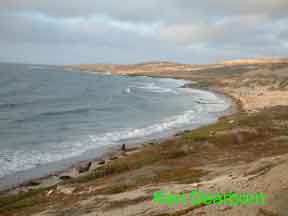
San Nicolas Island is a wedge of sandstone cliffs carved by the waves of the Pacific Ocean. A unique landscape and home to the San Nicolas Island fox. - Keri Dearborn


Links to
Experiencing Santa Cruz Island
Experiencing Santa Rosa Island