Showing posts with label San Miguel island fox. Show all posts

Saturday, December 16, 2023

Fox Foto Friday - Radio Collars on San Miguel Island Foxes

 Look who's getting radio tracking collars!

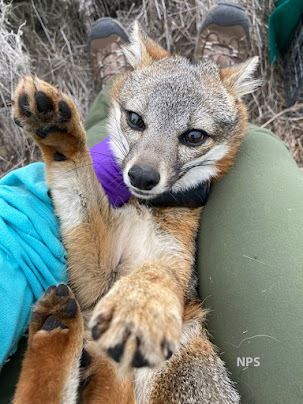
Island foxes born on San Miguel Island in April of 2023 are now adults and large enough to wear radio collars. Three were fitted with radio collars this week. The mask helps the island fox remain calm while the collar is being fitted.

Channel Island National Park biologists report this year's young adults are looking very healthy.

Watch them for yourself as they are released with their new radio collars.


Your donations to Friends of the Island Fox 

help to fund radio collars, vaccinations, and research 

into island fox health and behavior


Wednesday, December 15, 2021

A San Miguel Island Fox Gets A Radio Tracking Collar


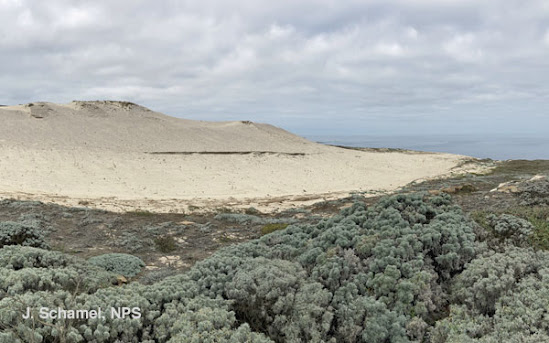
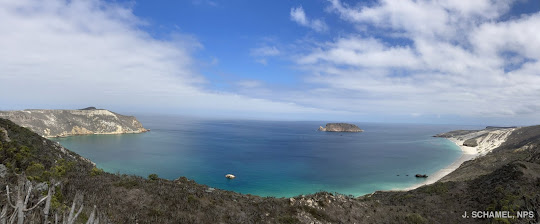
San Miguel Island is a windswept, treeless place. The most northwest of the California Channel Islands, and part of Channel Islands National Park, few people visit, but this island provides vital habitat for the rare San Miguel Island fox.

This fall during fox counting, a young male island fox was captured in this area of dunes and sage. Few pups were captured in 2021 on any of the Channel Islands; continued drought conditions reduced available food resources resulting in fewer pups being born. 

Male M515 is one of the few island fox pups documented in 2021. Following his health check, he was fitted with a radio-tracking collar funded by Friends of the Island Fox. This radio collar will enable biologists to monitor his survival and track his movement. 

As a young adult, M515 has yet to establish his territory. Will he stay in this dune area or roam to more shrubby parts of the island?

Will he stay close to the coastline or will he find a home in the island's interior? Which area will provide the greatest quantity and quality of resources? How large of a territory will he patrol? These are important questions that researchers are trying to answer.

Young male island foxes are on the move in autumn and winter. Is his priority finding a territory or a mate? We don't really know. As a youngster, however, he will have competition for territory from other males. The population of island foxes on San Miguel Island was estimated at 277 individuals in 2020. (2021 population estimates are currently being calculated.) Because the current population is down from an estimated high of 453 in 2019 (an average rainfall year), M515 may have an easier time finding a territory of his own.

His island is a beautiful, if rugged place to live. If he's lucky, winter rains will bring renewed plant growth and prey species. He might find a mate and father pups before his first birthday in April.

Through it all, his radio collar will allow biologists to track his survival and see where he ends up on the island. If you donated to Friends of the Island Fox - M515 might be wearing a collar you helped provide! 

Every Donation Helps Island Foxes

More about San Miguel Island

Friday, March 08, 2019

Island Journal - A Visit to San Miguel Island

A visit to San Miguel Island is a rare opportunity. Island foxes are few and the land is windswept. Experience a firsthand trip to this remote Channel Island.


Island Journal - San Miguel Island 

San Miguel Island lies at the top of the Southern California Bight, 26 miles from Point Conception. The western most of the Channel Islands, San Miguel receives the full force of the cold California current sweeping past its shores.

Recently, I went on a rarely offered day trip to San Miguel to observe firsthand how the island is recovering from years of ranching and to get a feeling of what island life must endure to survive there. 

After a night of light rain and distant thunder, the morning was overcast, but dry. On the boat trip out, the winds were light as was the swell.  The crossing was direct to San Miguel, approximately a 3-hour trip. About an hour out of Ventura, we spotted the blow of a Humpback whale.  The Islander Packers' boat took time to observe the mighty cetacean feeding in the channel.  A few minutes later, we observed 2 more blows further out.

Santa Cruz Island and Santa Rosa Island slowly passed by on our port side. Eventually, San Miguel came into view. 
 
There is no pier on San Miguel which means we landed by skiff. It's common to have large breakers at the beach on Miguel, which can easily swamp a skiff. Fortunately, the seas remained uncharacteristically calm. We arrived on schedule at 11:15 with 110 people on-board and 2 skiffs. Each skiff  holds 6 passengers. It took approximately 30 minutes to get everyone ashore. Once on the island we had  the mandatory island briefing by the National Park Service (NPS) naturalist.

San Miguel island is owned by the US Navy and managed by the NPS.  During WWII and through to the 1970s, San Miguel was used as a Navy bombing range. To protect visitors from any hazards that might still exist (the Navy did a complete survey in 2016 and found no unexploded ordnance), and to protect the natural resources, visitors must hike in escorted groups. However, you can freely explore the mile-long beach at Cuyler Harbor and hike up to the nearby ranger station and campground. 

coreopsis
To access the island interior, we hiked from the beach up the steep Nidever Canyon for approximately a half mile, gaining 600 feet in the process. The canyon is a great example of how the island is recovering. There is an incredible display of native vegetation; very healthy coastal sagebrush and coastal bluff scrub plant communities with coreopsis, buckwheat, and dudleya. Once on top, we were afforded terrific views of Cuyler Harbor. 

Our instructions were to be back on the beach by 2:30 to begin the skiffing process back to the boat for a 3:30 departure back to Ventura, which didn’t leave much time for exploring. I decided to check out the Cabrillo Monument and wander near the ranger station.

At the ranger station, I ran into one of the fox biologists that I know, so wandering became gabbing about fox whiskers and how ice plant travels the digestive system of the fox much like celery travels ours. Perhaps TMI, but hey...that’s what we talk about and that’s one way information gets passed on.

Talking scat passes the time quickly and I had to head back to the beach. On the beach, a juvenile elephant seal was thermoregulating. They're one of the pinniped species which call San Miguel Island home.


The route back to Ventura Harbor took us along the north side of Santa Rosa and Santa Cruz Islands with a stop in Painted Cave, one of the largest sea caves in the world. The winds remained light and sea was like glass.


We were treated to numerous pods of common dolphins, numbering in the thousands, as well as two minke whales, the smallest of the great whales.


We also spotted the same humpback whale, very close to where we spotted it in the morning. (Humpbacks can be identified by the markings on their tail flukes). The Santa Barbara channel did not disappoint! 

No fox sightings to report, but I did see the tell-tale signs of their presence, chiefly scat, littered about in typical fox fashion. 

The day to San Miguel didn’t become the island exploration I first believed it would, but instead became a time to develop a deeper appreciation for the whole ecosystem that encompasses the Channel Islands. An ecosystem where the tiniest zooplankton feeds the mightiest whales. An ecosystem where man’s impact can have a profound negative impact or bring a species back from the brink of extinction. - Mike Watling, FIF Advisory Board

Monday, March 20, 2017

Channel Island Fox Update 2016

photo courtesy of Anita Machlis
The annual meeting of the Island Fox Conservation Working Group in 2016 reported that the general status of five subspecies of California's Channel Island foxes is GOOD and STABLE. Concern for the San Nicolas Island fox continues.

2016 was a busy year for island foxes. Three subspecies were removed from the Endangered Species list and one was downlisted to Threatened status. The following update includes the population numbers from fall of 2015. (Land managers are currently compiling the fall 2016 data to present their official 2016 population numbers at the Annual Meeting in May 2017.)

San Nicolas Island

Drought impacts were a major concern in 2015-2016, however island foxes on San Miguel and San Nicolas Islands were more severely impacted. These two islands have the least amount of native plant diversity, leaving the highly omnivorous island foxes more dependent on introduced ice plant and the introduced snails and earwigs that live within it. (Island fox diet study) Continued years of drought dramatically reduced introduced species, greatly impacting the island foxes on these two islands. The situation on San Miguel and San Nicolas Islands, however, continue to be different from each other. This is the challenge of protecting island foxes.

photo courtesy of Paul Bronstein
Island Fox Update 2016 a specific island-by-island summary pdf

  • San Miguel Island ~ 382 foxes (low of 15 in the year 2000). Population numbers were revised in late 2016 going back to 2008. The population has recovered from extinction threat and slightly increased in number from 2014. Concern: Drought impact on food resources and increase in life-threatening parasites. (see Island Fox Update 2016 above)
  • Santa Rosa Island ~ 1,256 foxes (low of 15 in the year 2000). The population has recovered from extinction threat and, despite the drought, continues to thrive and increase. Concern: An unusual and fatal parasite, Leptospira, may have been introduced via sea lions. Further investigation is needed to determine the extent of threat to island foxes. 
    (see Island Fox Update 2016 above)
  • Santa Cruz Island ~ 2,170 foxes (low of ~ 80 in the year 2002). The population has recovered from extinction threat and is very robust. The increased number of older animals in the population combined with carrying capacity and drought may have caused a drop from the 2014 population high of ~ 2,700. Plant diversity on this island provides island foxes with diverse resources and drought has not been a threat. Concern: Golden eagle predation occurred again in 2016, but was limited. Biosecurity–introduced disease–remains a threat.
    native plant restoration efforts in 2016 on Santa Cruz Island
  • Santa Catalina Island ~ 1,812 foxes (low of ~ 103 in the year 2000).
    The population has recovered from extinction threat, but continued threats connected with large numbers of people visiting the island prompted the USFWS to maintain a Threatened status for this island fox subspecies. Concern: Biosecurity–introduced disease–poses a constant threat to Santa Catalina Island. Serology testing is an especially important conservation effort looking for early evidence of disease introduction. Even human trash poses threats to these island foxes
    photo courtesy of Melissa Baffa
     
  • San Clemente Island ~ 888 foxes (Not Endangered; adults only). Island foxes remain robust on this island, though the drought may have depressed survival in 2015. Concern: Island fox survival may have decreased in areas with less native plant diversity and therefore fewer food resources. The Navy has begun native plant restoration projects, but the effort is still in the early stages. The rainy season of 2016 may have positively impacted this effort. Island fox pups, abandoned by parents on this island, are the few individuals currently found in California zoos.
  • San Nicolas Island ~ 260 foxes (Not Endangered; adults only). In 2012, San Nicolas Island had the greatest density of foxes anywhere in the world and a population estimated at over 600 individuals. Since that year the population has declined and stabilized at ~ 250 individuals. Concern: The native plant diversity of this island was severely impacted in the last century. San Nicolas has the least biodiversity of native plant species. Island foxes became dependent on introduced plant species that died off during the years of consecutive drought. Island foxes have shown signs of emaciation and severe parasite infestation, either or both of these impacts may be a cause for decline. More on drought impacts as reported in 2016. The Navy has begun native plant restoration projects and the rainy season of 2016 may have positively impacted this effort. 
  •  
In addition to drought and disease impacts, there are concerns regarding the lack of genetic diversity in the San Nicolas Island fox population. To-date there is no evidence that the San Nicolas population suffers from genetic anomalies that could negatively impact their reproduction or survival. However a lack of genetic diversity can also impact how a species or subspecies is able to respond to disease challenges. Genetics and Disease Immunity Research

Everyone is watching the San Nicolas Island fox population and trying to establish why they have declined and whether or not their numbers improved in 2016. 

Keep informed of the status of the San Nicolas Island fox by subscribing to the FIF bimonthly newsletter SUBSCRIBE

Wednesday, June 18, 2014

Endangered Island Foxes Stabilizing But Need to Monitor Continues

courtesy of Kevin Schafer
The annual meeting of the Island Fox Conservation Working Group took place yesterday, hosted by Friends of the Island Fox

The good news is that the four endangered populations of island foxes on San Miguel, Santa Rosa, Santa Cruz, and Santa Catalina Islands continue to recover and stabilize. 

Island foxes on the two Navy islands, San Clemente and San Nicolas, are not considered endangered by the U.S. Fish & Wildlife Service (USFWS) and their populations remain stable and at high densities (number of individual animals per square kilometer).

The graph below shows population numbers for San Miguel Island through fall 2013. The population was initially estimated in 1994. Actual individuals were counted when island foxes were in captive breeding pens on the island. Through 2007, the island foxes on San Miguel were gradually returned to the wild. Wild population figures are estimated through an annual catching of individuals and computer extrapolation of that data. More on Counting Island Foxes.


The graph shows how San Miguel's population dropped dramatically due to golden eagle predation at the turn of the century. Fifteen surviving individuals became the founders of the current San Miguel Island fox subspecies; captive breeding by the National Park Service saved this subspecies from extinction.

The population has made an amazing and rapid recovery to a level greater than historically estimated before the crisis. Statistical analysis through fall 2013 calculated that for the fifth year in a row,  individual island foxes on San Miguel have a 90% chance of surviving through the next year and the potential for species extinction is very low.  

Currently the density of island foxes on San Miguel is very high, 10-20 individuals per kilometer in some habitat areas. National Park biologist Tim Coonan believes the data shows the San Miguel Island fox population has fully recovered and has reached the "carrying capacity" for this small island. This means the food and territory resources available on San Miguel can not support continued population increase. The minor population ups and downs since 2010 follow the pattern of a population responding to resource availability. 

Conservation efforts on behalf of the San Miguel Island fox have been very successful. Across Santa Rosa, Santa Cruz and Santa Catalina the stories of population recovery from the brink of extinction are all inspiring.


However, there is an additional cautionary chapter in the San Miguel story. As the island foxes in the National Park have recovered, funding has decreased for their management. The staff that works with the foxes on San Miguel and Santa Rosa has gone from six to three technicians. 

Since the end of 2013 thru May of 2014, seventeen radio-collared island foxes on San Miguel have died from peritonitis caused by a parasitic spiny-headed worm (the exact species is still being determined). This parasite has not been a problem on the Channel Islands before and typically does not cause mortality in canines. The spiny-headed worm is transmitted to the fox through another animal-species host that the fox has eaten.

Today as the biologists, veterinarians, land managers and government officials meet for a second day, they are sharing expertise and ideas about how to respond to this potential threat to the San Miguel Island fox. Over the next few months they will be looking for answers to new questions:
  • What prey species is carrying the parasite?
  • Have island foxes on San Miguel changed to a prey species that is a vector for this parasite?
  • Across San Miguel Island a higher number of island foxes are appearing underweight. Are these foxes infected with the parasite as well?
  • Is drought a factor in this problem?
  • Is high population density a factor?  
  • Why is the number of these parasites so high in individual foxes?
  • During the fall count, there appeared to be a very low number of pups on San Miguel. Is this a natural response to high population density and reduced resources? Is the parasite impacting female health and therefore reproduction?
  • Is the parasite a possible threat to other Channel Island fox subspecies?
Channel Island foxes are rare creatures. Prior to the near extinctions of 2000, little was known about this endemic California species. If there is one thing that has become obvious over the years, it is that change to the island habitat, either directly by people or indirectly through environmental toxins, climate change, or introduced invasive species, island fox survival requires vigilance. 

The continuity of public support and scientific experts engaged in island fox conservation is vital to maintaining this unique species into the future. Funding the Island Fox Conservation Working Group meeting is an important part of island fox conservation.

Stay tuned for more information from the Working Group meeting. 

Tuesday, November 23, 2010

Good News For Channel Island Foxes

Autumn is always a busy time for biologists working to save the endangered island fox on the California Channel Islands. This is the time of year when island foxes are caught, counted and given health checks. Early reports from the islands have been very positive. (Santa Catalina Island fox numbers)

photo courtesy of Kevin Schafer
Biologist Tim Coonan from Channel Islands National Park believes that the San Miguel Island fox population may have recovered to its pre-decline levels. This would be fantastic news and a tribute to all of the National Park employees, government agencies, public and private institutions and local citizens that worked so hard to save this critically endangered mammal.


In 2000, only 15 island foxes remained on San Miguel Island. More on San Miguel. The journey to reestablishing that population to over 400 individuals is now documented in a new book written by the biologists who were in the field saving the island fox.


Decline and Recovery of the Island Fox: A Case Study for Population Recovery 
by Timothy J. Coonan, Catherin A. Schwemm and David K. Garcelon. (Ecology, Biodiversity and Conservation, 2010)


The book provides a scholarly account of island fox biology, the crisis that caused the island fox population to plummet on four separate islands and the actions that were taken to save this rare species from extinction. It looks at the ecological impact on the islands when the island fox population was crashing and the role that public education plays in conservation efforts.


The recovery of the endangered island fox is a conservation success story and a model for other threatened plants and animals. Friends of the Island Fox celebrates the publication of this important book with our friends Tim Coonan, Catherin Schwemm and Dave Garcelon. Tim was instrumental in conveying the need for an education organization to Friends of the Island Fox founder Pat Meyer, Cathy served on our Board of Directors for four years, and Dave has frequently been a valued source for information.


If you are a serious student of ecology and endangered species, you may want to put this book on your gift list. Link To Book

Thursday, February 07, 2008

Island Romance - Island Fox Mating Season


Island Romance - Island Fox Mating Season

Are you contemplating romance and Valentine’s Day? So are the island foxes. The cold blustery days from December to February are the perfect season for California’s Channel Island foxes to pair up and settle down in a cozy den.

During autumn, island fox families tend to split up. The youngsters, now over six months old, head off on their own and the parents take a vacation from family life and each other. With the arrival of winter, the monogamous mates come back together. (About the island fox)

Island foxes make their dens in a sheltered location, sometimes underground, in a tree stump or in amongst dense undergrowth. The male and female establish a territory around their den site and settle down to finding food for a family.

A few island foxes born last spring, will also be out looking for a mate. Even though they are less than a year old, some will become parents this spring. Because population numbers are still far below normal on San Miguel, Santa Rosa, Santa Cruz and Santa Catalina Islands, island foxes are breeding younger and having more offspring than they usually would. The abundance of island deer mice and other food items makes it possible for a pair of island foxes to raise five pups instead of the typical two or three.

Valentine’s Day 2008 will be very special on San Miguel and Santa Cruz Islands. For the first time since emergency captive breeding began in 2000, ALL of the island foxes on these two islands are once again free-roaming and choosing their own mates.
(2007 fox release on San Miguel Island) (2007 fox release on Santa Cruz Island).

Captive breeding programs saved the island foxes from extinction on both of these islands, but human matchmakers are never as good as the foxes themselves. We can all hope that this year there will be an increased number of island fox pups born on San Miguel and Santa Cruz Islands.

Eleven of the island foxes released in Channel Islands National Park are wearing radio-tracking collars funded through donations to Friends of the Island Fox. (radio collars)

Pups born in the spring and foxes slated for release from the captive breeding facility on Santa Rosa Island will soon be needing there own radio tracking collars. Your donation to Friends of the Island Fox helps to provide radio tracking collars vital to monitoring the recovery of endangered island foxes. You can donate through the PayPal and Cause for Good buttons in the upper right .

This Valentine’s Day give a truly romantic gift.
Help support a solution.

Working together we can SAVE the island fox.