Showing posts with label funding island fox research. Show all posts

Tuesday, April 18, 2023

FIF Research Grant 2023

Friends of the Island is taking applications through August for the

FIF 2023 Research Grant

Download APPLICATION

From dietary investigation linked with territory use to microbes affecting island fox health, new science is revealing the complex world of island foxes and the Channel Island ecosystem.

This year FIF will be offering up to $7,000 in support toward research projects benefiting greater understanding of island foxes and the Channel Islands.

Last year's grant project is working to reveal the Spotted Skunk Genome and how the island spotted skunk is related to mainland populations.

Island spotted skunk origins may help support evolving information on how island foxes initially arrived on the Channel Islands.

More on current and past FIF Funded Research

FIF grant winners are asked to provide public updates on their work. 

See presentations by Fox Researchers for "Date with a Fox" programs

Recently published island fox science

Important island fox research is funded by DONORS LIKE YOU.

It's Science for Fox Sake! 


Wednesday, August 10, 2022

FIF Research Grant Deadline for 2022 Approaches


Small pieces of island fox whisker can reveal big data on island fox diet and behavior. 

Analyzing stable isotopes in slivers of island fox whisker, Juliann Schamel (Research grant recipient 2018 and 2019) has been uncovering the range of diet eaten by island foxes, drought impacts on their diet, and a new understanding of how some island foxes use marine resources.


Your scientific research could also benefit island fox survival and the management of rare and endangered species.

Friends of the Island Fox is accepting applications for the 2022 Island Fox Research Grant through August 29, 2022. 

Application 

More about current island fox research and recent grant recipients.

Your donations help support vital island fox research. 


Friday, April 15, 2022

FIF Taking Applications for 2022 Research Grant


This is a GPS radio collar being prepped to be worn by an island fox this summer. Katie Elder was FIF's 2021 Research Grant recipient and she will be investigating territory size on Santa Rosa Island. More on her work

Friends of the Island Fox is taking applications for our 2022 FIF Research Grant now through August 29, 2022.

Application

What will you uncover about island foxes?

Research in island fox ecology is an investment in the future and island fox survival. Not only is this work important for island foxes and the Channel Islands, but also for other endangered species with small population sizes in confined geographic habitats. An island doesn't have to be surrounded by water, it can be a confined habitat surrounded by desert, a city, or some other physical barrier.

Population viability calculations used for island foxes have been applied to the Sierra Nevada red fox.


See more on Current FIF Funded Research Projects

Recently published island fox discovery 

Discussion on island foxes and island spotted skunks

Update on island fox microbiome research


Tuesday, April 05, 2022

Island Foxes and Beach Foods


In 2018 Juliann Schamel was the recipient of Friends of the Island Fox's first Research Grant. Her investigation of island fox diet through stable isotopes in whiskers has evolved and deepened to look for connections between diet and surviving drought conditions. 

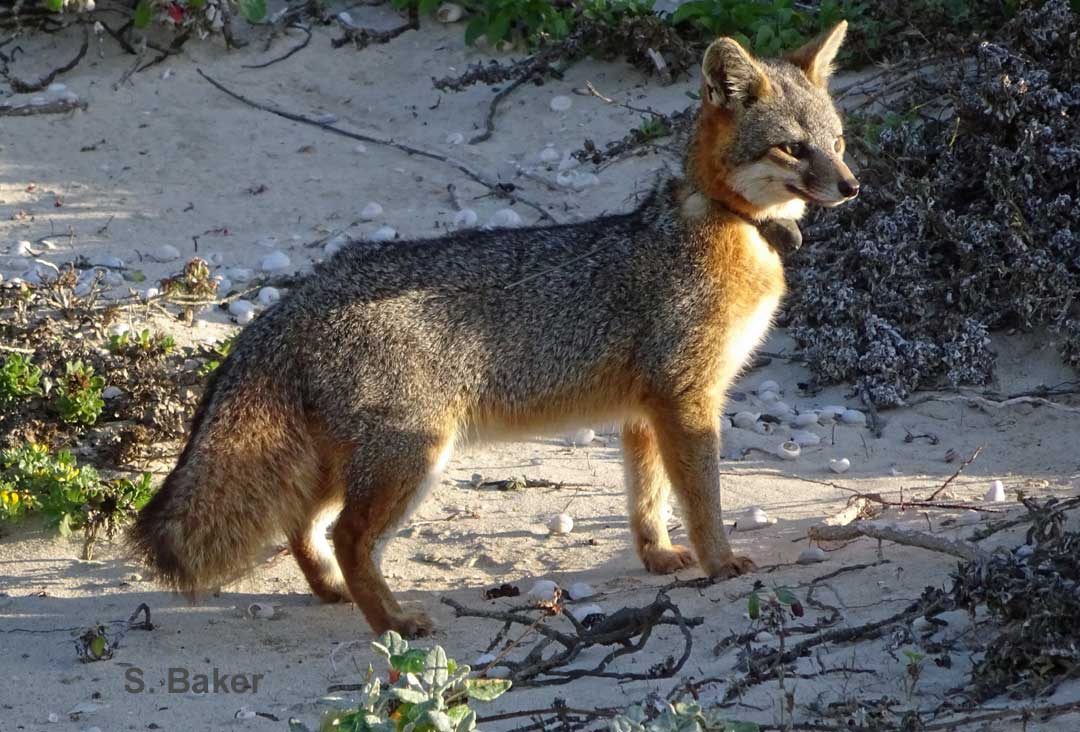
In 2019 FIF continued to fund Schamel's research as she followed the foxes and the potential of "beach foods" in their diet. It is no coincidence that the island fox above is in a beach area. 


If you look closely at the pile of kelp washed up on the beach, or "beach wrack," you'll see island fox foot prints all around it.

photo courtesy of Nick Schooler, UCSB
Combining her stable isotope research with collaborators at the University of California, Santa Barbara, Schamel has revealed that some island foxes are making use of food resources connected to sandy beaches. Tiny arthropods called "beach hoppers" live in the sand and emerge to eat the kelp that washes up on the beach. Look closely and you will see a group of them feeding on the edge of the kelp blade pictured. 

Some island foxes are eating these tiny, quick moving creatures. If you've turned over a clump of beach wrack and seen little hopping critters, commonly referred to as sand fleas, you've seen beach hoppers. They are not fleas at all; they are more closely related to shrimp.

Juliann Schamel recently presented a poster at the 2022 Wildlife Society Conference. POSTER

And her paper Diet of a threatened endemic fox reveals variation in sandy beach resource use on California Channel Islands with Henry M. Page, Marine Science Institute, UCSB, et. al. was published in PLOS ONE. Read the Paper

Your support for FIF helped fund this important research. The island fox and the beach hopper demonstrate an intertwining of terrestrial and marine ecosystems on the Channel Islands.

Friday, April 23, 2021

Investigating the Relationship Between Island Foxes and Island Spotted Skunks


Islands typically support few terrestrial, or ground-living, carnivores due to the challenges of traveling over water to arrive on islands. On Santa Cruz and Santa Rosa Islands we have the rare occurrence of  two insular carnivores: the island fox and the island spotted skunk (Spilogale gracilis amphialus).


How the skunk got to the islands remains unclear, yet evidence has shown they have existed with the foxes for at least 7,000 years. (Fox arrival on the islands)

The spotted skunk and island fox are rivals, competing for the same resources in the form of aggression and predation. Averaging 3–4 lbs on the northern islands, the island fox is the larger and more dominate species. Island spotted skunks are about half the size. However, there is little understanding of when and where these two species interact.


In 2020, Friends of the Island Fox provided some funding to aid in a better understanding of the activity pattern of skunks and foxes on Santa Cruz Island. (More on FIF Research Grants)

Modern Global Positioning Satellite (GPS) collar technology can now capture additional information from wildlife that was not previously accessible–including accelerometers, which measure the forces of active movement. In this study, several foxes and skunks were fitted with GPS and accelerometer enabled collars to map the movement of each species with the aim of revealing the environmental factors that are most important in driving the fox's activity, such as changes in temperature, reproduction, and/or competition.

Researcher Calypso Gagorik with island spotted skunk

Calypso Gagorik, the project's principle investigator, says: "Given that the spotted skunks are strictly nocturnal, the chance of fox-skunk encounters may be entirely driven by changes in daily fox activity patterns."

skunk radio collar

The map below shows the GPS data points of one spotted skunk and one island fox that have overlapping home ranges. (Red dots represent island fox locations and Blue indicators are island spotted skunk locations. Skunk locations are taken less frequently because the batteries on their collars are considerably smaller. Each GPS location mark requires battery use.) What still needs to be analyzed is whether the fox and skunk were active at the same time of the day.


The importance of this research according to Gagorik, is "if foxes and skunks utilize similar area, but are active at totally different times, then the chance of interspecific interactions may actually be quite low." In other words, an island fox might visit a water source during the day, while the island spotted skunk might drink from the same location at night.

Researcher Victor Zhang with spotted skunk

Previous accelerometer data that was collected in 2019 have informed Gagorik and, fellow researcher, Victor Zhang "that the timing of daily fox activity varies greatly across the year, and the current analyses (completion summer 2021) will aim to reveal the environmental factors that are most important in driving changes in fox activity timing." Island foxes may be hunting prey at night during the winter and feeding on fruit during the day in summer. Gagorik adds, "Knowledge of these relationships will allow us to better predict the behavioral responses of both species to environmental change, as well as generate new knowledge on fox and skunk ecology." (Calypso Gagorik, email communication).

Previous data has shown that foxes occupy a flexible niche within the island community. They possess the ability to take advantage of the various habitat types, which make up the Channel Islands. On the other hand, the island spotted skunk may have a more specialized niche driven by fox activity.

Friends of the Island Fox is committed to research that will expand understanding of island fox biology and behavior. The more we know about island foxes the better we will ensure a future for both species.


"Examining temporal niche and movement patterns of the island fox (Urocyon littoralis) and the island spotted skunk (Spilogale gracilis amphiala) on Santa Cruz Island, CA" was investigated by Calypso Gagorik and Victor Zhang in conjunction with Northern Arizona University and under the supervision of The Nature Conservancy.

FIF is accepting applications for our 2021 Research Grant thru August 31, 2021

Friday, April 16, 2021

Friends of the Island Fox 2021 Research Grant

Applications for Friends of the Island Fox's 2021 Research Grant are now available.

Slide of tooth sample from deceased island fox

Structures in island fox teeth may help clarify island fox lifespan.

Whisker samples can provide data on island fox diet.

Part of FIF's mission is to support research that will help build scientific understanding of island fox biology, health, behavior, ecology, and any aspect that influences the species' long-term survival. 

FIF welcomes applications for the $5,000 available in research funding.


Download FIF 2021 Research Grant Application

Applications will be accepted through August 31, 2021


2020 Grant Recipient:  

Alexandra DeCandia - Island Fox Microbiome

Previous Research Grant Recipients and other island fox research


Your donations to Friends of the Island Fox

help make this research grant possible