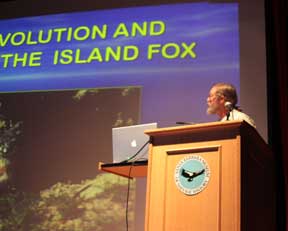
(Thank you to our guest blogger, researcher Courtney Hofman)
 |
| photo courtesy of Kevin Schafer |
People have long wondered how the
island fox first arrived on the Channel Islands. Did they swim? Were they swept
out to sea on a piece of debris? Did Island Chumash and Gabrieliño people or
their ancestors introduce them? Researchers have proposed a number of possible hypotheses of how the fox arrived but to test each hypotheses we must first examine
the data on when foxes arrived on the islands.
For a long time scientists thought that
island foxes had been on the islands for at least 16,000 years and some argued
they had been there as early as 40,000 years ago (Aguilar et al. 2004). This is well before
people arrived on the islands some 13,000 years ago. These early date estimates
were based on island fox bones recovered from paleontological sites. However,
direct radiocarbon dating of these same fox bones indicate that they are less than
7000 years old (Rick et al. 2009). Additional
radiocarbon dates on island fox bones recovered from archaeological sites
indicate that island foxes may have arrived on the islands approximately 7100
years ago, well after people.
When combined with radiocarbon dates,
genetic data can also be used to test hypotheses about the origins of the
island fox. Mitochondrial DNA is inherited from a fox’s mother and can tell us
a lot about the history of the island fox. In my recent study, mitochondrial
DNA was sequenced from 185 island and mainland gray foxes to explore how these
different populations are related to each other (Hofman et al. 2015).
 |
| Median-Joining Network of Island and Mainland Mitochondrial DNA |
By comparing these DNA sequences, we
know that northern island (Santa Cruz, Santa Rosa, and San Miguel) foxes are closely
related to each other while the southern island populations are more distinct
(Santa Catalina, San Clemente and San Nicolas). Together with radiocarbon
dates, mitochondrial DNA suggest that island foxes arrived on the northern
islands between 9200 and 7100 years ago and were likely quickly moved by humans
to the other islands. We cannot yet say how the foxes first arrived on the
islands. More genomic and archaeological data are needed to distinguish between
a human or natural introduction.
Read the full paper at http://journals.plos.org/
- Aguilar, A., Roemer, G., Debenham, S., Binns, M., Garcelon, D. and Wayne, R. K. (2004). High MHC diversity maintained by balancing selection in an otherwise genetically monomorphic mammal. Proc. Natl. Acad. Sci. U. S. A. 101: 3490–3494.
- Hofman, C. A., Rick, T. C., Hawkins, M. T. R., Funk, W. C., Ralls, K., Boser, C. L., Collins, P. W., Coonan, T., King, J. L., Morrison, S. A., Newsome, S. D., Sillett, T. S., Fleischer, R. C. and Maldonado, J. E. (2015). Mitochondrial Genomes Suggest Rapid Evolution of Dwarf CaliforniaChannel Islands Foxes (Urocyon littoralis). PLoS ONE 10:e0118240.
- Rick, T. C., Erlandson, J. M., Vellanoweth, R., Braje, T. J., Guthrie, D. A. and Stafford Jr., T. W. (2009). Origins and Antiquity of the Island Fox (Urocyon littoralis) on California’s Channel Islands. Quat. Res. 71: 93–98.