Showing posts with label island fox and fire. Show all posts

Friday, December 15, 2017

Island Foxes and the Thomas Fire

Santa Cruz Island shrouded in Thomas Fire smoke, 12/12/17
Yes, there is smoke on the water. While the Thomas Fire is burning on the mainland in Ventura and Santa Barbara Counties, smoke has blown off-shore engulfing the islands. On satellite images, Santa Cruz Island has frequently disappeared in the smoke.

NASA satellite photo 12/8/17
While embers from the fire did reach Santa Cruz in the early days of the Thomas Fire, no fires ignited on the island. In fact, on Tuesday, Dec. 12, FIF observers reported numerous island foxes behaving normally.


This young fox in the toyon tree was foraging for toyon berries. Can you find the fox in this picture? Other island foxes were hunting on the ground beneath the toyons and redberries. Despite the smoke, island foxes were well.


We know some of the people impacted by the massive Thomas Fire are island fox friends, biologists, National Park employees, and island fox supporters. Friends of the Island Fox extends its thoughts to everyone in Ventura and Santa Barbara Counties who have lost homes and been displaced by this tragic event.

Monday, September 18, 2017

Wildfire Can Threaten Island Foxes


Responding to wildfire on the Channel Islands raises a quandary, because there are positive and negative aspects to letting wildfire burn:
  • Fire is a natural element on the Channel Islands. Many native plants depend on fire to open up areas for new growth, to renew the soil, or even jump-start seeds. As omnivores, island foxes depend on diverse and healthy native plants.
  • Fire can provide unexpected abundance for predatory or scavenging animals, including island foxes. Smaller animals may get caught in the fire, while birds and larger animals might escape.
  • Years of drought, however, have created areas with exceptionally dry vegetation and greater than usual build-up of wildfire fuel.
  • Land animals, like the island fox, and some lesser-flying birds, like the island scrub-jay, can not escape a fire burning out of control that might consume an entire island.
  • Santa Cruz Island is home to endemic plants and animals that only live on that one island and nowhere else in the world. If the entire island burned, some of these species might be driven to extinction.
  • The National Park is tasked with protecting historic human cultural artifacts and structures that could be destroyed.
  • People visiting the island can not easily evacuate on their own; they are dependent on sea or air transportation provided by others. The National Park must always consider visitor and staff safety.
Island scrub-jays only live on Santa Cruz Island
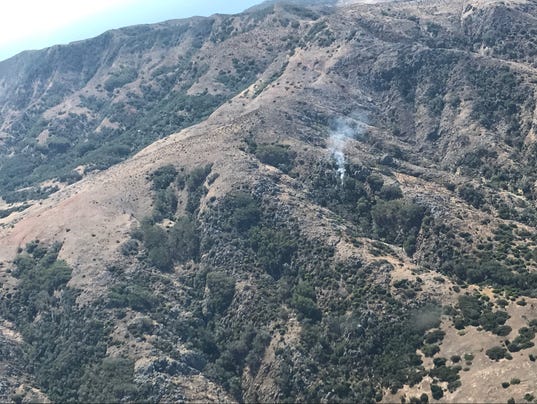
When lightning struck Santa Cruz Island during the night of Sept. 10th or early morning of Sept. 11th, all of these factors (and more) had to quickly be taken into account by officials at Channel Islands National Park.
2007 Catalina Island Fire
'Burnie Boots' - Catalina 2007
In 2007, fire raged up canyons and across hillsides on Santa Catalina Island. While only one female island fox was known to be injured in the fire, biologists later discovered that numerous island fox pups were lost to the flames because the fire occurred in spring and many pups were still too young to leave the dens where they were born. Catalina Island Conservancy biologists believe the injured female island fox risked her own life, walking across burning coals, to try and return to her pups in the den.

Wildfire is unpredictable, and in this incidence, the negative threats outweighed the potential positives. U.S. Forestry Service smoke jumpers were called in and they parachuted down to the island to put out the fire.

Fire on Santa Cruz Island 2017 - U.S. Forestry Dept. via Ventura Co. Star
The wildfire was first spotted by a concerned citizen on a boat. Threats to island foxes and the Channel Islands can come in many different forms. Some like disease from domestic dogs or introduced wildlife are similar to lightning, they may initially strike in one place, but the consequences can quickly spread across an entire island. Island foxes need all of us to be as vigilant as the boater who reported the wildfire - one person can make a difference.